
10 Designer Tricks That Made My Living Room Look Expensive for Less Than $50
The exact changes that made friends ask if I'd hired a designer
I used to think beautiful homes belonged to people with bigger budgets than mine.
Every magazine spread looked perfect. Every Pinterest photo seemed impossible to recreate without spending thousands of dollars. I'd scroll, save the photo to a board I rarely revisited, and close the app feeling a little further from the home I actually wanted, not closer to it.
Then, slowly, I noticed something that didn't add up. The rooms I kept saving weren't expensive because they were filled with expensive furniture. Plenty of them had furniture I recognized from budget stores. What they had instead was someone who understood a handful of simple design principles, and applied them consistently, whether the sofa cost $400 or $4,000.
Once I started applying those same principles in my own apartment, using furniture I already owned, something strange happened. Friends began asking if I'd hired an interior designer. One asked, half-joking, if I'd come into money. I hadn't. Most of the changes I made cost less than a single dinner out.
What follows are the ten tricks that made the biggest visible difference in my own living room, each one under $50, several of them costing nothing at all beyond rearranging what I already owned.
Table of Contents
- Hang Curtains Higher Than You Think
- Layer Your Lighting
- Choose One Larger Rug
- Swap Five Small Pillows for Two Textured Ones
- Let One Large Piece of Art Replace Several Small Ones
- Style Your Console With Symmetry
- Group Objects in Odd Numbers
- Add One Live Plant
- Clear Your Surfaces
- Mix Textures Instead of Matching
- How to Prioritize If You Can Only Do Three
- The Full Cost Breakdown
1. Hang Curtains Higher Than You Think

One of the first things I noticed while studying professionally designed homes was that curtains almost never started directly above the window. Instead, they were mounted much closer to the ceiling, often six to twelve inches above the window frame, with the rod extending several inches past each side.
It seems like such a small detail, but it completely changes how a room feels. By drawing your eyes upward, the walls appear taller and the windows feel larger than they actually are.
- Measure from the floor to roughly four to six inches below your ceiling — this is where your rod should sit.
- Choose curtain panels long enough to reach this new, higher point.
- Mount the rod so it extends 4–8 inches beyond each side of the window frame.
- Let the curtains pool very slightly at the floor, about half an inch.
Imagine a reader who rehangs her curtain rod just six inches higher one Saturday afternoon, expecting barely any difference, only to have a guest ask the following week if she'd renovated.
- Creates taller-looking ceilings without construction
- Makes windows appear larger and rooms feel brighter
- Adds elegance at essentially zero cost if you already own curtains
Product ideas: matte black curtain rod (extra-long), linen curtain panels (96" or 108"), decorative curtain rings
2. Layer Your Lighting Instead of Relying on One Overhead Fixture

A single bright overhead bulb flattens a room completely. Designers almost never rely on one light source — instead they layer a floor lamp, a table lamp, and sometimes a small accent light to create pools of warmth throughout the space.
- Turn off your main overhead light for one evening and notice how dark the room becomes.
- Add one lamp near your main seating area, at roughly shoulder height when seated.
- Add a second light source in the room's darkest corner.
- Replace cool white bulbs with warm white ones (2700K–3000K).
One homeowner shared that simply turning off her overhead light and switching on two secondhand lamps she already owned made her living room feel like an entirely different space, without spending a single dollar that week.
- Adds depth and warmth instead of flat, even brightness
- Creates a cozier atmosphere, especially in evenings
- Costs nothing if you use lamps you already own
Product ideas: small ceramic table lamp, warm white LED bulbs (2700K), slim accent floor lamp
3. Choose One Larger Rug Instead of a Small One

I used to buy the cheapest, smallest rug I could find. A too-small rug floating in the middle of a room draws a hard visual boundary around a tiny area, making the whole room look smaller and more fragmented, not cozier.
- Measure your seating area as a whole, not just the open floor space.
- Choose a size where at minimum the front legs of your furniture rest on it.
- If budget only allows a smaller rug, prioritize width over length.
- Center the rug on your seating arrangement, not the room itself.
- Unifies furniture into one cohesive layout
- Makes the room read as larger, not smaller
- Adds warmth and sound absorption underfoot
Product ideas: low-pile neutral area rug (8x10), jute rug, machine-washable large rug
4. Swap Five Small Pillows for Two Textured Ones

I used to pile five different pillows onto my sofa because I thought "more" meant "better." The room actually looked busier instead of more inviting. Swapping them for two larger, textured pillows completely changed the look. Sometimes luxury isn't about adding more — it's about knowing when to stop.
- Remove every pillow currently on your sofa.
- Choose your two favorite, largest, most complementary pillows.
- Place them at opposite ends, angled slightly rather than squared.
- Store or donate the rest.
- Prevents visual clutter on your main seating piece
- Textures add richness without adding "stuff"
- Reads as curated instead of accumulated
Product ideas: textured linen pillow cover, chunky knit pillow cover, velvet lumbar pillow cover
5. Let One Large Piece of Art Replace Several Small Ones
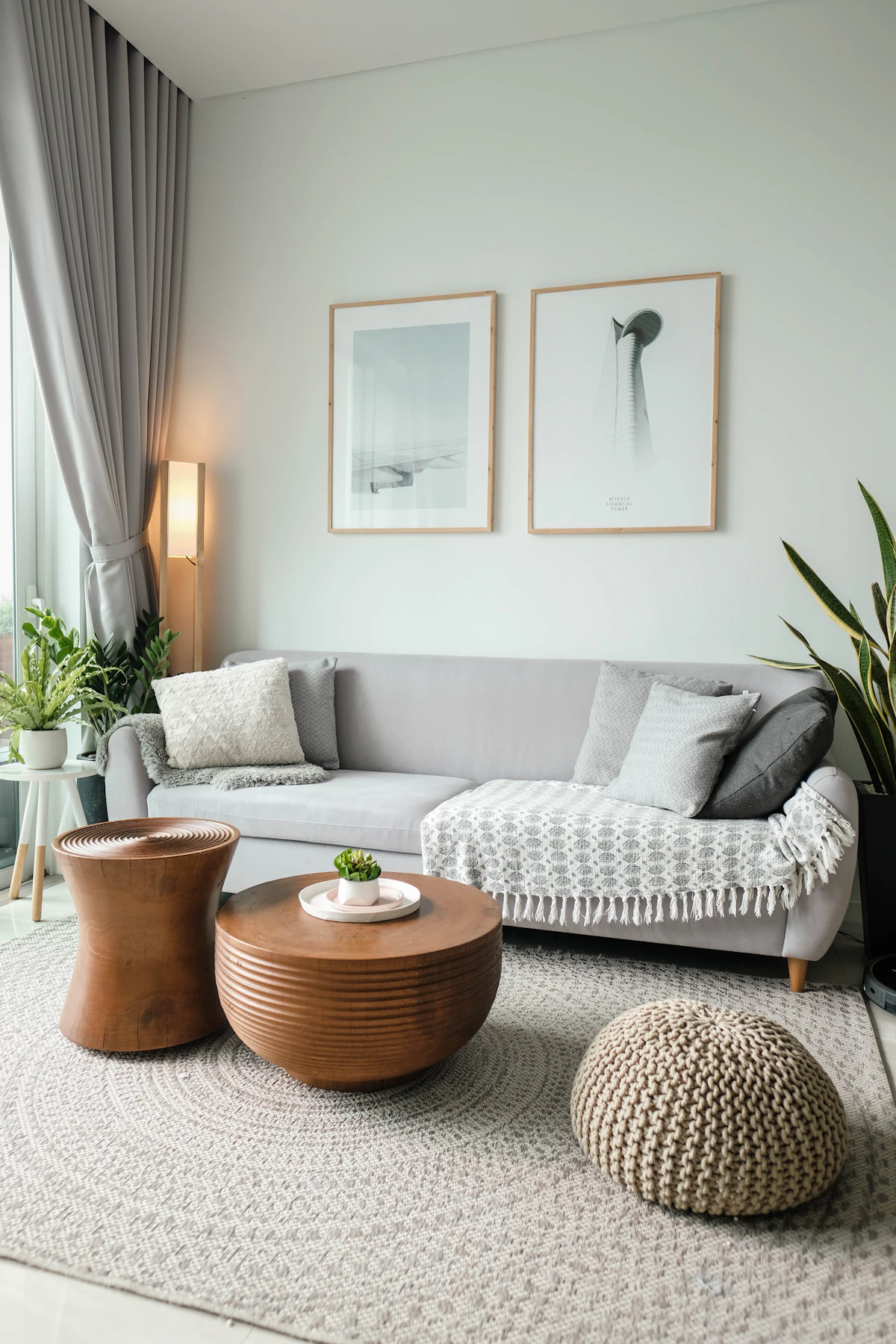
A wall covered in several small, mismatched frames often reads as cluttered, even when each individual piece is lovely on its own. One large, confident piece of art does more for a room than five small ones scattered around it.
- Measure the wall space above your sofa — art should span roughly two-thirds of the furniture's width.
- Look for printable large-format digital art you print yourself locally.
- Choose one simple, substantial frame — black or natural wood.
- Hang so the center sits at roughly eye level, 57–60 inches from the floor.
Imagine a reader who replaces a shelf crowded with small trinkets with a single oversized print. She said the room finally felt "finished" instead of "busy," and it cost less than the five mismatched frames it replaced.
- Creates one clear, confident focal point
- Reads as intentional rather than accumulated
Product ideas: large black frame (24x36), printable abstract wall art download, oversized canvas print
6. Style Your Console or Mantel With Symmetry
Symmetry is one of the simplest tricks designers use to make a space feel calm and expensive, and one of the most underused in budget decorating since it requires almost no purchase, only rearranging.
- Clear the entire surface first.
- Choose one taller, central item to anchor the middle.
- Place matching or similar-height items on either side.
- Add one or two smaller supporting objects near the base.
- Creates immediate visual balance and calm
- Reads as considered rather than randomly accumulated
Product ideas: small brass candlesticks, matching ceramic vases, twin table lamps
7. Group Objects in Odd Numbers, Not Even Ones
Objects grouped in odd numbers, three or five, tend to look more visually interesting and natural than groups of two or four. Even numbers can feel stiff and static; odd numbers feel more dynamic.
- Choose three objects of noticeably different heights.
- Place the tallest toward the back or one side.
- Layer the medium and shortest in front, overlapping slightly.
- Step back and check the grouping reads as one visual unit.
- Creates a more dynamic, natural-feeling arrangement
- Works on shelves, coffee tables, and mantels alike
Product ideas: small ceramic vase set, decorative wood tray, small sculptural object
8. Add One Live Plant for Warmth

A room without a single living thing in it can feel oddly sterile, no matter how well it's decorated otherwise. One plant, even a small one, adds warmth and life that furniture alone can't replicate.
- Identify your room's actual light level honestly.
- Choose a low-maintenance plant suited to it — pothos or snake plant.
- Place it in the room's emptiest or darkest corner.
- Water only when the top inch of soil feels dry.
- Adds natural color and softness decor alone can't provide
- Fills empty corners without more furniture
Product ideas: pothos plant, snake plant, woven plant basket
9. Clear Your Surfaces to Create Breathing Room
Expensive-looking rooms almost always have one thing in common: visible empty space. A coffee table crowded with mail and remotes reads as chaotic, no matter how nice the furniture underneath is.
- Remove everything currently on your coffee table.
- Create one hidden landing spot elsewhere for daily clutter.
- Return only one or two intentional objects.
- Make clearing surfaces a nightly two-minute habit.
- Empty space reads as intentional, not lacking
- Costs nothing — it's editing, not buying
Product ideas: small catch-all tray, hidden storage basket, drawer organizer
10. Mix Textures Instead of Matching Everything
I used to think a cohesive room meant everything matching exactly. Designer spaces actually do the opposite — they mix textures deliberately, creating richness through contrast rather than uniformity.
- Take inventory of the textures already in your room.
- Look for one or two textures to intentionally add.
- Aim for at least three distinct textures visible in any view.
- Resist buying a matching set as your next purchase.
- Adds depth that perfectly matched rooms often lack
- Feels layered and collected, which reads as more expensive
Product ideas: woven storage basket, brass accent tray, textured wood coaster set
11. How to Prioritize If You Can Only Do Three
If your budget or time only allows a few changes right now, start with these three, in this order:
- 1. Rehang your curtains higher — the highest-impact, lowest-cost change on the list, often free.
- 2. Size up or reposition your rug — affects how the entire room reads as unified.
- 3. Layer your lighting — changes the mood every evening, not just in photos.
The remaining seven tricks compound beautifully on top of these three.
12. The Full Cost Breakdown
For full transparency, here's roughly what all ten tricks cost combined:
| Item | Cost |
|---|---|
| Curtain rod repositioning | $0 (existing hardware) |
| New warm white bulbs | $8 |
| Secondhand lamps | $0 (already owned) |
| Rug (bought on clearance) | $45 |
| Pillow covers (two) | $14 |
| Printable large art + frame | $28 |
| Symmetry styling items | $0 (already owned) |
| Odd-number grouping items | $0 (already owned) |
| Small pothos plant | $6 |
| Storage basket | $9 |
| Woven basket + brass tray | $15 |
| Approximate total | Under $125 |
One of the biggest lessons I've learned about decorating is that beautiful homes rarely come together all at once. They're built little by little. A better lamp this month. A larger rug next month. Fresh curtains when the budget allows.
Over time, those thoughtful choices create a space that doesn't just look beautiful — it feels like home.
Don't measure your home against magazine covers or perfectly edited social media feeds. Measure it by how it makes you feel when you unlock the front door after a long day.
Because the most memorable homes aren't always the most expensive. They're the ones filled with intention, comfort, and the quiet confidence that every piece has a purpose.
Shop the Story
- matte black curtain rod extra long
- linen curtain panels 96 inch
- small ceramic table lamp
- warm white LED bulbs dimmable
- low-pile neutral area rug 8x10
- textured linen pillow covers set
- large black picture frame 24x36
- printable abstract wall art download
- small brass candlesticks set
- pothos plant live
- woven storage basket with handles
- brass accent tray small
- snake plant live small
- hidden storage basket coffee table