
Built-In Coffee Nooks Made for Slow Morning Rituals
We didn't build ours to save counter space. We built it because I wanted one place in the house that asked nothing of me before nine in the morning
For the first six years in this house, coffee was something that happened standing up, usually with one hand still holding my phone, in whatever six inches of counter were empty that day. It wasn't a ritual. It was a task I did on the way to the next task, and I didn't think there was anything wrong with that until a friend came to stay for a week and asked, gently, why I looked more tired making coffee than I did doing almost anything else in the house.
I didn't have an answer for her either, not really. I just knew that somewhere along the way, the one part of the morning that was supposed to be mine had turned into another chore squeezed into a countertop that already had too much going on. So when we finally redid the kitchen, the coffee nook wasn't a nice-to-have on the list. It was the first thing I drew, before the island, before the pantry, before anything else.
What I learned building it, and what I've since gathered from other people who did the same thing for the same quiet reasons, is that a built-in coffee nook isn't really about the coffee at all. It's about giving yourself a place to stand still for four or five minutes before the day asks anything of you. Here's what actually made that happen, in our house and in a few others.
Table of Contents
- A Nook Sized for One Chair, Not a Counter
- A Closed Door That Hides the Mess Instantly
- Open Shelving With Only What You Reach for Daily
- A Small Window Right Above the Machine
- Warm Wood Instead of Matching White Cabinetry
- A Second, Smaller Sink Just for This Corner
- A Built-In Bench Wide Enough to Sit and Wait
- Layout Guide by What You Actually Need
- Mistakes I Made Building Ours
- Common Questions
A Nook Sized for One Chair, Not a Counter
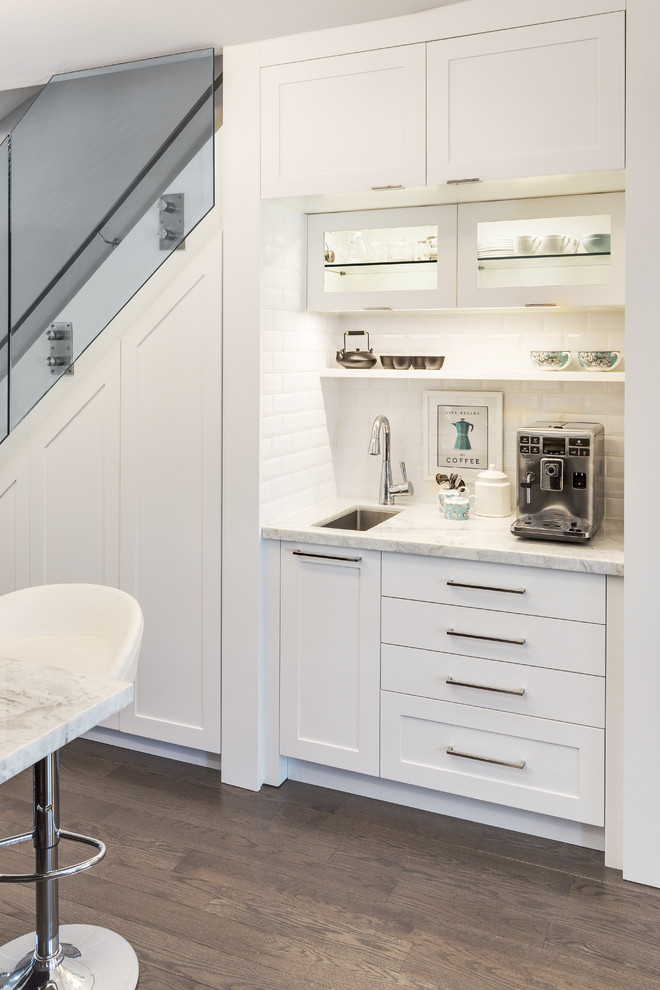
A reader named Idris told me he almost skipped a coffee nook entirely during his renovation, because his contractor kept sizing it like a small workstation, wide enough for three appliances and a stretch of open counter. It was Idris's wife who finally said something. "She said she didn't want a station," he told me. "She wanted a spot. Somewhere she could stand in one place with her mug and not be in anyone's way for five minutes."
They ended up shrinking the footprint by nearly a third, just enough for the machine, a narrow shelf, and the floor space for one person to plant their feet. It sounds like a small decision, but Idris says it changed how the corner felt entirely, from a workstation waiting to be used, into a spot that was quietly, unmistakably someone's.
- Start with the person, not the appliances, measure the space one adult needs to stand comfortably before adding anything to the counter around them.
- Resist the urge to widen the nook "just in case," a slightly tight, well-defined corner reads as intentional in a way a sprawling one doesn't.
- Leave a narrow buffer of empty counter on at least one side, even a few inches of breathing room changes how calm the spot feels to stand in.
- Creates a spot that feels personal rather than purely functional
- Naturally limits clutter by limiting the amount of available surface
- Often costs less to build than a wider, more heavily outfitted station
Search terms: "narrow coffee bar cabinet," "small kitchen nook layout," "compact coffee station shelf"
A Closed Door That Hides the Mess Instantly

A woman named Fabiola told me the single best thing she added to her coffee nook wasn't a feature at all, it was a pair of ordinary cabinet doors that fold back and close over the whole station. "It's not glamorous," she laughed, "but it means the fifteen minutes I spend in there every morning aren't followed by a mess sitting out until dinner." When guests come over, or when the day gets away from her, she closes the doors and the entire corner disappears, grounds, machine, and all.
What she described is something I've come to believe matters more than almost any other design choice on this list, a ritual space needs to feel separate from the rest of the day's demands, and a door that physically closes off the mess afterward does more of that emotional work than people expect from something so simple.
- Choose bifold or pocket-style doors rather than swinging cabinet doors, they take up less floor clearance in a tight nook.
- Size the opening generously enough that the machine and daily tools fit without needing to be moved before the doors close.
- Match the door material to your surrounding cabinetry so the closed nook reads as part of the kitchen rather than an obvious hiding spot.
- Keeps the daily mess of coffee-making from lingering in view
- Gives the ritual a clear beginning and end, opening and closing the doors
- Makes the kitchen feel considerably more finished for guests at any hour
Search terms: "bifold cabinet door hardware," "appliance garage coffee station," "pocket door cabinet kit"
Open Shelving With Only What You Reach for Daily
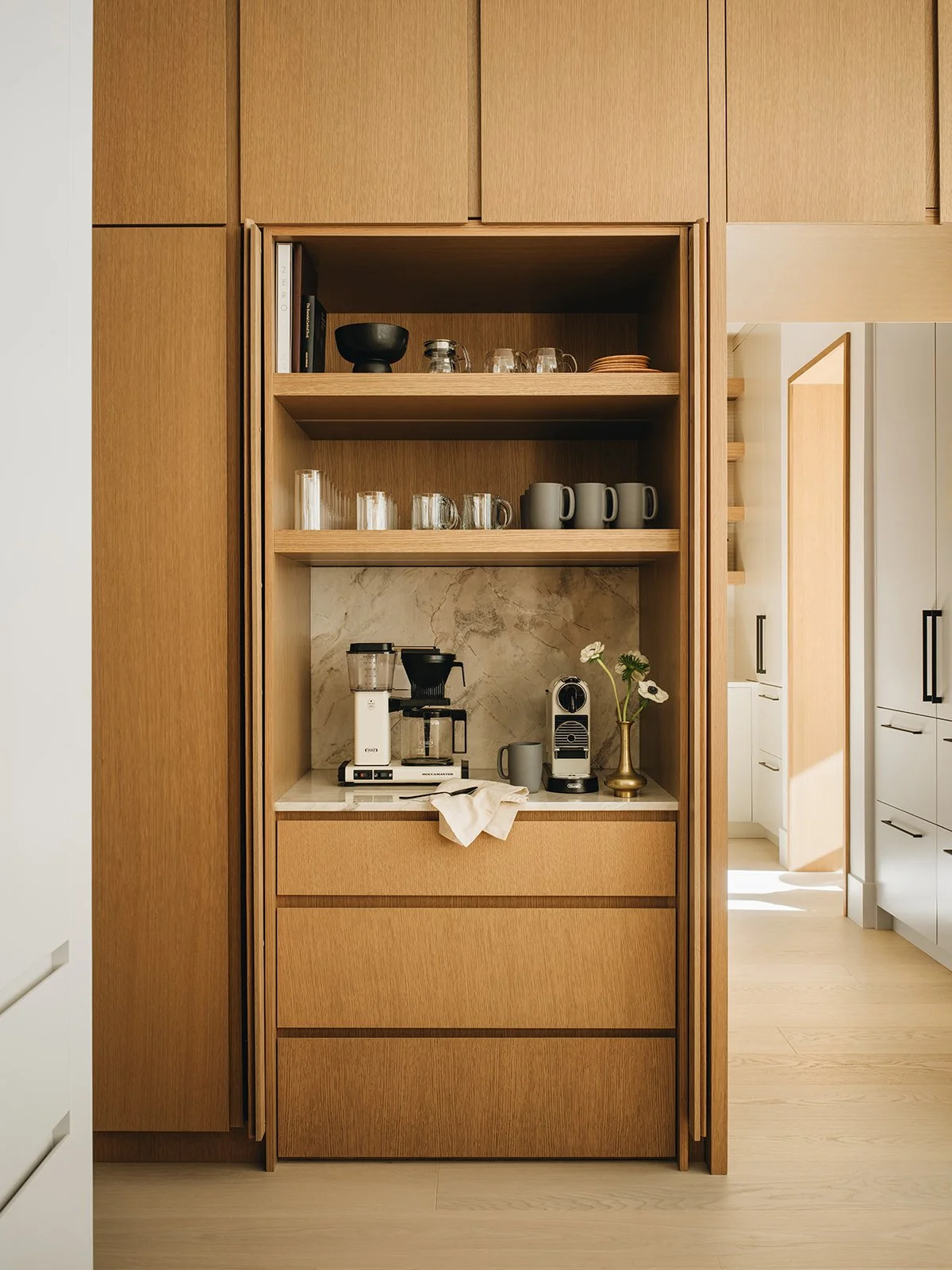
A reader named Bertram admitted his open shelving looked cluttered and busy for almost a year before his sister, visiting for the holidays, asked why half of what was up there was still in its box. "I'd just put things up because I had them," he said, "gift mugs, an espresso set I'd never used, a French press we'd switched away from years ago." Once he pulled everything down and put back only what he actually reached for each morning, the shelf finally looked, in his words, "like it belonged to someone who drinks coffee here, not someone who collects it."
It's a small discipline that ends up mattering a great deal, an open shelf is essentially a display of your actual habits, and a shelf edited down to what's genuinely used every day tells a far warmer, more honest story than one crowded with everything you own.
- Pull everything off the shelf and only put back what you've genuinely reached for in the last two weeks.
- Group items loosely by how often they're used, daily pieces at counter height, occasional ones higher up and out of the way.
- Leave visible empty space on the shelf on purpose, a slightly sparse shelf reads as considered, a full one reads as storage.
- Turns the shelf into an honest reflection of your actual morning habits
- Reduces visual clutter without spending anything on new storage
- Makes the daily ritual feel simpler, fewer choices, fewer things in the way
Search terms: "open kitchen shelving bracket," "minimal coffee bar styling," "wood floating shelf kitchen"
A Small Window Right Above the Machine

A homeowner named Delphine reworked her kitchen layout specifically so her coffee station would sit beneath the one small window on that wall, even though it meant losing a run of upper cabinets. "Everyone told me I was giving up storage for a view of the side yard," she said, "which, fair, it's not a dramatic view. But I'm not looking at the yard. I'm looking at the sky changing while the kettle heats up, and that's worth more to me than another cabinet I'd fill with things I don't need."
It's a trade a lot of people wouldn't make, and I understand why, storage is easy to justify and a window is harder to defend on paper. But every person I've spoken to who prioritized a window over their coffee station describes the same thing, a small daily pause, looking out instead of down, that the rest of the kitchen simply doesn't offer.
- If your layout allows it, position the coffee station under or beside an existing window rather than tucking it into a fully enclosed corner.
- Keep the windowsill clear of clutter, it's doing quiet work as a view, not as extra storage.
- If there's no window nearby, consider a mirror or a piece of art at eye level instead, the goal is simply somewhere to rest your gaze.
- Gives the ritual a natural focal point beyond the counter itself
- Connects the daily routine to something outside the house, weather, light, the yard
- Turns waiting for coffee into a small, welcome pause rather than dead time
Search terms: "kitchen window over counter," "coffee station near window layout," "kitchen accent mirror"
Warm Wood Instead of Matching White Cabinetry
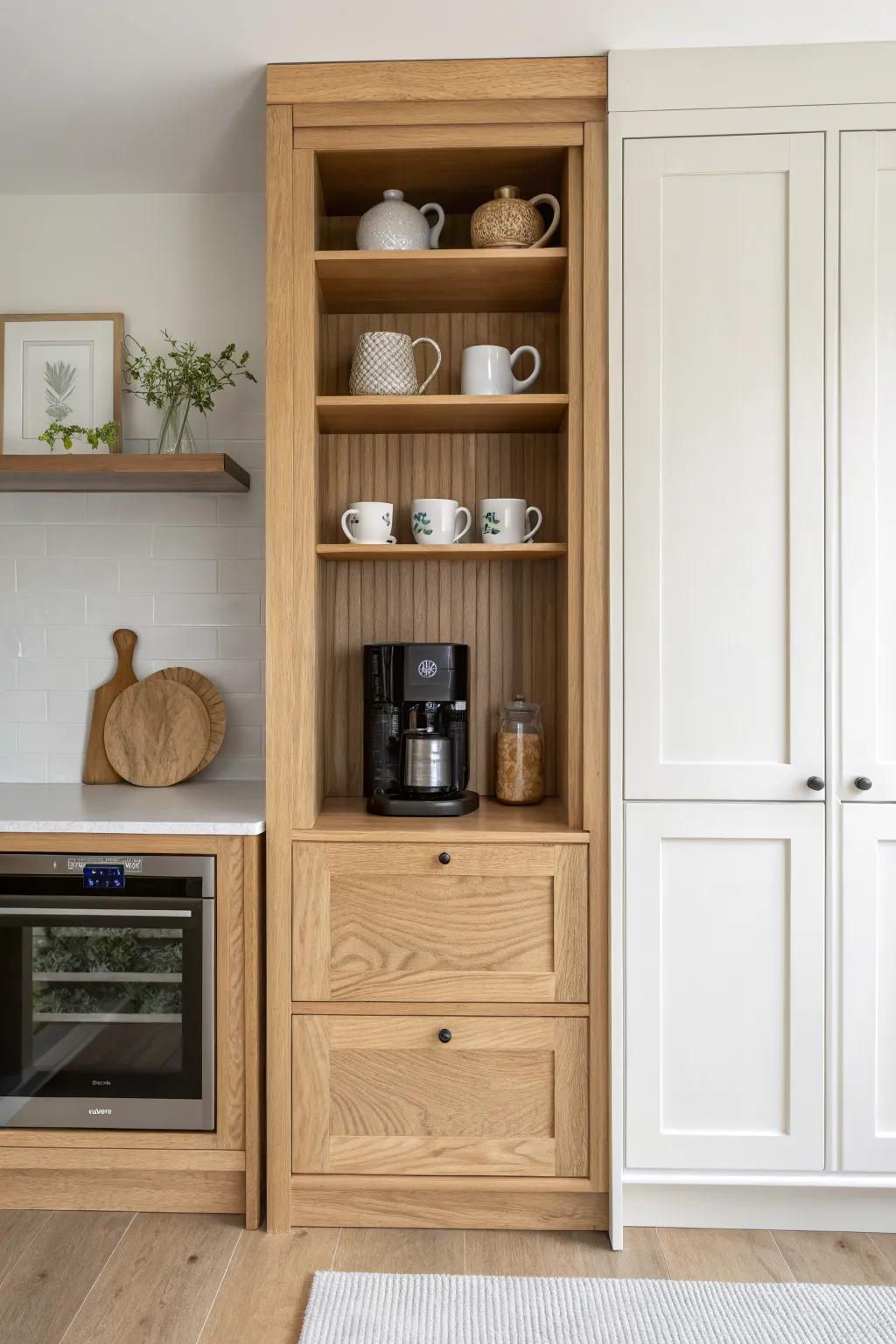
A reader named Osgood broke from his kitchen's all-white cabinetry specifically for his coffee nook, choosing a warm, unfinished oak instead. His designer questioned the shift at first, worried it would look disconnected from everything else in the room. "I told her that was sort of the point," he said. "I wanted to feel like I was stepping into a slightly different room for those few minutes, not the same white kitchen I'd be standing in for the rest of the day."
The contrast is subtle in person, the wood picks up warm morning light in a way the white cabinetry around it doesn't, and Osgood says it genuinely changes his mood walking toward it each morning, a small, deliberate signal that this corner is for something different than the rest of the kitchen's work.
- Choose one warm material, wood, brass, or a deep painted tone, and apply it only to the coffee nook's cabinetry or backsplash.
- Keep the departure subtle rather than jarring, a single accent material reads as intentional, several competing ones can feel disjointed.
- Tie the new material back to something else in the room, a wood floor, a brass faucet, so the contrast still feels connected rather than random.
- Signals a shift in purpose the moment you step toward the nook
- Adds warmth and texture to an often overlooked corner of the kitchen
- Creates a small sense of ritual simply by looking different from the everyday kitchen
Search terms: "warm oak cabinet coffee bar," "wood accent kitchen nook," "brass hardware coffee station"
A Second, Smaller Sink Just for This Corner
A reader named Perpetua called the small prep sink she added to her coffee nook "the least exciting, most useful thing" in her entire renovation. "You don't think about it until you're rinsing the same mug for the third day in a row at the kitchen sink, in the middle of dinner cleanup," she said. Now the whole loop, filling the kettle, rinsing the carafe, wiping down the counter, happens inside the nook itself, without ever stepping away from it.
It's not a glamorous addition, and it isn't cheap, but Perpetua says it's the detail that finally made the corner feel self-sufficient, a complete small world rather than a station that still depended on the rest of the kitchen to function.
- A small bar or prep sink, roughly 12 to 15 inches wide, is typically enough for rinsing mugs and filling a kettle without taking up significant counter space.
- Plan the plumbing early in any renovation, tying into an existing line nearby keeps costs meaningfully lower than running new plumbing across the kitchen.
- Choose a finish that matches your main kitchen fixtures so the second sink reads as intentional rather than makeshift.
- Keeps the entire ritual contained to one corner, start to finish
- Removes the small daily friction of walking back to the main sink
- Makes the nook feel like a genuinely self-sufficient space, not just a shelf with a machine on it
Search terms: "small bar prep sink," "compact kitchen sink 12 inch," "bar faucet coffee station"
A Built-In Bench Wide Enough to Sit and Wait

A reader named Halvard built a narrow bench into the wall beside his coffee nook, just wide enough for one person, with a cushion his mother-in-law sewed for it the first Christmas after it went in. "I didn't think I'd actually sit there," he admitted. "I figured I'd stand at the counter like always. But there's something about having somewhere to sit while it brews that made me actually wait instead of rushing off to do something else in those two minutes."
It's become, in his words, the one seat in the house nobody else really uses, which he says is exactly why it works, a small, slightly separate spot that belongs to this one ritual and nothing else, morning after morning.
- Look for an underused wall or corner near the nook, even a bench just 18 to 20 inches wide is enough for one person to sit briefly.
- Add a simple cushion or pad, comfort is what turns a built-in ledge into a seat people actually choose to use.
- Keep it visually separate from any dining seating in the kitchen, this bench belongs to the ritual, not to meals.
- Encourages actually slowing down during the few minutes coffee takes to brew
- Creates a small, personal seat that belongs to one specific daily habit
- Adds warmth and softness to a corner that's often all hard surfaces
Search terms: "built in kitchen bench small," "window seat cushion custom," "narrow banquette nook"
Layout Guide by What You Actually Need
| What you're missing most mornings | Try this |
|---|---|
| A sense of personal space | A nook sized for one chair, not a counter |
| A tidy kitchen for guests | A closed door over the whole station |
| Less visual clutter | Open shelving edited to daily-use only |
| Something to look at while waiting | A small window above the machine |
| A shift in mood, not just decor | Warm wood instead of matching cabinetry |
| Fewer trips across the kitchen | A second, smaller sink |
| A reason to actually sit still | A built-in bench beside the nook |
Ours ended up a narrow oak nook with a closed door, edited-down open shelving, and a bench my husband was sure we didn't need until he started using it more than I do.
Mistakes I Made Building Ours
- Sizing the nook for a future we didn't have yet: we built for appliances we thought we'd eventually own instead of the ones we actually used, and it sat half empty for a year.
- Matching every finish to the rest of the kitchen exactly: it looked cohesive, but it never felt like its own space until we let one material break away.
- Leaving the shelf fully open with everything we owned displayed on it: it read as cluttered for months before I finally admitted most of it didn't belong there.
- Assuming a bench was an unnecessary extra: it was the one addition I almost cut entirely, and it turned out to be the reason either of us actually sits still for those five minutes now.
Common Questions
How big does a built-in coffee nook actually need to be for a slow morning ritual? Often smaller than people expect, a footprint sized comfortably for one person tends to feel more personal and considered than a wide, generously sized station.
Is it worth building a coffee nook if I already have counter space for a machine? Most people who make the switch describe it less as gaining function and more as gaining a place, a defined corner tends to change how the ritual feels even when the equipment itself doesn't change.
What's the single most impactful addition on a limited budget? Editing the open shelving down to only what's used daily costs nothing and consistently makes the biggest visible difference for the least effort.
Can a coffee nook work in a very small kitchen with no extra wall space? Yes, several of the ideas here, a single closed cabinet, a narrow shelf, a small stool tucked to one side, scale down comfortably even in a tight galley kitchen.
I think about that week my friend stayed with us more than I probably should, the way she noticed something about my own morning that I'd stopped noticing myself. It wasn't dramatic. It was just coffee, made standing up, in a hurry, in whatever space happened to be free that day. I didn't know I was allowed to want something slower until someone else pointed out that I clearly did.
If your coffee nook still feels like a task rather than a ritual, look at whether it was built for a person to pause in, or simply for equipment to sit on. In nearly every nook featured here, that one distinction was the difference between a corner people rush past and one they actually stand in, on purpose, every single morning.
Shop the Story
- narrow coffee bar cabinet
- bifold cabinet door hardware
- floating wood shelf kitchen
- kitchen accent mirror
- warm oak cabinet finish
- compact bar prep sink
- bar faucet fixture
- built in bench cushion custom
- narrow banquette seating
- brass cabinet hardware