
Coffee Nooks That Create a Café Feeling at Home
I copied the tile and the shelving from cafés I loved for years before I understood the feeling was never really about the objects at all
For a long time I thought a café feeling was something you bought, a certain pendant light, a certain marble, a certain typeface on a little chalkboard. I collected all of it for our nook, carefully, over about a year, and standing in front of the finished result, it still felt like our kitchen with café props in it. Convincing from a photo. Hollow to actually stand in.
It was a barista I got to know at a small neighborhood café, the kind of place I went most mornings before we built our own nook, who finally said something that reframed the whole project for me. "It's not the tile," she said, laughing, when I asked what made her café feel the way it did. "It's that nobody's rushing you here. That's the whole trick. Everything else is just furniture."
I went home and looked at our nook completely differently after that. These are the seven things that actually closed the gap, and only two of them, it turns out, were objects at all.
Table of Contents
- Somewhere to Actually Sit, Not Just Stand
- A Small Marble or Zinc Bar Top
- Open Bottle and Syrup Display Shelving
- A Hand-Lettered Chalkboard, Genuinely Updated
- Warm, Low Pendant Light Over the Counter
- Café Chair Texture, Even If It's Just One Chair
- A Ritual With No Rush Built Into It
- Café Feeling Checklist by What You Have
- Mistakes I Made Chasing the Look
- Common Questions
Somewhere to Actually Sit, Not Just Stand
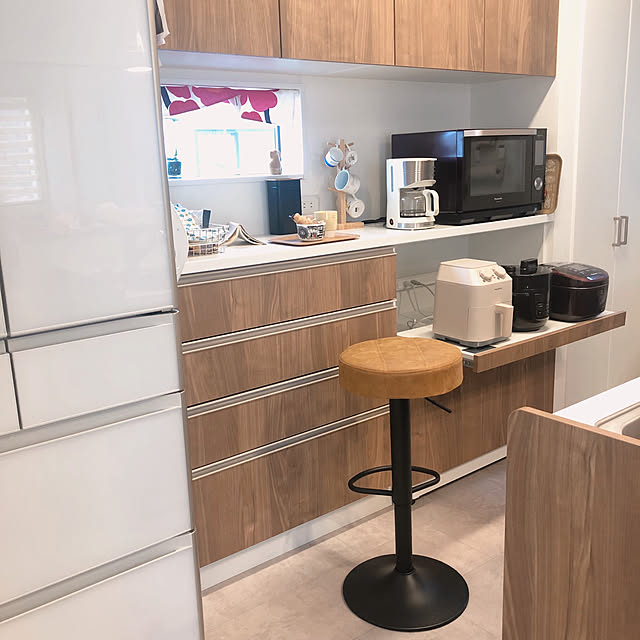
Our first nook had nowhere to sit at all, by design, we'd built it as a pure brewing station and assumed the sitting would happen elsewhere, at the table. A reader named Perpetue pointed out something I hadn't considered when she described her own setup, a single narrow stool tucked at the end of her counter. "A café isn't a counter you stand at and leave," she wrote. "It's a place you're allowed to stay in for a few minutes."
I added one small stool to ours, nothing elaborate, and the nook genuinely changed function overnight. It stopped being a stop on the way to somewhere else and became, at least for five minutes some mornings, a destination of its own.
- Look for even a narrow gap, 18 to 24 inches, along your nook's counter or an adjacent wall where a single stool could fit.
- Choose counter-height seating that matches your actual counter height, not a mismatched barstool scaled for a different surface.
- If there's genuinely no floor space, a small fold-down shelf at seated height, even used occasionally, achieves some of the same effect.
- Changes the nook's actual function, not just its appearance, from a stop to a stay
- The single most-cited detail among readers who said their nook genuinely feels like a café
- Works even in a very small footprint with the right stool choice
Search terms: "narrow counter stool," "backless counter height stool," "small bistro stool"
A Small Marble or Zinc Bar Top

A homeowner named Iolanthe added a small, separate marble bar top to the edge of her nook, distinct from her main countertop material, specifically because she remembered leaning on a zinc bar in a café years earlier and wanting that exact sensation, cool, solid, slightly worn, at home. "It's not about matching the rest of the kitchen," she told me. "It's about having one surface that feels like it's meant to be leaned on, not just worked at."
The detail is small, often just a narrow ledge or strip, but it introduces a genuinely different material sensation into the nook, one your hands and forearms actually register the way a café counter does, distinct from the rest of the kitchen's surfaces.
- Look for a narrow strip, even a foot or two, where a distinct material could be introduced without disrupting the rest of the counter's continuity.
- Choose a cool, solid material specifically, marble, soapstone, or zinc, that offers a genuinely different tactile sensation from the rest of the kitchen.
- Position it at a spot you'd naturally lean while waiting for coffee to brew, not necessarily where equipment sits.
- Introduces a genuine tactile difference your body actually registers, not just your eyes
- A small footprint makes a splurge material realistic here even on a modest budget
- Directly recreates the specific sensory memory many people associate with their favorite café
Search terms: "marble bar top remnant," "zinc countertop strip," "soapstone counter ledge"
Open Bottle and Syrup Display Shelving
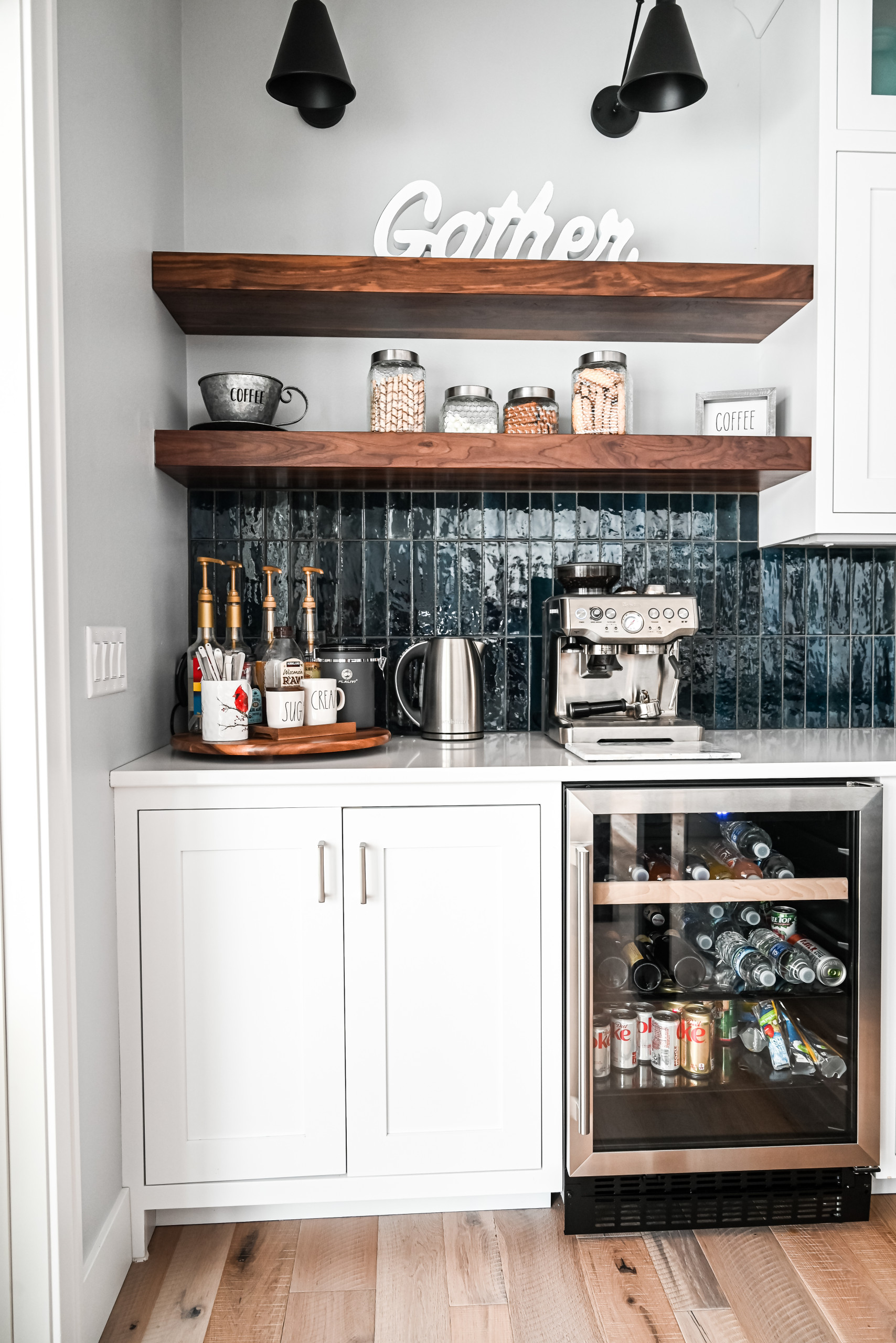
A reader named Dashiell described the exact moment his nook started feeling like a café to him, not a new appliance or a new tile, but the day he moved his syrups, his oat milk, and his cinnamon into small glass bottles lined up on open shelving instead of leaving them in their original packaging tucked in a cabinet. "Cafés don't hide their ingredients," he said. "Somehow that's the whole tell."
It's a small, almost decorative shift with a real functional upside too, everything he actually reaches for daily is visible and within arm's reach, rather than buried behind a cabinet door, which turns out to matter for the ritual feeling as much as the visual one.
- Decant your most-used daily ingredients, syrups, sugar, cinnamon, into matching glass bottles or jars.
- Line them up on open shelving at eye level, treating the arrangement itself as part of the styling, not just storage.
- Keep the collection edited, three or four genuinely used items reads as curated, ten reads as clutter.
- Doubles as genuine function, your most-used items stay within arm's reach
- Directly recreates a specific, recognizable café visual cue
- Turns ordinary daily ingredients into part of the styling rather than something to hide
Search terms: "glass syrup bottle set," "glass storage jar kitchen," "labeled glass canister"
A Hand-Lettered Chalkboard, Genuinely Updated

I bought a small chalkboard early on, wrote "Coffee Bar" on it in careful lettering, and it stayed exactly that way, unchanged, for over a year. It looked fine. It also, I eventually realized, did nothing to create the café feeling I wanted, because a café's chalkboard changes constantly, and a static one is really just a sign.
A reader named Wilhelmina described actually updating hers weekly, a small daily quote, or whatever drink she was experimenting with that particular week. "It's a tiny thing," she said, "but erasing and rewriting it is part of my Sunday routine now. It's become its own small ritual, not just a prop."
- Choose a genuinely small chalkboard, a large one raises the pressure to fill it and makes updating feel like a chore rather than a quick ritual.
- Set a simple, low-effort habit, updating it weekly with a drink, a quote, or even just the date, rather than aiming for elaborate lettering.
- If chalk feels like too much upkeep, a small rotating card holder with swappable inserts achieves a similar effect with even less effort.
- The regular act of updating it is itself a small, café-like ritual, not just the object
- A genuinely low-cost detail relative to its visual and emotional impact
- Signals a lived-in, active space rather than a styled, static one
Search terms: "small chalkboard sign," "chalk marker set," "rotating card display holder"
Warm, Low Pendant Light Over the Counter

A designer I spoke with put it simply, most home lighting is chosen for visibility, most café lighting is chosen for mood, and the two goals genuinely conflict if you're not careful. Our overhead fixture, bright and centered on the ceiling, did its job perfectly and never once felt like anywhere I wanted to sit.
Swapping it for a low-hanging, warm-toned pendant, closer to the counter and dimmer than our old fixture, made an immediate, almost embarrassing difference. It's the same principle covered in an earlier piece on layered lighting, but worth repeating specifically here, because café lighting is doing very deliberate emotional work, not just illumination.
- Hang a pendant genuinely low over the counter, 12 to 20 inches above the surface, rather than relying on a distant ceiling fixture alone.
- Choose a warm bulb temperature, closer to candlelight than daylight, specifically for this fixture.
- Keep a brighter task light available separately for actual brewing steps that need real visibility, and dim or turn it off once you're simply sitting with your cup.
- Does more emotional work toward the café feeling than almost any object on this list
- Directly recreates a specific, recognizable sensory cue from the cafés people love
- A relatively affordable fixture swap for the amount of mood it changes
Search terms: "low hanging pendant light warm," "plug in pendant light kit," "warm bulb dimmable"
Café Chair Texture, Even If It's Just One Chair
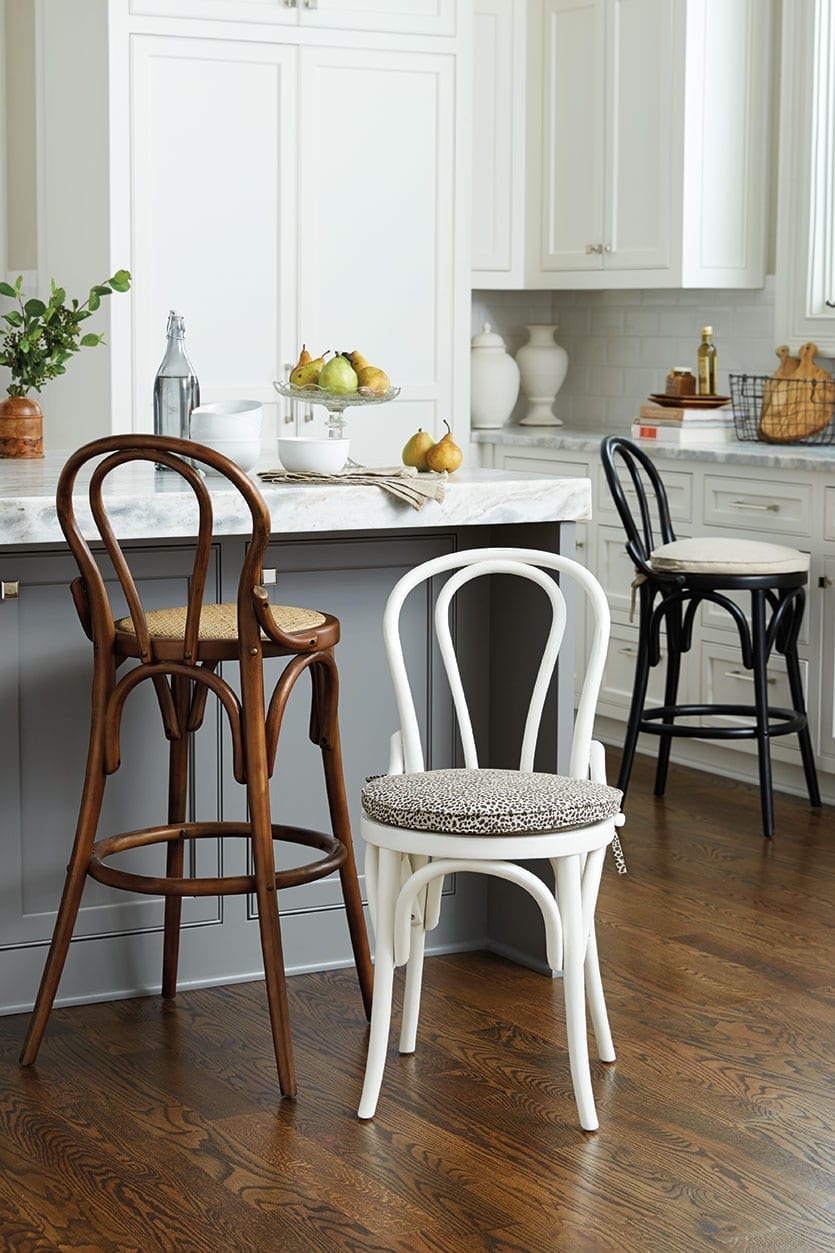
A reader named Theodora described choosing a single bentwood café chair for the small corner beside her nook, deliberately different from the rest of her dining chairs. "It was the one piece of furniture I bought specifically to look borrowed from somewhere else," she said, "and that's exactly why it works, it doesn't match, it transports."
Cane, rattan, and bentwood carry a specific, recognizable texture that most home dining furniture doesn't, lighter, more open, slightly worn even when new. A single piece introduced deliberately does more to signal "café" than an entire matched dining set ever could.
- Choose just one chair or stool in cane, rattan, or bentwood specifically, rather than trying to match your entire seating set to this texture.
- Place it somewhere slightly apart from the rest of your dining furniture, near the nook itself rather than at the main table, so it reads as its own distinct spot.
- Let it look a little worn or imperfect if secondhand, this texture is meant to feel lived-in, not brand new.
- A single piece can do the visual work of an entire matched furniture set
- Cane and rattan carry an immediately recognizable café association most home furniture lacks
- Easy to source secondhand, which only adds to the lived-in effect
Search terms: "bentwood cafe chair," "cane bistro chair," "rattan counter stool"
A Ritual With No Rush Built Into It

This is the piece the barista actually meant, and it took me the longest to understand. A café feeling isn't primarily architectural at all, it's the fact that nobody's clock is running while you're there. At home, that has to be built on purpose, because nothing about a kitchen naturally slows you down the way a café's whole business model does.
A reader named Cosima described setting a simple, small rule for herself, five minutes at the nook, coffee only, no phone, before the rest of the morning starts. "It's not really about the coffee," she admitted. "It's the only five minutes of my day nobody's asking anything of me. The nook just gave me a reason to actually take it."
- Choose a small, specific ritual, five minutes, one cup, no phone, and attach it to the physical act of standing or sitting at the nook.
- Protect that window deliberately, even waking five minutes earlier if that's what it takes to actually have it uninterrupted.
- Let the rest of the space you've built, the seating, the light, the shelf, support this one small habit, rather than treating the styling as the end goal itself.
- The detail every other item on this list is quietly in service of
- Costs nothing, and yet is the piece most people, myself included, skip entirely
- Turns a beautifully styled counter into a space that's actually used the way it was designed to be
Search terms: "morning routine journal," "phone charging station away from kitchen," "small kitchen timer"
Café Feeling Checklist by What You Have
| Your starting point | Add these first |
|---|---|
| No budget at all | The five-minute ritual, plus decanting existing ingredients into visible jars |
| Under $75 | A small chalkboard you'll actually update, plus glass bottles for daily-use items |
| Under $250 | A single secondhand café chair and a plug-in pendant kit |
| Room to fully commit | A dedicated stool, a marble or zinc bar strip, and warm pendant lighting together |
The barista's comment stayed the truest thing on this whole list, none of it matters much without the five minutes you actually protect to use it.
Mistakes I Made Chasing the Look
- Buying a chalkboard and never updating it: a static sign is just decor, the changing is what actually matters.
- Skipping seating entirely: a pure standing station never once felt like anywhere I wanted to stay for more than a minute.
- Matching every chair instead of introducing one different one: a fully matched set reads as coordinated, not café.
- Finishing every material detail and still rushing my coffee: the space was right for over a year before I ever actually used it the way it was designed to be used.
Common Questions
Which single change makes the biggest difference if I can only do one? Adding somewhere to actually sit, even a single small stool, came up more often than any other detail in the stories I collected researching this piece.
Do I need an espresso machine specifically for this to feel authentic? Not at all, several readers described a genuinely café-like ritual built entirely around a simple pour-over or drip setup, the feeling comes from the ritual and the space, not the equipment.
How do I keep a café-styled nook from looking like a theme rather than my actual home? Introduce just one or two of these ideas deliberately rather than all seven at once, restraint is what keeps it feeling personal rather than like a set built for a photo.
Is it strange to build an entire design article around five unrushed minutes? I didn't expect it either, until nearly every person I spoke with mentioned that exact detail before I'd even asked about it directly.
I spent a long time thinking the café feeling lived in the tile, the pendant, the little chalkboard sign. It genuinely doesn't, not primarily. It lives in whether you actually let yourself stay for a few minutes once the coffee's ready, and every material choice on this list only exists to support that one small, unpaid-for thing.
If your nook still feels like a station instead of a café, try the barista's version of the fix before you buy anything else. Give yourself five real, unrushed minutes there tomorrow morning, and see how much of the feeling shows up on its own.
Shop the Story
- narrow counter stool
- marble bar top remnant
- glass syrup bottle set
- small chalkboard sign
- low hanging pendant light warm
- bentwood cafe chair
- rattan counter stool
- chalk marker set
- plug in pendant light kit
- zinc countertop strip