
Countertop Choices That Change the Entire Look of a Coffee Nook
Real material tradeoffs, not just seven pretty samples
A countertop is the single largest continuous surface in most coffee nooks, and it carries more of the visual weight than any cabinet finish, tile pattern, or fixture placed on top of it. Two nooks can share identical cabinets and hardware and still feel like entirely different rooms once the counter material changes, cool and formal in polished stone, warm and worn-in on wood, industrial and matte in concrete.
The seven materials below aren't ranked, they're genuinely different tools suited to different priorities, heat tolerance, porosity, maintenance routine, and budget all vary meaningfully between them, and the right choice depends on how the specific station actually gets used, not just how it photographs.
A note on accuracy before starting: material performance varies by specific product, sealant, and fabrication quality within each category below, always confirm exact care requirements and warranty terms with your fabricator or supplier for the specific slab or product you select.
Here are seven countertop materials, and how each one genuinely changes a coffee nook's look and daily behavior.
Table of Contents
- Honed Marble
- Butcher Block Wood
- Poured Concrete
- Quartzite
- Stainless Steel
- Terrazzo
- High-Pressure Laminate
- Stone vs. Wood vs. Composite: How These Differ
- A Maintenance Guide by Material
- Common Countertop Selection Mistakes
- The Full Cost Comparison
- Common Questions
Honed Marble

A honed, matte finish softens marble's natural veining into a quieter, chalkier surface than its polished counterpart, and it's the finish most fabricators actually recommend for a working counter, since a honed surface shows etching and light scratching far less obviously than a high-gloss polish does. Marble is a genuinely soft, porous natural stone, and coffee, being mildly acidic, along with citrus, wine, and most acidic foods, will etch its surface over time regardless of sealing.
- Choose a honed rather than polished finish for a working coffee station specifically, this is the single biggest factor in how forgiving the surface is day to day.
- Reseal on a schedule recommended by your fabricator, typically every six to twelve months for a natural stone sealer, more porous slabs may need it more often.
- Wipe acidic spills, coffee drips included, promptly rather than letting them sit, this reduces etching even though it won't eliminate it entirely.
- Accept that some etching and patina will develop with genuine daily use, many people choose marble specifically for this aged character rather than despite it.
- Genuine natural veining no engineered material fully replicates
- A honed finish is forgiving of daily wear compared to polished
- Develops real patina and character with age, for those who want it
Search terms: "honed marble countertop remnant," "marble sealer natural stone," "marble etch repair kit"
Butcher Block Wood

Butcher block brings genuine warmth and grain to a coffee nook that no stone or composite material replicates, and it's one of the few counter materials that can actually be sanded and refinished at home when it shows wear, rather than requiring professional resurfacing or replacement. It does require real, ongoing maintenance, regular oiling to keep the wood sealed against water absorption, and it's genuinely more vulnerable to water damage and staining near a splash-prone zone like a coffee station than a sealed stone or composite surface.
- Choose a food-safe mineral oil or a specific butcher block conditioner, applied on a regular schedule, monthly is a common starting recommendation for a well-used surface, adjusted based on how dry the wood looks and feels.
- Wipe up water and coffee spills promptly rather than letting them sit, this is the single most important habit for wood counter longevity.
- Consider a food-safe polyurethane or water-based sealant instead of oil alone if you want more water resistance, though this trades away the ability to sand and re-oil the surface as easily later.
- Position the wood section slightly back from the most splash-prone zone if possible, pairing it with a more water-resistant material directly under the equipment itself.
- Genuine warmth and grain variation no other material matches
- Can be sanded and refinished rather than replaced when worn
- Softens an otherwise all-stone or all-metal kitchen
Search terms: "butcher block countertop," "food safe mineral oil wood counter," "butcher block conditioner"
Poured Concrete
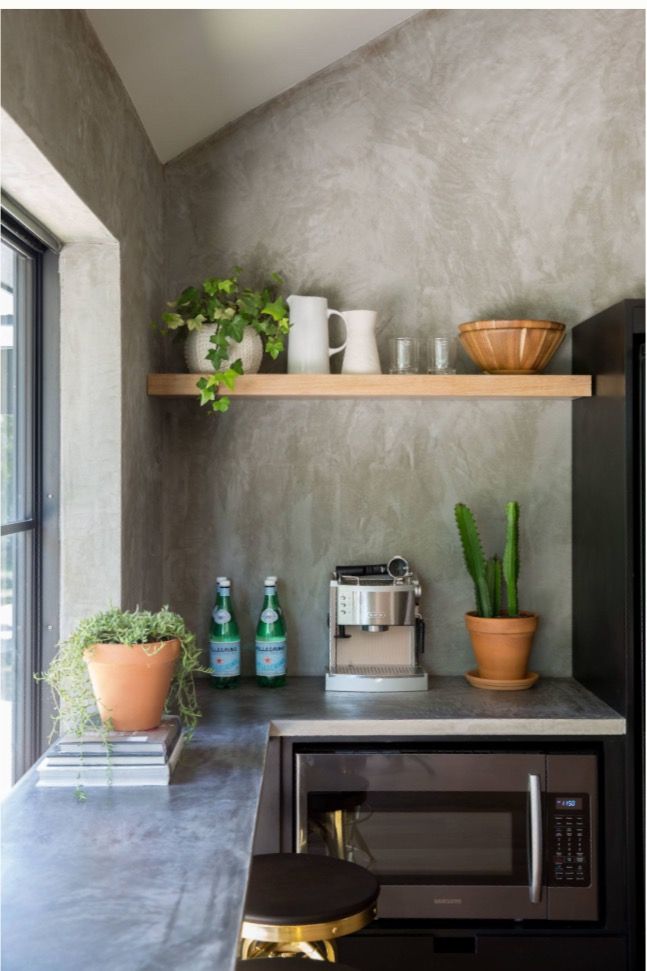
Poured concrete offers a genuinely custom look no manufactured slab material can match, it's cast on-site or fabricated to fit the exact footprint, edge profile, and even integrated details like a built-in drainboard or a recessed trivet, in essentially any color achievable through pigmenting and finishing techniques. It's also a porous material that requires sealing, and despite its industrial, indestructible appearance, it can develop hairline cracks over time as it cures and settles, a characteristic many people accept as part of the material rather than a defect.
- Work with a fabricator experienced specifically in concrete countertops, this is a distinct specialty from general concrete work, curing, mix design, and finishing all affect the final result significantly.
- Confirm the sealing product and resealing schedule recommended for your specific installation, this varies by sealer type and by how the counter is actually used.
- Discuss hairline cracking as a realistic possibility during the planning process, most fabricators can explain how they minimize it and how it's typically addressed if it occurs.
- Consider integrated features, a built-in trivet zone, a drainboard, or a custom edge profile, at the design stage, this is one of concrete's genuine strengths over a manufactured slab.
- Genuinely custom color, shape, and integrated detail possibilities
- Distinctive industrial texture unlike any manufactured material
- Can incorporate built-in functional features during fabrication
Search terms: "concrete countertop fabrication," "concrete counter sealer," "custom concrete countertop coffee station"
Quartzite

Genuine quartzite is a natural metamorphic stone, harder and generally more heat- and scratch-resistant than marble, with a similar soft veining and movement that often gets it chosen as a marble alternative for exactly that reason. It's a critical distinction to verify at the slab yard, though, some stone marketed as quartzite is actually dolomitic marble or a softer stone with similar veining, genuine quartzite typically won't be scratched by a steel knife blade, a rough field test some fabricators use, while a softer look-alike often will.
- Ask your fabricator directly whether a specific slab is genuine hard quartzite or a softer dolomitic marble sold under the same name, and request documentation or a test if there's any doubt.
- Choose a honed or leathered finish if you want quartzite's durability with a softer, more matte visual than a full polish.
- Seal according to your fabricator's specific recommendation, genuine quartzite is generally less porous than marble but still typically benefits from sealing.
- Confirm the specific slab's heat rating with your fabricator before assuming all quartzite handles direct heat identically, natural variation exists even within the category.
- Marble-like veining with genuinely greater hardness and heat tolerance
- A natural stone option better suited to heavier daily use
- Available in a wide range of finishes, from polished to leathered
Search terms: "quartzite countertop slab," "quartzite vs marble hardness," "leathered finish quartzite counter"
Stainless Steel

Stainless steel is the material commercial kitchens rely on specifically because it's non-porous, genuinely heat resistant, and resistant to staining and bacterial growth in a way few other countertop materials match, making it an unusually practical, if visually cooler and more industrial, choice for a coffee station. Its main tradeoff is cosmetic, it shows fingerprints, water spots, and light scratching more visibly than a textured or patterned material, since there's no natural veining or grain to help disguise daily wear.
- Confirm the steel gauge with your fabricator, a heavier gauge resists denting and warping better than thin decorative-grade steel.
- Choose a brushed rather than mirror-polished finish for daily use, brushed steel hides fingerprints and light scratching considerably better than a high-polish mirror finish.
- Plan for regular wiping with a stainless-specific cleaner to maintain the finish and reduce visible water spotting, a genuine daily habit for this material.
- Confirm seam and edge fabrication details with your supplier, custom stainless counters are typically welded and finished on-site or in a fabrication shop, not simply cut like a stone slab.
- Genuinely non-porous, heat resistant, and hygienic
- Commercial-kitchen-grade practicality for daily use
- A distinct, cool-toned industrial look unlike any stone option
Search terms: "stainless steel countertop fabrication," "brushed steel counter gauge," "commercial grade stainless counter"
Terrazzo
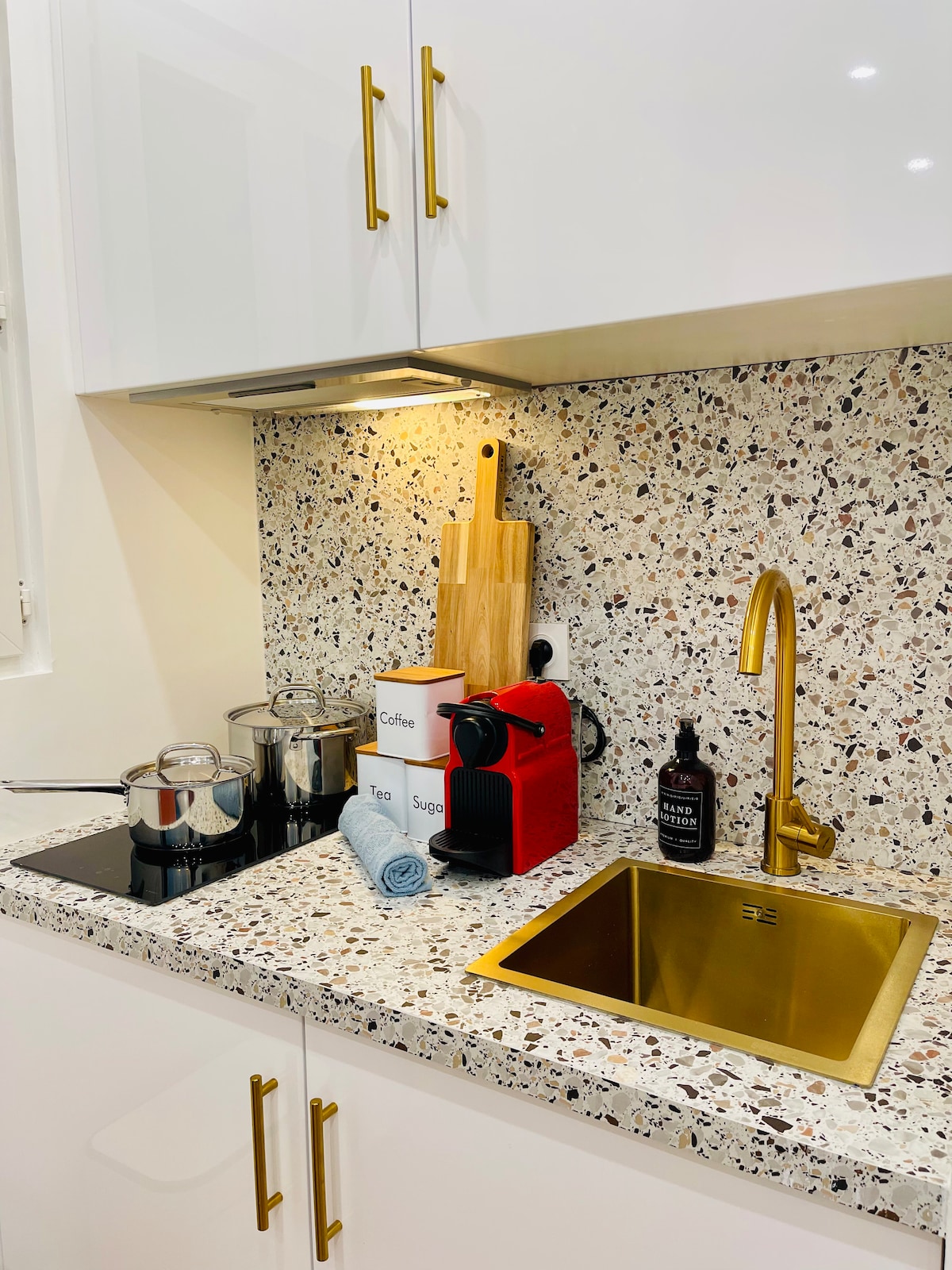
Terrazzo, made from chips of marble, granite, glass, or other aggregate suspended in a cement or resin binder and then ground smooth, offers a genuinely distinctive speckled texture with real customization potential, chip size, color combination, and density can all be specified, letting the material be tuned to match a coffee nook's exact palette in a way few other materials allow. Traditional cement-based terrazzo is more porous and benefits from sealing, while modern epoxy-resin terrazzo is generally less porous and more stain-resistant out of the fabrication process.
- Confirm whether you're selecting cement-based or resin-based terrazzo, and ask your fabricator directly about the sealing and maintenance schedule appropriate to that specific type.
- Choose chip size and color intentionally, larger chips read more casual and bold, finer chips read more subtle and refined, both are genuine terrazzo options.
- Consider a custom chip blend that pulls a color already present elsewhere in the coffee nook, tile, hardware, or paint, terrazzo fabricators frequently offer this level of customization.
- Ask about precast versus poured-in-place terrazzo, precast slabs are fabricated off-site and installed like stone, poured-in-place is done directly in your kitchen, each has different lead time and cost implications.
- Genuinely customizable color and chip pattern, unlike a fixed natural stone slab
- A distinctive, textured look with real design history behind it
- Available in both traditional and lower-maintenance modern formulations
Search terms: "terrazzo countertop precast," "resin terrazzo counter," "custom terrazzo chip blend"
High-Pressure Laminate

High-pressure laminate, layers of resin-saturated paper fused under heat and pressure to a substrate, has advanced considerably from its dated reputation, current lines offer genuinely convincing wood, stone, and solid-color visuals, along with a matte, textured finish that reads far less obviously as laminate than older glossy versions did. It remains one of the most affordable counter materials available, with real tradeoffs, it isn't heat resistant the way stone or steel is, and unlike solid surface or stone, damage generally can't be sanded out or repaired invisibly.
- Choose a current-generation textured or matte laminate line specifically, these look noticeably more convincing and premium than older glossy laminate products.
- Plan a separate heat-safe landing zone, stone or tile, near the equipment, since laminate itself isn't rated for direct hot contact.
- Confirm edge profile options with your fabricator, modern laminate offers considerably more edge detailing than older post-form counters, including options that mimic a thicker stone edge.
- Avoid cutting directly on laminate, its surface layer can be scored or damaged by a blade in a way that isn't repairable the way solid surface material can be.
- Genuinely the most affordable material on this list by a wide margin
- Current lines offer convincing, updated visual options
- Available in an enormous range of colors and patterns
Search terms: "high pressure laminate countertop," "matte textured laminate counter," "laminate edge profile options"
Stone vs. Wood vs. Composite: How These Differ
Natural stone, marble, quartzite, brings genuine, non-repeating veining and a cool, formal surface temperature, its main tradeoffs are porosity and, for softer stones like marble, vulnerability to acid etching, both manageable with sealing and care but real considerations for a daily-use coffee station. Wood brings warmth and the unique ability to be sanded and refinished at home, at the cost of needing consistent oiling and more caution around standing water. Composite and manufactured materials, concrete, terrazzo, laminate, and stainless steel, each solve a specific problem, custom shape and integrated detail for concrete, customizable color and pattern for terrazzo, extreme affordability for laminate, and non-porous hygienic performance for steel, generally trading some of stone's natural, non-repeating visual complexity for that specific practical advantage. None of these categories is universally correct, the right material depends on how much daily wear the specific station will see, how much maintenance routine you're genuinely willing to keep up, and which tradeoff, porosity, heat sensitivity, or a cooler industrial look, you're most comfortable living with.
A Maintenance Guide by Material
- Honed marble and quartzite: reseal on a schedule recommended by your fabricator, wipe acidic spills promptly, expect some patina over time with marble specifically.
- Butcher block: oil regularly on a set schedule, wipe standing water promptly, can be sanded and refinished when it shows real wear.
- Concrete and terrazzo: confirm the specific sealing schedule for your material type, cement-based versions generally need more frequent sealing than resin-based ones.
- Stainless steel: wipe with a stainless-specific cleaner regularly, expect visible fingerprints and water spots as a normal, cosmetic part of daily use.
- Laminate: avoid direct heat and cutting on the surface itself, use a dedicated heat-safe zone and cutting board nearby.
Common Countertop Selection Mistakes
- Choosing polished marble for a heavily used working surface: a honed finish is considerably more forgiving of daily etching and light scratching.
- Assuming any slab labeled "quartzite" is genuinely hard quartzite: confirm the actual mineral composition with your fabricator, the marketing term isn't always used precisely.
- Setting hot equipment directly on an unrated material: laminate and some sealers can be damaged by direct heat, plan a dedicated heat-safe zone regardless of your main counter material.
- Skipping the sealing schedule for a porous material: marble, concrete, and cement-based terrazzo all genuinely need ongoing sealing, not a one-time application at installation.
The Full Cost Comparison
| Material | Typical Cost (per sq ft, installed) |
|---|---|
| Honed marble | $60–150 |
| Butcher block wood | $35–90 |
| Poured concrete | $70–135 |
| Quartzite | $70–160 |
| Stainless steel | $75–175 |
| Terrazzo | $65–150 |
| High-pressure laminate | $20–50 |
Common Questions
Which material is the easiest starting point on a limited budget? High-pressure laminate, current textured lines offer a genuinely updated look at a fraction of the cost of the other materials here.
Which material needs the least ongoing maintenance? Stainless steel and resin-based terrazzo generally require the least active maintenance, mainly regular wiping rather than a sealing schedule, though stainless shows fingerprints more visibly on a daily basis.
Can different countertop materials be mixed within one coffee nook? Yes, this is common and practical, pairing a primary material with a small heat-safe inlay in a different, more heat-tolerant material at the equipment landing zone specifically.
Is it worth choosing a more expensive, higher-maintenance material like marble for a coffee station specifically, given how much daily use and splashing it sees? This depends on personal priorities, many people accept marble's higher maintenance specifically because they value its natural veining and the patina it develops, others prefer a lower-maintenance material like quartzite or terrazzo precisely because of a coffee station's heavy daily use, there's no universally correct answer.
The countertop was never actually a neutral background decision, it's the single material choice that shapes more of a coffee nook's character than any other. Every material here changes both the look and the daily behavior of the space, and the right one depends less on which photographs best and more on which tradeoff, porosity, heat sensitivity, ongoing maintenance, actually fits how the station gets used.
Request physical samples of your top two or three materials before deciding, seeing and touching a sample under your kitchen's actual light tells you more than any photo can.
Shop the Story
- honed marble countertop remnant
- butcher block countertop
- concrete countertop sealer
- quartzite countertop slab
- stainless steel countertop fabrication
- terrazzo countertop precast
- high pressure laminate countertop
- marble sealer natural stone
- food safe mineral oil wood counter
- heat resistant counter inlay