
The Most Relaxing Coffee Nook Designs for Calm Homes
I filled ours with everything I thought I loved, and it took a therapist's offhand comment to notice it was the busiest, loudest corner in the house
For a long time, our coffee nook was the most decorated spot in the kitchen, open shelves crowded with mugs and appliances and little collected objects, every surface doing something. I thought that meant it was finished. It wasn't until a friend, a therapist, stood in front of it one morning and said, half joking, "this is a lot to look at before eight a.m.," that I actually looked at it the way she was seeing it.
She wasn't wrong. My eyes had nowhere to rest, no quiet spot to land before the day asked anything of me. I'd built a corner meant for the calmest five minutes of the morning and filled it with more visual noise than anywhere else in the house.
Paring it back taught me something I didn't expect, that a relaxing space isn't really about what you add to it. It's almost entirely about what you're willing to leave out. Here's what that looked like for us, and for a handful of other people who came to the same conclusion from very different starting points.
Table of Contents
- A Muted Palette With One Quiet Exception
- A Tambour Door That Hides the Noise
- One View, Positioned at Eye Level
- Soft, Textured Materials Underfoot
- A Shelf Pared Down to Almost Nothing
- A Small Ritual Object That Signals Pause
- A Single Living Plant, Not a Collection
- Calm Guide by What's Overwhelming You
- Mistakes I Made Before I Slowed Ours Down
- Common Questions
A Muted Palette With One Quiet Exception
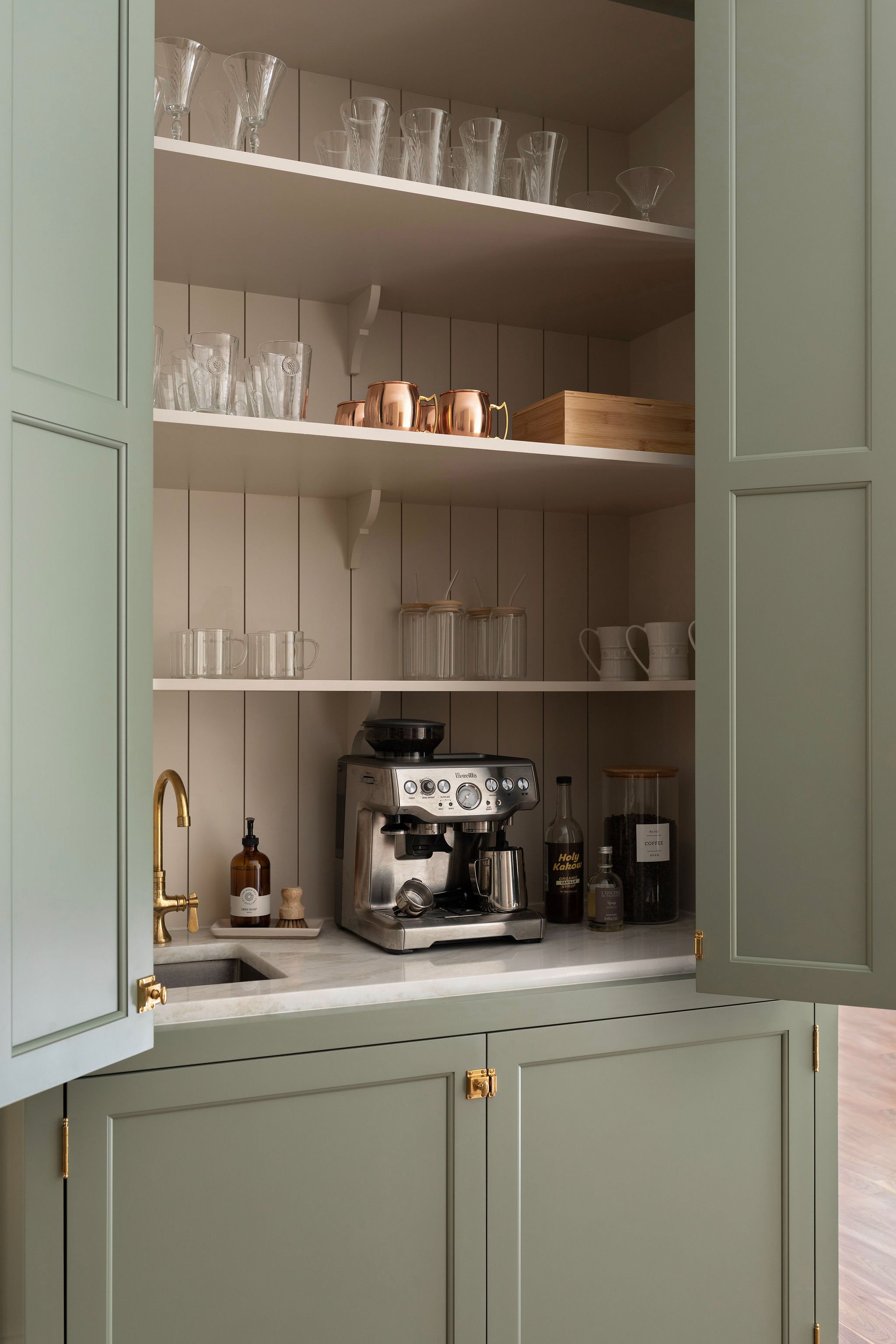
A reader named Wilhelmina repainted her coffee nook in a soft, chalky sage after years of a bright white she said had started to feel almost clinical in the early morning light. She kept everything else quiet, matching tile, a plain wood counter, and allowed herself exactly one exception, a small ceramic canister in a warm rust color that sits alone on the counter. "Everyone notices that one canister," she said. "It wouldn't stand out at all if everything around it wasn't so quiet."
What she'd landed on, without quite naming it that way, was restraint as a form of care. A muted palette doesn't ask anything of you first thing in the morning, no visual decision to make, no color competing for attention, just a soft, settled backdrop that lets the one thing she chose to stand out actually do so.
- Choose one muted, low-contrast base color for the majority of the nook, walls, tile, and cabinetry, staying within a narrow tonal range.
- Allow yourself exactly one small exception in a warmer or bolder tone, more than one or two starts to undo the calm the palette is meant to create.
- Test paint and tile swatches specifically in early morning light, a color that reads calm at noon can feel flat or cold at six a.m.
- Removes the small, daily visual decisions a busier palette quietly demands
- Gives your eyes an actual resting point first thing in the morning
- Makes any single accent piece you do keep feel far more intentional
Search terms: "muted sage kitchen paint," "warm greige cabinet color," "low contrast kitchen palette"
A Tambour Door That Hides the Noise

A reader named Ezra installed a curved tambour door across the front of his coffee station specifically so the machine, the grinder, and their attendant cords could disappear entirely behind a smooth wooden shutter the rest of the day. "It's not really about mess," he said. "It's that even a tidy row of appliances is still visual noise. Closing that door is like closing a chapter of the morning."
What he described is less about hiding clutter and more about giving the eye permission to stop scanning. A closed tambour reads as one simple, uninterrupted plane of wood, no dials, no cords, no small decisions about whether anything needs wiping down, just a calm surface until it's actually time to use what's behind it.
- Choose a tambour or roll-front door specifically for stations with several small appliances, this handles awkward shapes better than a flat swinging cabinet door.
- Keep a power strip mounted inside the enclosure so appliances can stay plugged in and simply be closed away rather than unplugged and reconnected daily.
- Match the door's wood tone to nearby cabinetry so it reads as a continuation of the room rather than a separate feature.
- Removes the small, constant visual noise of cords, dials, and appliance clutter
- Gives the space a genuinely uninterrupted, restful surface most of the day
- Keeps appliances plugged in and ready, so closing it away costs no real convenience
Search terms: "tambour cabinet door," "appliance garage roll front," "hidden coffee station cabinet"
One View, Positioned at Eye Level

A reader named Noor positioned her coffee station directly beneath a small kitchen window overlooking the garden, a deliberate decision she made after noticing how many of her calmest mornings, at friends' houses or on vacation, involved a view she could look at while waiting for something warm to finish. "I used to stand facing a wall," she said. "Now I stand facing something alive. It changes what my mind does during those two minutes."
Not everyone has a window to work with, and she was quick to say the same principle can apply to a single piece of art or even a framed photograph, hung at the exact eye level of someone standing at the counter. The specific thing matters less than the fact that there's one considered thing there at all, rather than a blank stretch of cabinetry.
- If a window is available, orient the station to face it directly, even a modest view outperforms a blank wall for this purpose.
- Without a window, choose one piece of art or a single framed image, hung specifically at the eye level of someone standing at the counter, not above cabinet height.
- Resist the urge to fill the rest of that wall, one considered focal point works better than several competing for attention.
- Gives the mind somewhere calm to rest during an otherwise idle minute or two
- Turns a small, routine wait into a genuinely restful pause rather than dead time
- Works whether or not you have access to an actual window or outdoor view
Search terms: "kitchen window coffee station," "framed botanical print kitchen," "eye level kitchen wall art"
Soft, Textured Materials Underfoot
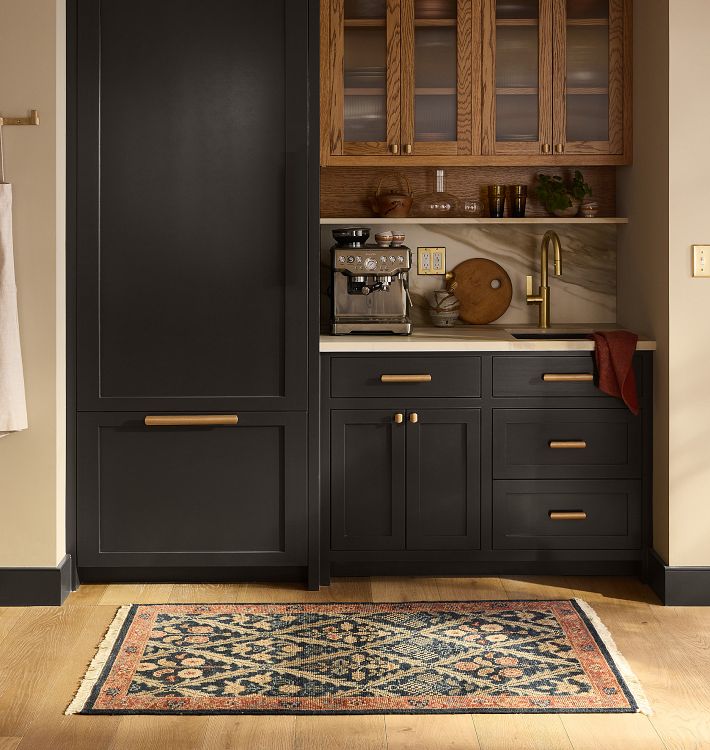
A reader named Cosima laid a small, densely woven wool rug in front of her coffee station, something she'd initially dismissed as impractical for a kitchen. "I thought it would just get ruined," she said. "But it's the first thing my feet feel every single morning, before anything else has happened yet, and that turned out to matter more than I expected."
Standing on cold tile first thing in the morning is a small, easy-to-overlook kind of tension, one most people never think to address because it seems too minor to matter. Cosima's experience suggests otherwise, a soft, warm surface underfoot changes the physical sensation of the whole ritual before a single sip has been taken.
- Choose a low-pile, densely woven rug specifically, this holds up far better to daily foot traffic and occasional spills than a plush, high-pile option.
- Size it to extend slightly beyond where you'd naturally stand, this prevents cold tile from creeping in at the edges of the routine.
- Choose a washable or spot-cleanable material given the proximity to a working coffee station and the daily splashes that come with it.
- Adds a genuine, physical layer of comfort before a single sip is taken
- Softens the coldest, least considered part of most kitchen mornings
- A relatively inexpensive addition compared to most material upgrades on this list
Search terms: "low pile washable kitchen rug," "small kitchen runner rug," "wool blend accent rug"
A Shelf Pared Down to Almost Nothing

A reader named Tobias removed roughly two thirds of what had been sitting on his open coffee shelf, down to a single stack of matching bowls, one canister, and nothing else. "I kept telling myself the shelf needed more to look finished," he said. "It was the opposite. Every object I removed made the ones left behind look more considered, not less."
What he arrived at is something close to the old design principle that a room is finished not when there's nothing left to add, but when there's nothing left to take away. A pared-down shelf gives each remaining object room to actually be looked at, rather than blurring together into a wall of stuff the eye learns to skip over entirely.
- Remove everything from the shelf and add back only what you reach for daily, this is usually a smaller list than what was originally sitting there.
- Choose objects with some visual relationship to each other, similar tones or materials, rather than a random mix of whatever's left.
- Leave genuine empty space between what remains, this negative space is doing as much visual work as the objects themselves.
- Gives each remaining object genuine visual weight instead of blending into clutter
- Reduces the small, constant visual noise a crowded shelf quietly creates
- Costs nothing beyond a willingness to put a few things away
Search terms: "minimal open shelf styling," "matching ceramic canister set," "simple kitchen shelf display"
A Small Ritual Object That Signals Pause

A reader named Ingeborg keeps a small hourglass timer beside her station, turned over the moment she starts brewing, not for accuracy, she admitted, but as a small, deliberate signal to herself that this particular stretch of time is meant to be slow. "It sounds a little silly," she said, "but watching sand fall is different from watching a clock. My phone is nowhere near it. It's the one object in the house that only means one thing."
What she'd built, without quite framing it this way, is a small physical cue that separates this moment from the rest of a fast-moving day. Most objects in a kitchen serve several purposes at once, but a single-purpose object, something that exists only to mark this particular pause, carries a kind of quiet permission that multipurpose things rarely do.
- Choose one small object, a timer, a specific mug reserved only for this ritual, a small dish for a single item, that serves no other function anywhere else in the house.
- Keep your phone and any charging cords well away from the station specifically, this is what protects the pause from being interrupted or shortened.
- Use the object consistently, the same way each morning, this is what turns it into a genuine cue rather than just another decoration.
- Marks the coffee ritual as genuinely separate from the rest of a busy day
- Keeps the station from quietly becoming a catch-all for unrelated clutter
- A small, inexpensive object that carries far more meaning than its size suggests
Search terms: "small hourglass sand timer," "single dedicated ceramic mug," "kitchen ritual object"
A Single Living Plant, Not a Collection

A reader named Rasheed keeps a single small trailing plant on his coffee station's shelf, deliberately resisting the urge to add more once he noticed how much calmer the one plant felt compared to the crowded collection he'd kept years earlier in a different kitchen. "I used to think more greenery meant more calm," he said. "It's actually the opposite past a certain point, it starts to feel like something else to manage before I've even had coffee."
There's something to the idea that one living thing, tended consistently, does more for a space than several plants competing for attention and light. A single plant becomes a small, quiet marker of care, something noticed and checked on daily, rather than a backdrop that blurs into the rest of the shelf.
- Choose one low-maintenance variety suited to your kitchen's actual light conditions, this is what keeps the plant a source of calm rather than a source of guilt.
- Give it a dedicated, considered spot rather than squeezing it in wherever there's a gap, this is what lets it read as intentional.
- Resist adding a second or third plant once the first one is thriving, the goal here is one considered presence, not a growing collection.
- Adds a genuine, living presence without competing for attention with itself
- Becomes a small, daily point of care rather than another thing to maintain
- Costs little and requires no renovation or major purchase
Search terms: "low light pothos plant," "small kitchen counter plant," "snake plant low maintenance"
Calm Guide by What's Overwhelming You
| What feels like too much right now | Try this |
|---|---|
| Too much color and pattern | A muted palette with one quiet exception |
| Too many appliances on display | A tambour door that hides the noise |
| Nothing calming to look at | One view, positioned at eye level |
| Mornings that feel cold and rushed | A soft, textured rug underfoot |
| A shelf that feels cluttered | Pare it down to almost nothing |
| A day that starts too fast | A small ritual object that signals pause |
Ours ended up the pared-down shelf and a single plant first, the rest came slowly, once I stopped assuming calm meant adding something new.
Mistakes I Made Before I Slowed Ours Down
- Mistaking a full shelf for a finished one: every object I eventually removed made the space feel more considered, not less.
- Letting the station double as a catch-all for mail and chargers: the one spot meant for a pause had become the busiest surface in the kitchen.
- Choosing colors I liked in a showroom, not in early morning light: a shade that felt warm at noon read cold and flat at six a.m.
- Assuming more plants meant more calm: a crowded collection became one more thing to manage, not a source of rest.
Common Questions
Which of these ideas makes the fastest, most noticeable difference? Paring down an open shelf tends to have the most immediate visual effect, and it costs nothing beyond a willingness to put things away.
Do I need to repaint or renovate to make a coffee nook feel calmer? Not necessarily, several of these ideas, the shelf, the plant, the ritual object, the rug, require no construction or paint at all.
How do I choose just one accent color if I love several? Pick the one that appears least often elsewhere in your kitchen already, this is what will let it stand out as the single intentional exception rather than blending in.
Is it realistic to keep phones and clutter away from a coffee station permanently? Most people find a dedicated basket or drawer elsewhere in the kitchen, chosen specifically for that overflow, makes it far easier to keep the station protected day to day.
I think about my friend's comment more than I probably should, standing in front of a shelf I'd once been proud of, hearing it described as a lot to look at before eight a.m. She wasn't criticizing the space. She was noticing something I'd stopped being able to see myself, that a corner built for the calmest part of the day had quietly become the loudest one.
If your coffee nook still feels busy even after everything else in the house feels settled, it might be worth taking something away rather than adding something new. In nearly every calm nook I've featured here, that was the actual shift, not a purchase, just less.
Shop the Story
- muted sage kitchen paint
- tambour appliance cabinet
- framed botanical wall print
- low pile washable kitchen rug
- matching ceramic canister set
- small hourglass sand timer
- low light pothos plant
- simple wood floating shelf
- warm greige paint sample
- snake plant small pot