
Lighting Designs That Transform Built-In Coffee Nooks
I lived with one flat overhead light for two years before I understood it was the reason the whole nook felt like an afterthought
For a long time, our coffee nook only had one light source, the same overhead flood light that lit the rest of the kitchen, on the same switch, at the same harsh brightness, whether it was seven in the morning or seven at night. I never questioned it. It hadn't occurred to me that a corner used almost entirely before sunrise might need its own kind of light, softer, warmer, closer to where I actually stood.
An electrician I hired for a different job glanced at the nook while running wire nearby and asked, almost casually, why I was lighting a five-foot corner the same way I lit a twenty-foot kitchen. I didn't have a good answer. I'd simply never separated the two in my mind, the coffee station and everything else, as though one bright switch could do the job for both.
Once I started paying attention, I noticed how much of what makes a coffee nook feel special isn't the cabinetry or the tile at all, it's the quality of light falling across them at six in the morning, half awake, before the rest of the house has stirred. Here's what I learned, and what other people learned redoing their own.
Table of Contents
- A Single Pendant, Not a Row of Downlights
- Warm Under-Cabinet Lighting, Dimmed Low
- Wall Sconces Flanking the Station
- A Picture Light Above Open Shelving
- Backlit Glass-Front Cabinets
- A Vintage Task Lamp Left Out on the Counter
- Hidden Strips Under a Floating Shelf
- Lighting Guide by Mood
- Mistakes I Made Lighting Ours
- Common Questions
A Single Pendant, Not a Row of Downlights

A reader named Odalys replaced the two recessed downlights above her coffee nook with a single small pendant, hung low and slightly off center over the counter. Her electrician questioned it at first, worried a single fixture wouldn't provide enough light to actually see by. "I told him I wasn't trying to see the whole counter," she said. "I was trying to see my coffee."
She was right, in the end. The single pendant throws a warm, contained pool of light exactly where she stands each morning, while the rest of the nook falls into a soft, flattering dimness around it. It's a small trade, less overall brightness for far more atmosphere, and she says it's the first thing she notices walking into the kitchen before sunrise.
- Hang the pendant low enough to feel personal, roughly 30 to 36 inches above the counter, rather than at standard overhead ceiling height.
- Choose a warm-toned bulb, somewhere around 2700K, a cooler white bulb will undercut the cozy effect a single pendant is meant to create.
- Put it on its own dimmable switch, separate from the rest of the kitchen's lighting, so the mood can shift independently of everything else.
- Creates a warm, contained pool of light instead of an even, clinical wash
- Often requires less rewiring than a row of recessed downlights would
- Gives the nook its own distinct mood, separate from the rest of the kitchen
Search terms: "small kitchen pendant light," "low hanging counter pendant," "warm dimmable pendant fixture"
Warm Under-Cabinet Lighting, Dimmed Low

A reader named Winslow installed a slim LED strip under his upper cabinets, set to a warm color temperature and wired to a dimmer he keeps low, almost amber, in the early hours. "I use it more than the overhead light now," he told me. "It's enough to see the counter without waking my whole body up before I've even had coffee."
What he described, and what I've since noticed in every nook that does this well, is how differently light behaves when it comes from below the eye line instead of above it. It washes the counter and backsplash in a soft glow without ever hitting your face directly, which is a small thing, but it changes how gentle the whole room feels first thing in the morning.
- Choose a warm white LED strip, ideally adjustable between 2200K and 3000K, rather than a fixed cool white option.
- Install it toward the front edge of the cabinet rather than tucked at the back, this reduces glare and casts a more even wash across the counter.
- Wire it to a separate dimmer or smart switch from your main kitchen lighting, so you can genuinely use it as a low, early-morning setting.
- Provides genuinely useful task light without the harshness of an overhead fixture
- Doubles as a gentle, low mood setting for early mornings or late evenings
- A relatively simple, affordable upgrade compared to most other lighting changes
Search terms: "warm white under cabinet LED strip," "dimmable LED tape light," "under cabinet lighting kit"
Wall Sconces Flanking the Station
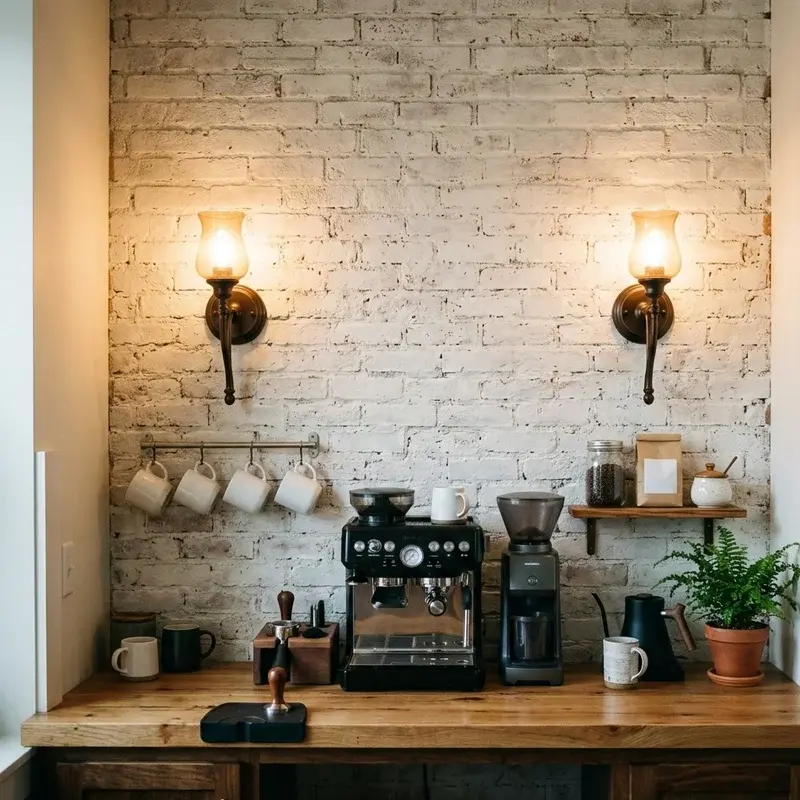
A homeowner named Marisol mounted two small brass sconces on either side of her coffee nook's backsplash, an idea she borrowed, half jokingly, from a bathroom vanity mirror setup. "I wanted the same kind of flattering light you get getting ready in the morning," she said, "just pointed at my coffee instead of my face."
The symmetry of it is what makes her nook photograph so well, two matching warm points of light framing the space evenly, without a single shadow cast awkwardly from one side. It's a detail borrowed from a completely different room, and it works better in the kitchen than most people would expect.
- Mount sconces at a height roughly level with where an average adult's eyes fall while standing at the counter, too high and the effect is lost.
- Space them evenly on either side of the station's focal point, whether that's the machine, a piece of art, or open shelving.
- Choose a warm bulb and, where possible, a shaded or frosted fixture rather than an exposed bulb, to keep the light soft rather than glaring.
- Creates soft, even, flattering light with none of the harsh shadows overhead lighting can cast
- Adds a symmetrical, considered focal point to the wall itself
- Works as both a light source and a piece of hardware detail on its own
Search terms: "brass wall sconce kitchen," "plug in wall sconce with cord cover," "swing arm wall light"
A Picture Light Above Open Shelving

A reader named Callum mounted a small brass picture light, the kind meant to illuminate a framed painting, above his open coffee shelving instead of over an actual piece of art. "It felt a little silly ordering it for mugs and a bag of beans," he admitted, "but it made the shelf look like something worth looking at, not just storage."
The narrow, directional beam a picture light throws is different from almost anything else on this list, it doesn't wash the whole wall evenly, it draws a single confident line of light down across exactly what's displayed. Callum's open shelf of mismatched mugs looks, under that light, like it was arranged on purpose. Which, eventually, it was.
- Choose a picture light sized to the width of your shelf, an oversized fixture will overwhelm a small display.
- Mount it slightly forward of the shelf's edge, angled down, so the beam actually lands on the objects rather than the wall behind them.
- Style the shelf with a little more intention once the light is in, sparse and considered reads far better under a directional beam than a crowded shelf does.
- Elevates an everyday open shelf into something that reads as deliberately curated
- Throws a confident, directional beam unlike any other light source on this list
- A small, self-contained fixture that rarely requires major electrical work
Search terms: "brass picture light shelf," "battery operated picture light," "LED display shelf light"
Backlit Glass-Front Cabinets

A designer I consulted described a coffee nook where she'd fitted a small glass-front cabinet with an interior LED strip, so the mugs and glassware inside seemed to glow faintly from within even with the kitchen lights off. "It's a party trick, honestly," she laughed, "but it's also just genuinely lovely to walk past at eleven at night for a glass of water."
What makes this idea different from the others on this list is that it doesn't light the counter at all, it lights the objects themselves, turning ordinary glassware into something that looks lit from the inside, almost jewel-like against the dark wood around it.
- Choose a slim LED strip specifically rated for enclosed cabinet use, mounted along the interior top edge, angled slightly downward.
- Keep the glass itself relatively clear rather than heavily frosted or textured, a busier glass pattern can scatter and dull the effect.
- Wire it to a separate switch or smart plug, this is a light meant to be used selectively, not left running all day.
- Turns everyday glassware and mugs into a genuinely striking nighttime display
- Adds a light source that has nothing to do with actually preparing coffee, purely mood
- A contained, self-installed project that doesn't require major electrical work
Search terms: "cabinet interior LED strip," "glass front cabinet lighting," "display cabinet LED kit"
A Vintage Task Lamp Left Out on the Counter
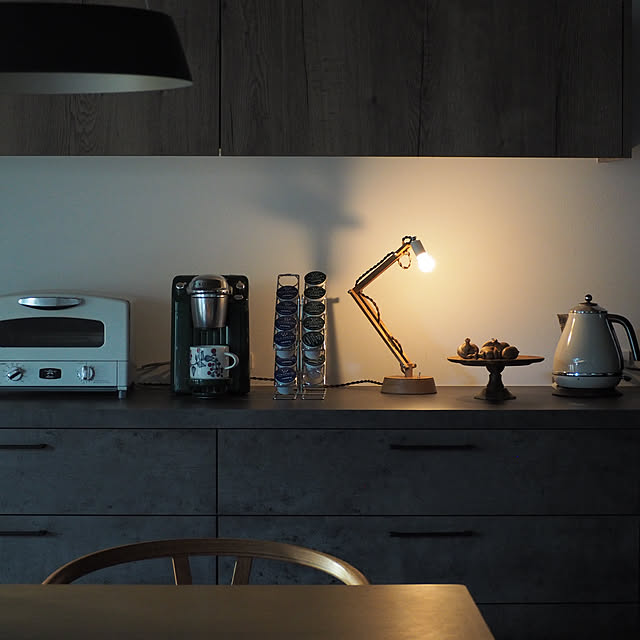
A reader named Petronella never installed any dedicated lighting in her coffee nook at all. Instead, she found a small vintage brass task lamp at an estate sale, the kind with an articulated arm meant for a desk, and simply left it plugged in on the counter beside her kettle. "It felt like cheating at first," she said, "like everyone else was hardwiring things and I just bought a lamp."
But there's something genuinely charming about a lamp that isn't built in, something that could be picked up and moved, that looks chosen rather than installed. It gives her nook a slightly domestic, lived-in feeling that a recessed or hardwired fixture, however beautiful, can't quite replicate on its own.
- Choose a lamp with an articulated or adjustable arm specifically, this lets you angle the light exactly where you need it, unlike a fixed fixture.
- Place it toward the back corner of the counter, out of the direct path of daily tasks, so the cord and base don't get in the way.
- Pick a warm bulb and a shade or diffuser that softens the light, an exposed bulb on a task lamp can run a little harsh up close.
- Requires no electrical work at all, just an outlet that's likely already there
- Adds a collected, personal touch that a built-in fixture can't replicate
- Can be moved, adjusted, or swapped out entirely whenever the mood changes
Search terms: "vintage brass task lamp," "articulated desk lamp," "small counter lamp kitchen"
Hidden Strips Under a Floating Shelf

A reader named Soren built a single floating shelf above his coffee station with an LED strip recessed into a groove along its underside, hidden from view no matter where you stand in the kitchen. "You can't actually see where the light is coming from," he said, "which somehow makes people notice it more, not less."
It's a quieter effect than a pendant or a sconce, no visible fixture, no hardware to coordinate with anything else, just a warm band of light seeming to float beneath the wood. Soren said more than one guest has asked how it works before they've asked about anything else in the room.
- Route a shallow groove along the underside of the shelf, close to the front edge, before it's mounted, this fully conceals the strip once installed.
- Choose a warm, dimmable LED strip and run the wiring back through the wall or down a rear support bracket to keep it invisible.
- Test the brightness before finalizing the groove depth, a strip set too deep can dim the effect more than expected.
- Provides genuine, useful light with absolutely no visible fixture to coordinate
- Creates a quiet, almost floating effect that guests consistently notice first
- Keeps the wall itself clean and uncluttered, letting other details lead
Search terms: "recessed LED shelf groove," "floating shelf hidden light strip," "warm dimmable LED tape"
Lighting Guide by Mood
| What you want it to feel like | Try this |
|---|---|
| Cozy and contained | A single low-hung pendant |
| Gentle, early-morning glow | Warm dimmable under-cabinet strip |
| Symmetrical and calm | Wall sconces flanking the station |
| Curated, gallery-like | A picture light over open shelving |
| A little unexpected | Backlit glass-front cabinets |
| No electrical work at all | A vintage task lamp on the counter |
| Invisible source, clean wall | Hidden strips under a floating shelf |
Ours ended up a low pendant on a dimmer and a warm under-cabinet strip for the mornings I can't quite face full brightness yet.
Mistakes I Made Lighting Ours
- Sharing one switch with the rest of the kitchen for two years: the nook never got its own mood until it got its own control.
- Choosing a cool white bulb because it seemed "brighter, therefore better": it made six in the morning feel like an operating room.
- Never asking about a dimmer at all: I assumed on and off were the only two settings until an electrician mentioned otherwise.
- Overlooking a plug-in lamp as a real option: I spent months planning wiring for a fixture a secondhand lamp could have solved in an afternoon.
Common Questions
Which of these lighting ideas is easiest to try without an electrician? A vintage task lamp or a plug-in under-cabinet LED strip are both genuinely no-wiring-required options that make a real visual difference.
What color temperature should I actually look for in warm lighting? Somewhere between 2200K and 2700K reads as warm and cozy, anything above 3000K starts to feel closer to daylight than candlelight.
Do I need my coffee nook lighting on the same switch as the rest of my kitchen? Not at all, and in most of the nooks featured here, a separate switch or dimmer was exactly what let the space develop its own distinct mood.
Can I combine more than one of these ideas in a single small nook? Yes, and most well-lit nooks actually layer two or three, a task light for function, paired with something softer and more ambient for mood.
I still think about that electrician's offhand question more than I probably should, why I was lighting a five-foot corner exactly like a twenty-foot kitchen, as though the two spaces asked for the same thing simply because they shared a ceiling. They don't. One is where you cook. The other is where you stand still, half awake, waiting for something warm.
If your coffee nook still feels a little flat even after everything else is finished, look at what's lighting it before you look at anything else. In nearly every nook I've featured here, the light was doing more of the emotional work than any single material choice.
Shop the Story
- small kitchen pendant light
- warm dimmable LED strip
- brass wall sconce
- battery operated picture light
- cabinet interior LED kit
- vintage brass task lamp
- recessed LED shelf groove kit
- plug in sconce with cord cover
- dimmer switch kit
- warm white LED bulb 2700K