
Curved and Arched Coffee Nook Ideas Beyond the Standard Rectangle Cabinet
Real softened lines, not another 90-degree corner pretending to be a design choice
Every line in my kitchen was a right angle. Rectangle cabinets, a rectangle counter, a rectangle backsplash tile grid behind it all, the kind of layout that's efficient to build and easy to price out, which is exactly why almost every kitchen defaults to it. My coffee corner followed the same logic, boxy and correct and, honestly, a little cold, all edges and no softness anywhere I actually rested my eyes.
What changed things wasn't ripping anything out. It was introducing a single curve, an arched niche built into an existing rectangular wall, in just that one zone. A curve reads as deliberate specifically because it costs more effort than a straight line, nobody accidentally builds an arch, so even one small curved detail signals real intention in a way that's hard to fake with a straight edge.
A quick note before we start: a few of the experiences ahead were shared with me directly by people who've added curves to their own coffee corners, and a few are offered as illustrative examples to make a principle easier to picture, I've tried to keep that distinction clear throughout.
Here are seven curved and arched directions for a coffee nook specifically, ranging from a simple mirror swap to a built-in niche.
Table of Contents
- A Built-In Arched Niche
- A Curved Bullnose Counter Edge
- An Arched Mirror or Window
- Curved-Front Cabinet Doors
- A Rounded Peninsula Edge
- An Arched Tile Backsplash Niche
- A Curved Banquette Nook
- Curved Design vs. Standard Rectangle Cabinetry: How These Differ
- A Placement Guide for Where Curves Work Best
- Common Curved-Design Mistakes
- The Full Cost Comparison
- Common Questions
A Built-In Arched Niche

A reader told me that recessing a shallow arched niche directly into the wall behind her coffee station, sized just for her most-used mugs and a small plant, turned an ordinary flat wall into what now reads as the architectural focal point of the whole kitchen, all from a space that used to just be blank drywall.
- Confirm the wall isn't load-bearing and check for plumbing or electrical runs inside it before any cutting begins, this is a step for a contractor to verify, not a DIY guess.
- Use a flexible drywall product or thin bendable plywood ribs to form the curved arch profile, standard rigid drywall won't curve on its own.
- Keep the niche shallow, just deep enough for what you plan to display, a deep niche requires more structural planning and cost.
- Paint the interior a contrasting tone from the surrounding wall to emphasize the shape, this is what makes the arch read clearly rather than blending in.
- Genuine architectural detail, not a surface-level decoration
- Creates a real focal point using otherwise unused wall depth
- Permanent and structural, reads as a considered renovation
Search terms: "arched wall niche kitchen," "flexible curved drywall," "recessed display niche"
A Curved Bullnose Counter Edge
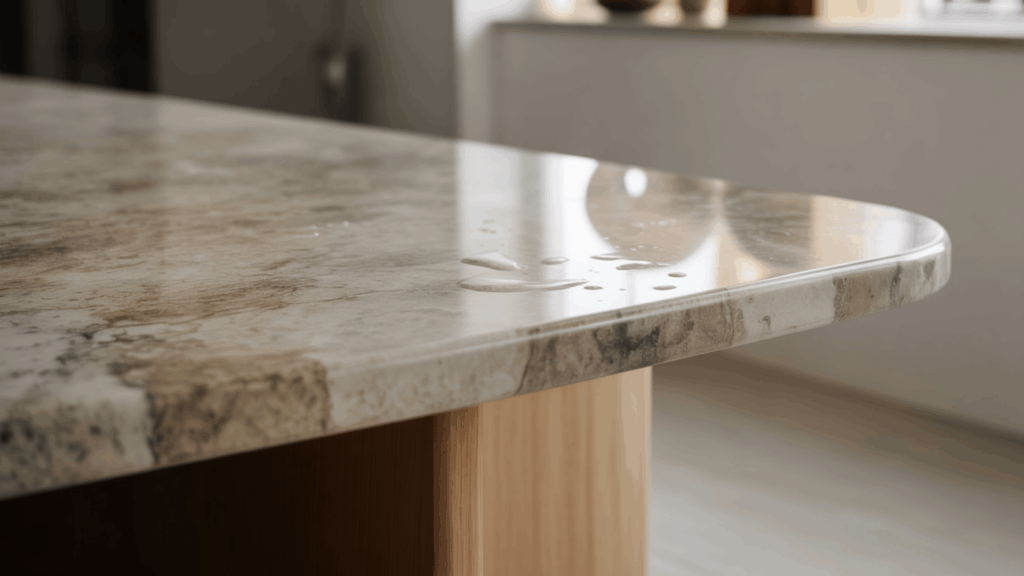
A homeowner shared that swapping her coffee station counter's sharp square edge for a full bullnose profile, a rounded edge that curves the stone's entire thickness into a smooth half-circle, was such a small change on paper that she almost skipped it, and became the detail her hand notices every single time she rests it on the counter.
- Request a physical edge profile sample from your fabricator, photos alone can make a bullnose and a smaller eased edge look nearly identical.
- Confirm this edge treatment is possible on your specific counter material, most stone and solid surface materials can be shaped this way, though it typically adds fabrication cost and time.
- Consider limiting the bullnose edge to just the coffee station section if you're not replacing your whole counter, a clean seam transition to a square edge elsewhere is a normal fabrication detail.
- Ask your fabricator about polishing the curved edge to match your counter's existing surface finish, matte or glossy, so it reads as one continuous piece.
- A genuinely tactile detail, felt as much as seen
- Softens the hardest line in most kitchens, the counter edge
- Can be applied to just one section rather than the whole counter
Search terms: "bullnose countertop edge," "rounded stone counter edge," "curved edge profile fabrication"
An Arched Mirror or Window

Imagine a reader whose coffee nook had a plain rectangular mirror above the counter for years, and who found that swapping it for a genuinely arched version, same size, same placement, was one of the lowest-effort changes on this entire list while still completely shifting the character of the wall.
- Measure your existing rectangular mirror or window opening, most arched mirrors are sold in comparable width and height ranges to standard rectangular ones.
- Choose a full arch, rounded top with straight sides, or a half-round shape depending on how dramatic a curve you want, the two read quite differently.
- Confirm mounting hardware compatibility, an arched mirror's weight distribution differs slightly from a rectangular one, and some require specific curved-frame mounting brackets.
- If replacing an actual window rather than a mirror, this is a structural change requiring a contractor, unlike a simple mirror swap.
- One of the lowest-effort ways to add a genuine curve
- A direct swap in most cases, no construction required
- Softens the wall above the counter, a typically very rectangular zone
Search terms: "arched wall mirror," "half round mirror kitchen," "curved frame mirror"
Curved-Front Cabinet Doors

A reader told me she chose a single curved cabinet door for the end of her coffee station's cabinet run specifically, where it faces into the room, rather than curving every door, and the one rounded corner is what breaks up what would otherwise be a straight, boxy row of flat fronts.
- Ask your cabinet supplier specifically how the curved front is constructed, thermofoil-wrapped, veneered, or laminated, since this affects both cost and durability.
- Position the curved door at a visible end panel or corner, where it faces into the room, this is where a single curved piece reads most clearly.
- Confirm curved cabinet fronts are available in your chosen door style and finish before finalizing the rest of your cabinetry order, not every line offers this option.
- Pair with straight-fronted doors elsewhere in the run rather than curving every door, one curved element reads as intentional, an entire curved run is a much larger commitment.
- Genuine dimensional curve, not a painted illusion of one
- A single door is enough to soften an entire cabinet run
- Available across a range of finishes and price points
Search terms: "curved cabinet end panel," "bullnose corner cabinet door," "rounded cabinet front"
A Rounded Peninsula Edge

A homeowner shared that rounding off the corner of her coffee station's small peninsula, where it juts into the walking path, solved a practical problem, she'd bumped that sharp corner more times than she could count, while also becoming the softest, most photographed line in her whole kitchen.
- Identify which corner of your peninsula or island actually protrudes into a walking path, this is usually the one worth rounding first if you're not curving the whole counter.
- Choose a rounded radius proportional to your counter's overall size, a very small radius on a large counter can look like an afterthought rather than an intentional curve.
- Confirm the base cabinetry beneath the counter can also accommodate the new shape, or budget for a matching cabinet modification.
- Have this done by an experienced fabricator, reshaping an existing counter is more involved than ordering a new curved edge on a fresh installation.
- Genuinely functional, softens a real bump-into-it hazard
- Can often modify an existing counter rather than requiring full replacement
- Reads as considered rather than simply practical
Search terms: "rounded peninsula corner counter," "curved island edge fabrication," "counter corner reshaping"
An Arched Tile Backsplash Niche
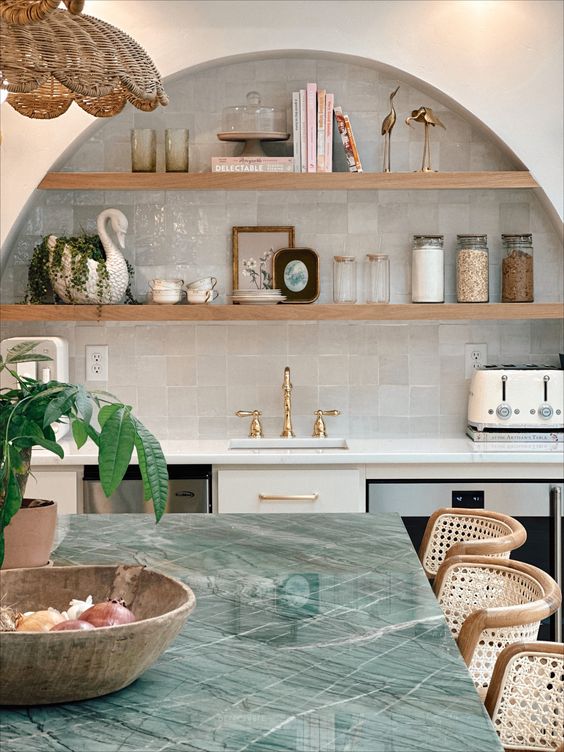
A reader told me she tiled a simple arched shape directly onto her flat backsplash wall, a contrasting terracotta arch set within her existing cream tile field, rather than building an actual recessed niche, achieving a similar curved focal point at a fraction of the cost and construction involved.
- Plan the arch shape and size on paper or with painter's tape directly on the wall first, to confirm proportions before any tile is cut.
- Choose a tile installer experienced in curved cuts, an arch requires precise curved tile cutting that a standard square backsplash installation doesn't.
- Select a contrasting tile color or texture for the arch itself so it reads clearly against the surrounding field.
- Keep the surrounding field tile simple, letting the arch shape be the clear focal point rather than competing with a busy pattern elsewhere.
- Achieves a curved focal point without any wall construction
- Considerably lower cost than a true built-in niche
- Works within an existing flat backsplash wall
Search terms: "arch shape tile backsplash," "curved tile cutting kitchen," "contrast tile arch design"
A Curved Banquette Nook

A homeowner shared that building a curved banquette bench into her coffee corner, rather than the standard straight bench most built-in seating defaults to, meant the seat itself gently wraps around anyone sitting there, and turned what used to be a stand-and-go coffee station into a spot people actually linger in.
- Work with a carpenter or millworker experienced in curved furniture construction specifically, this is a more specialized skill than standard straight built-in carpentry.
- Plan the curve's radius based on your actual available floor space and how many people you want the bench to comfortably seat.
- Choose upholstery or cushions cut and sewn specifically to the curved shape, standard rectangular cushions won't fit a curved bench properly.
- Confirm the curved bench's structural support underneath, curved forms distribute weight differently than a straight bench and need appropriately planned support.
- Genuine furniture-level craftsmanship, not a surface treatment
- Physically inviting, the curve wraps around whoever sits there
- Transforms a stand-and-go station into a real gathering spot
Search terms: "curved banquette bench," "custom curved built-in seating," "curved cushion upholstery"
Curved Design vs. Standard Rectangle Cabinetry: How These Differ
Standard rectangle cabinetry is manufactured for efficiency, straight cuts, square joints, and modular panels that are cheap and fast to produce at scale, which is exactly why it became the default. Curved and arched elements require genuinely different fabrication methods, flexible drywall or curved forms for an arch, wrapped or laminated substrates for a curved door front, specialized routing for a bullnose edge, techniques that take more time, more material waste, and more skilled labor than a straight cut. That added effort is precisely what makes a curve register as intentional the moment someone sees it, nobody arrives at a rounded corner by accident. The trade-off is real, curves generally cost more and take longer than their straight equivalents, which is why most of the strongest results here use a curve as a single, well-placed accent, a niche, a mirror, one cabinet end, rather than converting an entire kitchen to curved lines throughout.
A Placement Guide for Where Curves Work Best
- Arched niches and tiled arches: work best on a flat wall directly behind or above the coffee station, where they read as a clear focal point.
- Bullnose counter edges and rounded peninsula corners: most valuable at edges people actually touch or walk past, prioritize function alongside the visual softening.
- Arched mirrors: suit the same placement as a standard rectangular mirror, a simple swap rather than a new architectural feature.
- Curved cabinet fronts: read most clearly at a visible end panel or corner facing into the room, not buried mid-run.
- Curved banquettes: need enough floor space for the curve's radius to feel intentional rather than cramped, measure carefully before committing.
Common Curved-Design Mistakes
- Curving everything at once: one well-placed curve reads as intentional, converting every line in a kitchen to curved at once is a much larger, costlier undertaking with diminishing visual impact.
- Assuming a curve is always a simple swap: mirrors and rounded edges are often direct replacements, but niches, curved cabinetry, and banquettes involve real construction, know which category your idea falls into before budgeting.
- Skipping the structural check on load-bearing or utility-filled walls: always confirm with a contractor before opening any wall for a niche.
- Choosing too small a radius: a very shallow, subtle curve on a large surface can read as an error rather than an intentional design choice, proportion matters.
The Full Cost Comparison
| Idea | Typical Cost |
|---|---|
| Built-in arched niche | $300–900 |
| Curved bullnose counter edge | $80–250 |
| Arched mirror or window | $50–180 |
| Curved-front cabinet doors | $120–350 |
| Rounded peninsula edge | $150–400 |
| Arched tile backsplash niche | $90–260 |
| Curved banquette nook | $400–1,200 |
Common Questions
Which idea is the easiest starting point? An arched mirror (Idea 3), it's typically a direct swap for an existing rectangular mirror with no construction involved.
Is curved design always more expensive than straight rectangle cabinetry? Generally yes, curved fabrication requires more specialized labor and material, budgeting for a moderate premium over an equivalent straight feature is realistic.
Can I add just one curved detail rather than redesigning the whole kitchen? Yes, and this is how most of the strongest results happen, a single arch, edge, or mirror is enough to soften an otherwise rectangular space.
Do curved elements require a different type of contractor than standard cabinetry work? Some do, curved niches, banquettes, and cabinet fronts benefit from a contractor or fabricator with specific experience in curved construction, worth asking directly about their experience with curved work before hiring.
The rectangle was never actually required just because it's the easiest shape to build at scale. Every idea here proves the same point: one genuine curve, placed with intention, does more to soften a coffee corner than any amount of straight-lined cabinetry ever will.
Start with the lowest-effort version this weekend, an arched mirror swap, and let it tell you whether the rest of the corner is ready for something more structural.
Shop the Story
- arched wall mirror
- arch shape tile backsplash
- curved cabinet end panel
- bullnose countertop edge
- flexible curved drywall
- curved banquette cushion
- rounded corner counter fabrication
- half round mirror kitchen
- contrast tile arch design
- custom curved built-in seating