
Built-In Coffee Nooks for Entertaining Guests
I used to apologize for my coffee corner every time someone visited, now it's the one spot in the house I don't mind people crowding into
For years, whenever we had people over, I'd catch myself steering guests away from the coffee nook and toward the living room instead, half embarrassed by the clutter of mismatched mugs and the one machine doing far too much work for a full table of people. It felt like a private, slightly chaotic corner, not something meant to be seen.
Then, at a friend's housewarming, I watched something shift. Her coffee nook wasn't tucked away at all, it was where everyone naturally gathered, drinks in hand, long after dinner had technically ended. Nobody had directed them there. They just drifted toward it, the way people always seem to end up in a kitchen no matter how many other rooms are available.
That night changed how I thought about our own nook entirely. I stopped designing it as a private morning ritual and started asking what would make it genuinely welcoming to a room full of people. The answers, from my own house and from readers who'd done the same, surprised me more than once.
Table of Contents
- A Self-Serve Mug Wall Guests Can Choose From
- A Small Bench That Invites People to Linger
- A Chalkboard Menu for Drink Options
- A Syrup and Garnish Tray, Styled Like a Bar Cart
- Doubling the Station for a Crowd
- A Fold-Away Front That Opens Only for Company
- A Backdrop Built for Photos
- Hosting Guide by Group Size
- Mistakes I Made Entertaining Around Ours
- Common Questions
A Self-Serve Mug Wall Guests Can Choose From

A reader named Amara mounted a small peg rail of mismatched mugs above her coffee station, deliberately collected over years rather than bought as a matching set, and told me the moment she noticed it working was watching a guest actually pause and choose one, turning it over, reading the little chip on the handle before deciding. "I used to hide the mismatched ones," she said. "Now that's the whole point."
What she'd stumbled onto is something small but real, people relax a little when they're given a choice instead of handed a decision. A mug wall turns a two-second act into a small, easy moment of participation, and more than one guest has told her it's the first thing they gravitate toward at a party.
- Mount a simple peg rail or row of hooks at a height guests can comfortably reach without asking for help.
- Lean into variety rather than matching sets, a collected, mismatched wall reads as far more inviting and personal than a uniform display.
- Keep a small stack of saucers or coasters nearby, this turns the moment of choosing a mug into a small, complete ritual rather than a half-finished one.
- Gives guests a small, easy way to participate rather than simply being served
- Turns a collection of mismatched mugs into a genuine styling feature
- Costs very little beyond a rail or set of hooks already suited to most kitchens
Search terms: "wall mounted mug rail," "coffee mug peg hooks," "open mug display shelf"
A Small Bench That Invites People to Linger

A homeowner named Desmond built a narrow bench along the wall opposite his coffee station, barely two feet deep, just enough for someone to perch with a cup while the rest of the party carried on elsewhere. "I didn't think anyone would actually use it," he admitted. "It's become the spot where the real conversations happen, honestly, more than the dining table does."
There's something to the idea that people linger where they're given somewhere to sit, even briefly, even on a narrow bench built more as an afterthought than a centerpiece. Desmond said guests will often end up there in pairs, cup in hand, long after the rest of the room has moved on to something else.
- Look for even a narrow, underused stretch of wall near the station, a bench doesn't need much depth to genuinely invite someone to sit.
- Add a single cushion or a folded throw rather than a full upholstered seat, this keeps the commitment and cost low while still softening the spot.
- Keep a small side table or ledge within reach for setting down a cup, this is what actually makes lingering comfortable rather than awkward.
- Turns a quick pour-and-go station into a genuine spot for lingering conversation
- Requires very little floor space compared to a full seating area
- Can be added to almost any existing nook without major renovation
Search terms: "narrow wall bench kitchen," "fold down wall bench," "small kitchen seating nook"
A Chalkboard Menu for Drink Options

A reader named Priya hung a small chalkboard beside her station listing three or four drink options in her own handwriting, updated depending on what she'd stocked that week. "It started because I was tired of explaining the syrup options to every single guest individually," she laughed. "Now people just read it and decide, and I get to actually talk to them instead of narrating a menu all night."
What she noticed afterward surprised her, guests lingered at the board a little, reading the options, sometimes asking questions about a specific one, in a way that felt more like a conversation starter than a chore she'd offloaded. It gave the nook a small sense of occasion, like it had been set up specifically for that gathering.
- Keep the list short, three to four options at most, a crowded chalkboard is harder to read quickly than a simple one.
- Update it for the specific occasion rather than leaving a generic, permanent list, this is what gives it a sense of being made for that gathering.
- Mount it at a height easily read while standing at the counter, not tucked low or high where it goes unnoticed.
- Frees the host to spend time with guests instead of repeating drink options aloud
- Gives the nook a small, occasion-specific sense of having been set up with care
- An inexpensive addition that can be updated for every gathering
Search terms: "small wall chalkboard," "framed kitchen chalkboard sign," "hanging menu chalkboard"
A Syrup and Garnish Tray, Styled Like a Bar Cart

A reader named Solveig arranges her syrups, cinnamon, and a small dish of orange peel on a round brass tray beside the machine whenever she's expecting company, the same way she'd set up a bar cart for drinks. "I realized I was already doing this for cocktails," she said, "and just never thought to do it for coffee. It's the same instinct, really, just a different drink."
The tray does something simple but effective, it contains what would otherwise be a cluttered row of bottles into one deliberate, self-contained object. Guests reach for what they want from the tray itself rather than rifling through a cabinet, and it disappears back into storage the moment the gathering ends.
- Choose a tray with a slight lip or rim, this keeps smaller bottles and dishes from sliding around when guests reach for something.
- Limit it to a handful of options, three or four syrups and a couple of garnishes, more than that starts to look cluttered rather than curated.
- Bring the tray out specifically for gatherings rather than leaving it permanently on the counter, this keeps it feeling special rather than routine.
- Contains clutter into one deliberate, attractive object instead of scattered bottles
- Makes it easy for guests to serve themselves without hunting through cabinets
- Appears and disappears for gatherings, keeping the everyday counter uncluttered
Search terms: "round brass serving tray," "coffee condiment tray," "small bar cart tray"
Doubling the Station for a Crowd
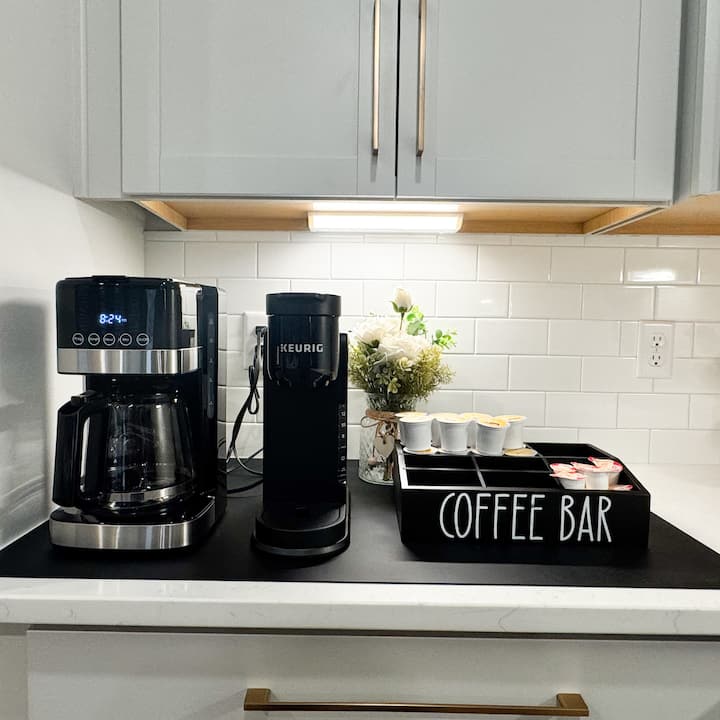
A homeowner named Faustina added a second, smaller kettle and a backup carafe specifically for gatherings, kept tucked away the rest of the year and brought out only when hosting a larger group. "I used to just apologize for the wait," she said, "everyone standing around one kettle for eight people. Now nobody's really waiting on anything."
She was careful to point out this isn't about doubling the whole station, the machine, the grinder, all of it, that would be excessive for a home kitchen. It's about identifying the one or two genuine bottlenecks, usually hot water and a place to set a filled cup, and solving specifically for those when a crowd is coming.
- Notice which specific step causes the most waiting during a typical gathering, for most people it's either hot water or a place to set a filled cup down.
- Keep a simple backup solution, a second kettle or a folding side table, stored away and brought out specifically for larger gatherings.
- Set up the backup slightly apart from the main station rather than crowding both into the same small footprint, this actually reduces the bottleneck rather than doubling it.
- Solves the actual bottleneck guests experience rather than overhauling the whole station
- Keeps the everyday footprint small while still being ready for a crowd occasionally
- A realistic, low-cost fix compared to a full secondary coffee bar build-out
Search terms: "backup electric kettle," "folding side table small kitchen," "extra carafe coffee station"
A Fold-Away Front That Opens Only for Company

A reader named Thaddeus installed a set of simple bifold doors across his coffee nook, ordinarily kept shut to hide the everyday clutter of daily use, and opened wide only when guests were expected. "It's a bit theatrical," he admitted, "opening the doors right before people arrive. But it makes the nook feel like a reveal, not just something that was always sitting there."
What he described is a small piece of stagecraft that costs very little once the doors themselves are installed, a threshold moment, opening the space specifically for the occasion, that makes even a modest nook feel like it was prepared just for that gathering.
- Choose simple bifold or sliding doors that fold flat against the wall when open, this keeps them from becoming an obstacle during a gathering.
- Keep the interior slightly more composed than your everyday standard, since it will be seen at its best, most curated moment.
- Treat opening the doors as a small, deliberate part of preparing for guests, not an afterthought done in a rush right as the doorbell rings.
- Turns opening the nook into a small, deliberate moment of hosting
- Keeps everyday clutter hidden without requiring the space to be perfectly tidy at all times
- Makes even a modest nook feel like it was prepared specifically for the occasion
Search terms: "bifold cabinet doors," "kitchen nook curtain rod," "sliding pocket door kitchen nook"
A Backdrop Built for Photos

A reader named Yolanda told me, half sheepishly, that she chose her coffee nook's tile specifically with photos in mind, imagining a friend leaning against the counter mid-conversation, drink in hand, and what that photo would actually look like afterward. "It sounds vain typed out," she said, "but it's really just about wanting the memory of the party to look as warm as the party actually felt."
Her nook has become, without her ever asking for it, the default spot where people end up photographed at her gatherings, drink in hand, leaning against the same stretch of counter. She thinks it's the warm tile and the low pendant light more than anything else, a background that flatters rather than competes with whoever's standing in front of it.
- Choose warm, matte finishes over anything glossy or reflective, a shiny surface tends to bounce back harsh flash photography in a way a matte one doesn't.
- Favor warm, low lighting near the station specifically, this flatters skin tones far better than a bright, cool overhead light.
- Keep the immediate background simple and uncluttered, a single interesting detail, like a patterned tile or an open shelf, reads better in a photo than a busy, crowded counter.
- Becomes part of how a gathering is actually remembered afterward, not just where drinks were made
- Rewards choices already worth making anyway, warm tile, soft lighting, an uncluttered wall
- Requires no separate investment beyond decisions you'd likely make for other reasons
Search terms: "warm matte tile backsplash," "flattering kitchen lighting," "coffee nook photo backdrop ideas"
Hosting Guide by Group Size
| Who's coming over | Try this |
|---|---|
| Just one or two friends | The mug wall and a chalkboard with a couple of options |
| A small gathering, six or so | The syrup tray and a small bench for lingering |
| A larger party or open house | Doubling the station's actual bottleneck point |
| Guests you want to impress a little | The fold-away front, opened as they arrive |
| Any gathering worth remembering | A warm, uncluttered backdrop near the station |
Ours ended up the mug wall and the tray, mostly, plus a backup kettle we only bring out twice a year, and somehow that's been enough.
Mistakes I Made Entertaining Around Ours
- Hiding the mismatched mugs instead of displaying them: the collection guests actually responded to was the one I used to keep tucked away.
- Explaining drink options out loud to every single guest: a five-minute chalkboard would have saved me an entire evening of repeating myself.
- Assuming a bigger party meant a bigger overhaul: a second kettle solved more than any renovation would have.
- Never once thinking about how the nook photographed: it took a friend's tagged photo for me to notice the lighting was doing us no favors.
Common Questions
Which of these ideas makes the biggest difference for a small, casual gathering? The mug wall and a short chalkboard menu tend to do the most work for the least effort, both are about giving guests an easy way to participate.
Do I need to renovate my nook to make it more entertaining-friendly? Not usually, most of what actually changes the experience, a tray, a sign, a backup kettle, doesn't require any construction at all.
How do I keep the nook from looking cluttered when I'm hosting a lot of people? Containing extras onto a single tray, and bringing out backup items only for the gathering itself, keeps the everyday footprint from ever feeling crowded.
Is it worth designing a coffee nook around photos, or is that overthinking it? It's a small consideration, not a redesign, mostly a matter of favoring warm, matte, softly lit choices you'd likely want for other reasons anyway.
I think about that housewarming more than I probably should, the way everyone drifted toward my friend's coffee nook without ever being asked to, the way people always seem to end up in the one spot in a house that feels genuinely lived in. I'd spent years treating our own nook like something to apologize for. It turns out it just wanted to be let in on the party.
If you're bracing yourself to explain away your coffee corner the next time people visit, try letting it do a little more of the hosting instead. In nearly every nook I've featured here, that was the shift that mattered most, not a renovation, just permission.
Shop the Story
- wall mounted mug rail
- small kitchen bench seat
- framed kitchen chalkboard
- round brass serving tray
- backup electric kettle
- bifold cabinet doors
- coffee syrup bottles set
- folding side table
- tension curtain rod kitchen
- warm matte tile backsplash