
7 Mediterranean Arched Wall Ideas That Make a Plain Wall Feel Like a Seaside Villa
The old villas of Greece, Italy, and Spain never relied on fancy furniture. They relied on soft curves, rough walls, and warm light
Think of the homes that make you want to slow down: a whitewashed stairwell in a Greek island village, a stone alcove in an Italian farmhouse, a sunlit courtyard arch in southern Spain. What they share is not expensive decor. It is the way the walls themselves feel, thick, textured, curved, and warm.
The good news is that you do not need a villa to borrow that feeling. An arch, whether it is built into the wall, painted onto it, or simply repeated through a mirror or a shelf, gives even a modern flat wall the softness that Mediterranean style is known for.
Below are seven arched wall ideas, from simple weekend projects to real renovation work, with the measurements, materials, and safety points that most guides skip. Pick the one that suits your home and budget, and start there.
Table of Contents
- Recessed Arched Niches With Warm Light
- Textured Plaster or Limewash Walls
- A Painted Arch on a Flat Wall
- An Arched Mirror as the Wall's Centerpiece
- Handmade Tile Inside the Arch
- Aged Wood and Wrought Iron Accents
- Terracotta, Olive, and Herb Styling
- Which Idea Fits Your Home
- Mistakes to Avoid
- Common Questions
Recessed Arched Niches With Warm Light

In old stone and plaster houses, walls were thick enough to carve small arched alcoves right into them, holding a lamp, a ceramic jug, or a few books. Today the same effect is possible in a normal home by framing a shallow niche between wall studs.
Because a standard interior wall is usually built with 2x4 studs, the cavity is only about 3.5 inches deep. That is perfectly enough for a display niche holding small pots, candles, and decorative pieces, but not for deep shelving.
- Use a stud finder and check the wall on both sides. Never cut into a load-bearing wall, an exterior wall with insulation, or a wall containing pipes or wires without professional advice.
- Plan the niche width to fit between two studs. Studs are commonly spaced 16 inches on center, which leaves roughly 14.5 inches of open space between them.
- Make the arched top with a flexible curved drywall or a pre-formed arch kit, and finish the edges with plaster or joint compound for a soft, rounded look.
- Add a small warm LED strip or puck light inside. Have any new wiring done by a licensed electrician.
- Adds depth and shadow, which flat walls never have
- Creates a natural place for a small, glowing display
- Looks intentional and architectural, not decorated-on
Search terms: "arched wall niche shelf," "arch shaped floating shelf," "plug in LED puck light warm"
Textured Plaster or Limewash Walls

An arch looks good on any wall, but it looks like a villa when the wall around it has a hand-troweled, cloudy finish. Soft plaster textures, limewash, and Roman clay–style finishes give walls the slightly uneven look of old buildings, and they make an arch feel like it has been there for a century.
Stay with warm, sun-faded colors: chalky white, sand, warm cream, pale ochre, or a soft terracotta.
- Read the product instructions carefully. True limewash and lime plaster need the right base and primer, and painted drywall usually needs specific preparation.
- Test a sample board and look at it in morning, midday, and evening light. Limewash dries lighter than it looks wet.
- Apply thin coats in loose crisscross strokes, letting each coat dry fully. Roman clay and plaster finishes are applied with a trowel in thin layers.
- Wear gloves and eye protection. Lime-based products are alkaline and can irritate skin and eyes.
- Avoid using these finishes on splash areas like shower walls unless the product is specifically sealed and rated for wet use.
- Adds depth and warmth that flat paint cannot
- Makes even a small arch look old and considered
- Hides minor wall imperfections beautifully
Search terms: "limewash paint warm white," "Roman clay wall finish," "limewash brush wide"
A Painted Arch on a Flat Wall

If you cannot build an arch, you can paint one. A tall arch shape painted in a deeper shade than the wall around it works as a headboard backdrop, a frame around a console table, or a focal point behind a sofa. It is one of the simplest ways to make a plain wall look designed.
- Decide the arch width. The radius of the curved top is exactly half that width.
- Mark the center line, then measure down from your chosen top point by the radius to find the center of the curve.
- Tie a pencil to a string the length of the radius, pin the string at that center point, and swing the pencil to draw a perfect semicircle. Draw straight sides down from each end.
- Use painter's tape on the outside edge, press it firmly, and paint the edge with a thin coat of the wall color first to seal the tape line before applying the arch color.
- Remove the tape while the final coat is still slightly damp for the cleanest edge.
- Costs almost nothing and takes a weekend
- Fully reversible with a coat of the original paint
- Adds an architectural focal point to any flat wall
Search terms: "painter's tape delicate surface," "terracotta matte wall paint," "sample size paint"
An Arched Mirror as the Wall's Centerpiece

A tall arched mirror with a thin metal or wood frame brings in the curve of a Mediterranean arch and bounces light around the room. Placed opposite a window, it doubles the daylight and makes the wall feel larger and brighter.
- Check the weight of the mirror and choose anchors rated well above it. Screw into a stud where possible.
- For a floor-leaning mirror, secure it to the wall with a safety strap or bracket so it cannot tip, especially around children and pets.
- Place it where it reflects something worth seeing, such as a window, a plant, or a warm lamp, not a cluttered corner.
- Leave the bottom edge either close to the floor for a full-length look, or hang it at eye level with furniture below.
- Brings in natural light and makes small rooms feel larger
- Works as art without needing a gallery wall
- Easy to move and rehang, even in a rental
Search terms: "arched floor mirror metal frame," "arch wall mirror gold," "anti tip furniture strap"
Handmade Tile Inside the Arch

Mediterranean homes often use tile as the one bold moment in a quiet room. An arched alcove behind a stove, sink, or bathroom vanity, lined with handmade glazed tile, becomes the room's focal point. Zellige-style tiles have a glossy, slightly irregular surface that catches light differently across every piece.
- Order a few extra tiles, and mix them from several boxes while laying so the color variation spreads evenly.
- Use an installer experienced with handmade tile, since uneven thickness makes laying and grouting harder than with standard tile.
- Choose narrow grout lines in a color close to the tile, and seal grout and any porous tile as the manufacturer recommends.
- Use tiles rated for the location. Wet areas and cooking areas need appropriate waterproofing and heat-safe materials.
- Creates a focal point using a small area of material
- Adds color and shine that plaster walls alone do not have
- Durable and easy to clean in kitchens and baths
Search terms: "zellige tile handmade," "glazed ceramic tile handmade look," "peel and stick tile backsplash"
Aged Wood and Wrought Iron Accents
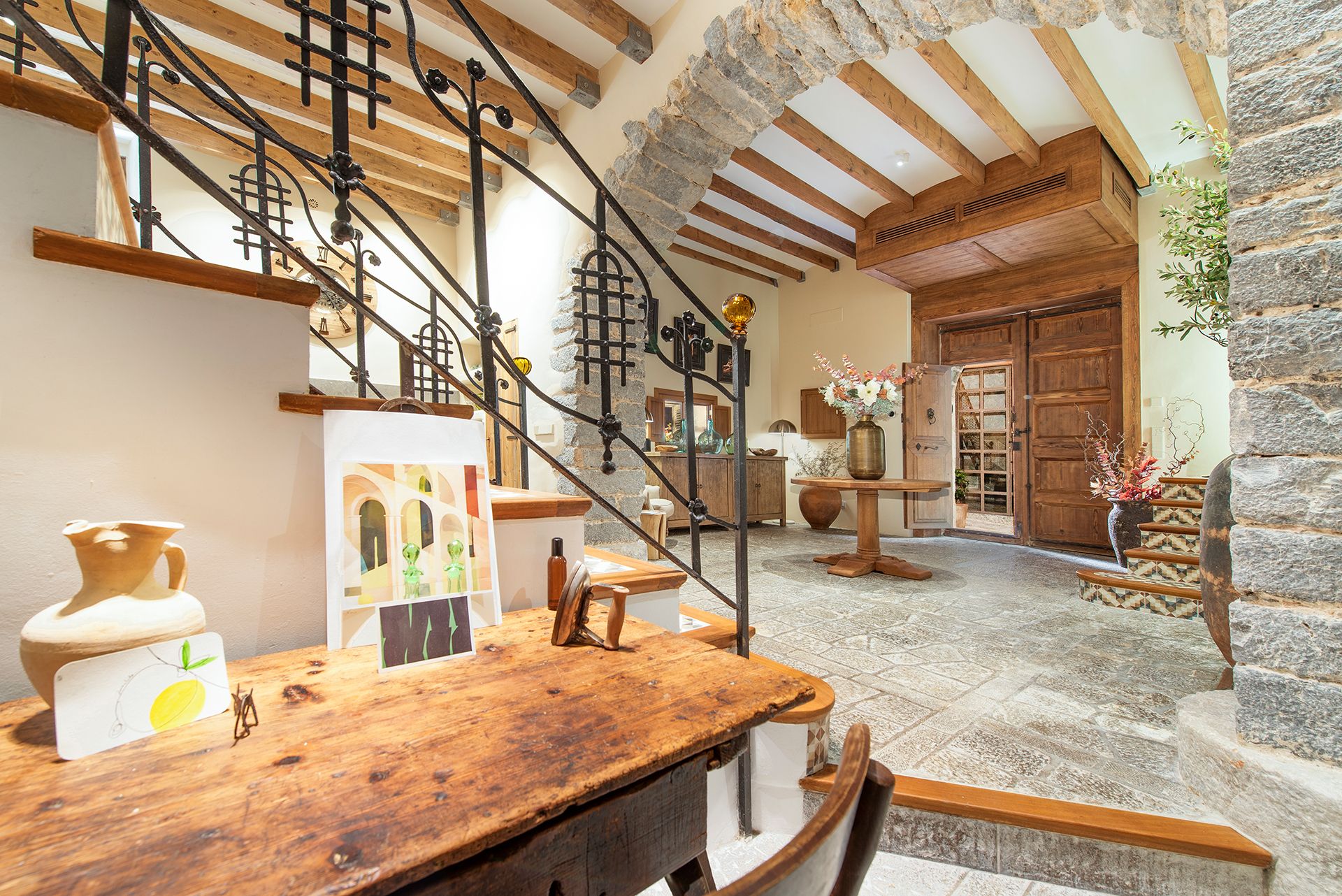
Thick wooden beams, weathered doors, and dark iron details give Mediterranean interiors their sense of age and strength. Near an arched wall, a rustic wood console, an iron wall hook rail, or a wrought iron candle sconce provides a strong contrast to soft plaster curves.
- Pick one wood piece as the anchor, such as a console table or bench under the arch.
- Add one or two iron accents, such as a candle sconce or a curtain rod, in a matching finish.
- Choose natural, slightly worn finishes over glossy new ones.
- Never leave open flames unattended, and keep candles away from curtains, dried plants, and other flammable materials. Battery candles are a safe alternative.
- Adds weight and contrast against soft walls
- Makes a new home feel like it has history
- Pieces are easy to find secondhand
Search terms: "rustic wood console table," "wrought iron wall sconce candle," "iron wall hook rail"
Terracotta, Olive, and Herb Styling
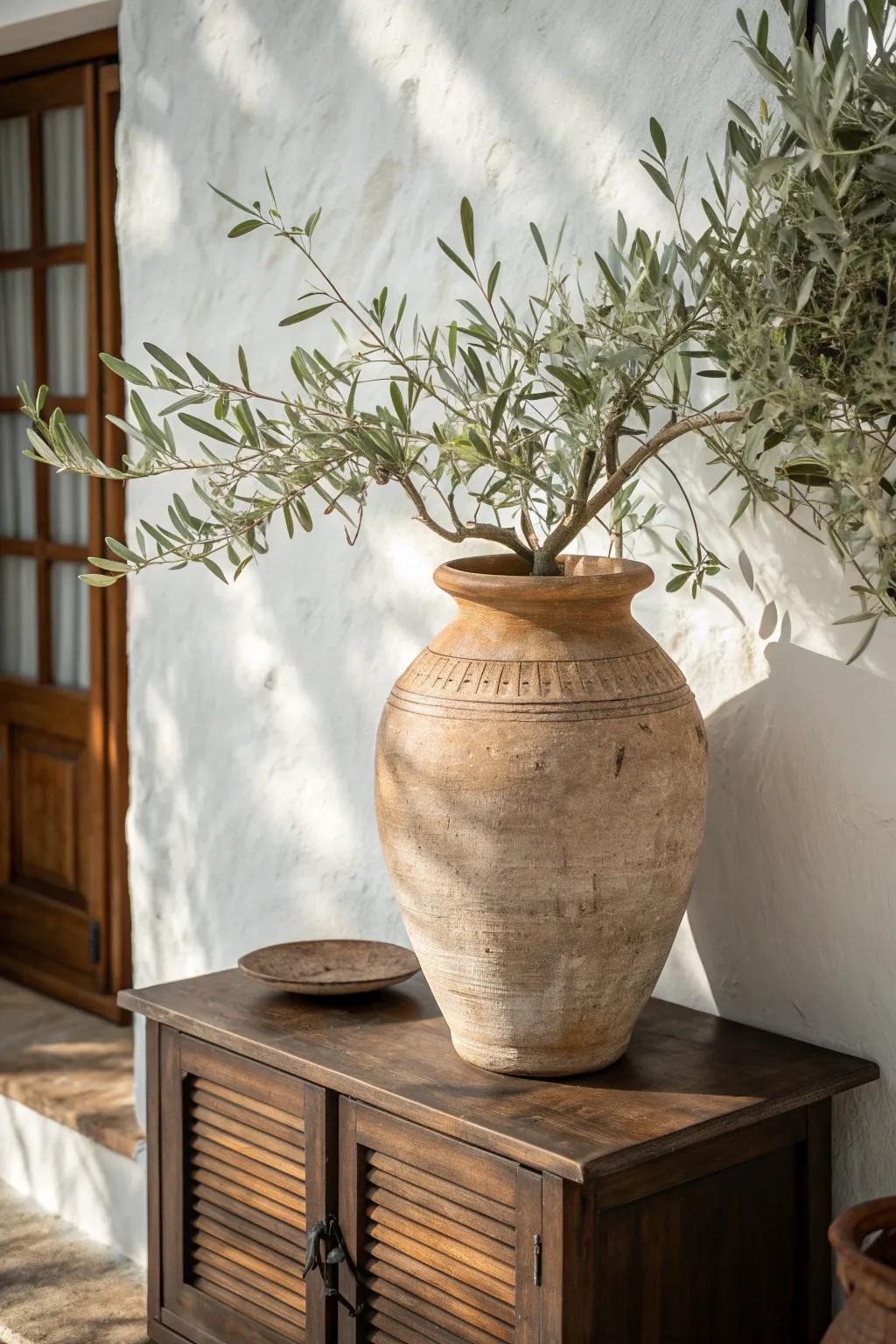
Terracotta pots, an olive branch in a jug, and a small pot of rosemary or basil on a shelf all pull the scent and color of a Mediterranean garden indoors. Placed in and around an arched niche or beside an arched wall, they finish the look without looking staged.
- Match the plant to the light. Olive trees and most herbs need bright light, ideally a sunny window. For dim spots, use dried stems or good-quality faux olive branches.
- Put a saucer or waterproof liner under every terracotta pot.
- If you have cats or dogs, check each plant against the ASPCA toxic and non-toxic plant lists before buying.
- Group items in odd numbers and vary heights, so the display looks collected rather than lined up.
- Adds life, scent, and natural color
- Inexpensive and easy to change with the seasons
- Works with every other idea in this article
Search terms: "terracotta pots with saucers," "faux olive branch stem," "ceramic jug vase rustic"
Which Idea Fits Your Home
| Your situation | Start with this |
|---|---|
| Renting, cannot change walls | Painted arch (with permission) or arched mirror |
| Flat, plain wall | Limewash finish and an arched mirror |
| Renovating a kitchen or bath | Handmade tile inside an arched alcove |
| Homeowner wanting real depth | Recessed arched niche, after checking the wall |
| Small budget | Terracotta pots, a jug of olive branches, and a painted arch |
Choose one main idea and let the rest be small supporting touches. Mediterranean style is calm, and it rewards restraint.
Mistakes to Avoid

- Cutting into a wall without checking it: wires, pipes, and structure can be hiding behind drywall.
- Drawing the arch by eye: use a string and pencil for a true, even curve.
- Hanging a heavy mirror on weak anchors: it can fall and cause serious injury.
- Expecting perfect uniformity from handmade tile: variation is part of its beauty.
- Using cool white lighting: it makes warm plaster look gray and flat. Choose warm bulbs around 2700K.
- Overloading the space: too many accents hide the arch you are trying to show off.
Common Questions
What makes an arch feel Mediterranean rather than just decorative? Texture and warmth. A softly curved shape on a smooth, cool-toned wall looks modern. The same shape on a warm, hand-finished wall, with natural materials nearby, looks Mediterranean.
What is the easiest way to add an arch to a rented home? A painted arch (with your landlord's permission), a large arched mirror, or an arch-shaped shelf. None of these requires structural changes.
What paint colors suit Mediterranean style? Warm white, sand, cream, pale ochre, terracotta, soft sage, and muted blue all work well together.
Do arched walls work in small rooms? Yes. Arches draw the eye upward and soften corners, which can make small rooms feel more open. Keep the finish light and the accessories few.
Can I build a real arch myself? Simple arch shapes can be built with curved drywall or pre-made arch kits, but anything involving structural walls should be planned with a qualified contractor.
The beauty of Mediterranean design is that it was never trying to impress anyone. It came from thick walls, local materials, and the simple wish to make shade and light feel good. An arch is one of the oldest ways to do that.
If your walls feel flat, start small. Paint one arch, hang one mirror, or add one warm light, and see how the room changes by evening. Often that is all it takes to make a house feel like a place you want to slow down in.
Shop the Story
- arched wall niche shelf
- limewash paint warm white
- arched floor mirror metal frame
- zellige tile handmade
- rustic wood console table
- wrought iron wall sconce candle
- terracotta pots with saucers
- faux olive branch stem
- warm white LED bulb 2700K
- anti tip furniture strap