
Curved Arch Built-In Shelving Ideas
An arch softens a wall, and shelves give it a job — together they turn storage into architecture, not just furniture pushed against the wall
Built-in shelving has always been the quiet workhorse of a home — useful, but rarely the thing anyone actually notices. An arch changes that. Put an arched opening around a run of shelves and suddenly the storage reads as an architectural feature, not as a bank of cubbies. The curve does the same work a doorway does: it tells your eye this is a boundary, a room within a room, a place with edges rather than a flat surface covered in objects.
I spent a while studying arched built-ins because I wanted to add one to a wall in our living room, and I kept running into the same problem: the arch either looked bolted on, or it looked like it had been there for a hundred years. There was very little in between, and almost everything came down to a small handful of decisions made before any shelf was mounted.
This is the collection of what actually works, from full-height arched openings to shallow niches and tambour-bent curved tops, along with the specific moves that make a curved arch built-in feel like part of the house rather than an addition to it.
Table of Contents
- Why the Arch Works Around Shelving
- A Full-Height Recessed Arch Niche
- A Shallow Arched Display Niche
- Tambour-Bent Shelves for a True Curve
- A Freestanding Arched Bookcase Wall
- An Arched Opening Framing a Reading Nook
- An Arched Niche Above a Fireplace or Console
- Paint the Reveal, Not Just the Wall
- Lighting the Shelves Inside the Arch
- What Almost Always Fails
- Common Questions
Why the Arch Works Around Shelving

An arch around a shelf run does two jobs at once. It softens the rectangular edges that shelves always produce, and it gives the storage a clear visual boundary that says "this is a designed thing, not a functional object." Rectangular shelves are the default, the shape a shelf takes when nobody has thought about it. An arched shelving unit is the shape a shelf takes when someone has.
A reader named Fionnuala installed one in her dining room and said the change was less about the shelves themselves and more about the whole wall. "It made the wall feel like a piece of furniture that was built into the house," she said. "Before, it was just shelves. Now it's a wall that has shelves in it, if that makes sense."
- The arch softens the hard rectangular grid that shelves naturally produce
- It gives the shelving a focal boundary, so it reads as a feature rather than as storage
- The curve draws the eye up, which makes the whole wall feel taller
- It works at almost any scale, from a small display niche to a full bookcase wall
A Full-Height Recessed Arch Niche

The most architectural version is a full-height recessed arch niche, the same move as a recessed doorway niche but used for shelves instead of passage. Because the niche is cut into the wall rather than applied to it, the shelves sit inside the wall itself, and the arch reads as the boundary of a room rather than the frame of a piece of furniture.
A reader named Cormac built one into a hallway wall and described the result as "the wall becoming the storage. There's no bookcase anymore. There's a wall that happens to have shelves inside it, and the arch is what makes that read as intentional."
- Confirm with a contractor whether the wall can be recessed, and how deep — 8 to 12 inches is a common target depth for a functional niche.
- Match the arch's radius to the surrounding room's other arched details, so the whole house feels connected.
- Choose adjustable shelves rather than fixed, so the storage can be reorganized as needs change.
- Line the reveal with the same finish as the shelves themselves, so the interior of the niche reads as one continuous material.
A Shallow Arched Display Niche
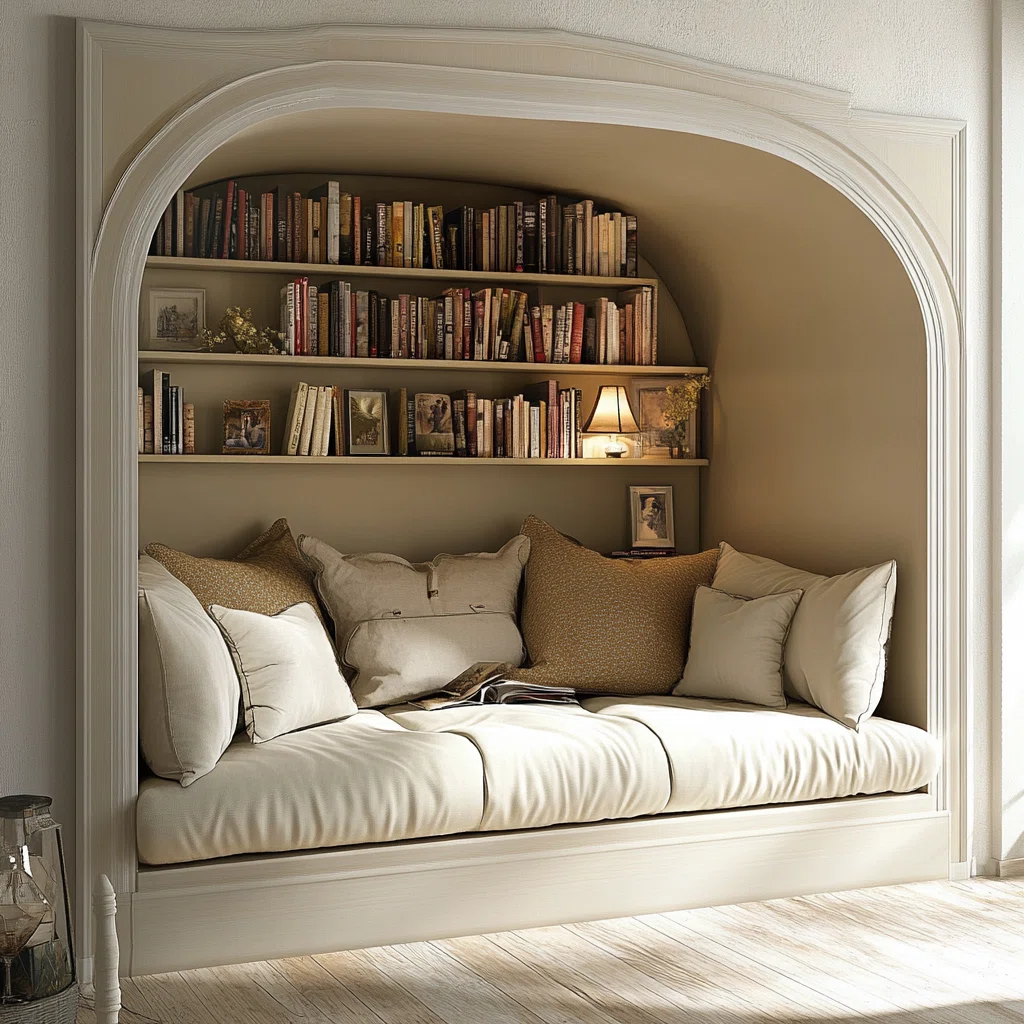
The shallower version — 2 to 4 inches deep — is more of a display feature than true storage, and its purpose is different. Because the niche is too shallow for most books or objects, it works as a small architectural moment, a place for one or two considered pieces rather than a working shelf. It's the version that most clearly echoes the design principle of a recessed lighting niche, applied to display.
A reader named Caoimhe added one above her entryway console and said it "made a blank wall feel designed. There's a small vase, a small sculpture, and a tiny light. From across the room it reads as a small architectural moment."
- Choose a depth of 2 to 4 inches — enough to feel architectural, shallow enough to keep the wall's structure intact.
- Include one adjustable shelf inside, so the display can change height as needed.
- Add a discreet light at the top of the niche — a puck light or a slim LED strip — so the objects read as lit from within.
Tambour-Bent Shelves for a True Curve
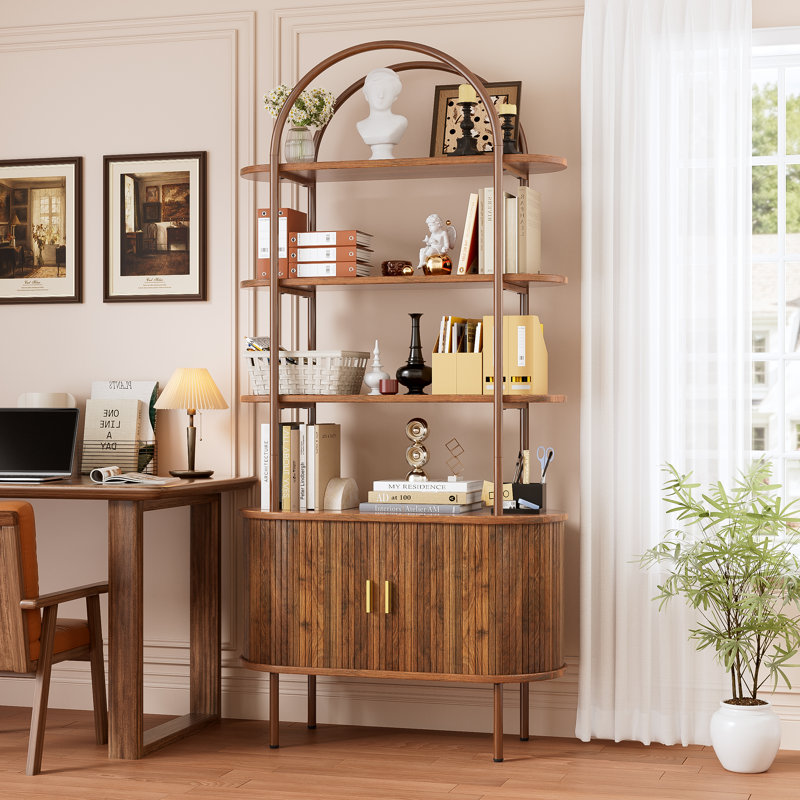
Where the arch is not a frame around the shelves but the shelf itself, tambour construction is usually the answer. Tambour, the same technique used for roll-top desks and curved cabinet fronts, is a set of narrow wood slats glued to a flexible backing so the assembly can be shaped into a curve. Wrapped around a curved shelf run, it turns a standard bookcase into a genuinely curved piece of joinery.
A reader named Fionn had a cabinetmaker build a tambour-curved shelf unit around an arched opening in his hallway. "It reads as one continuous curve," he said. "The shelves and the arch are the same piece. I don't think I could have gotten that effect any other way."
- Work with a cabinetmaker experienced in tambour construction — this is not a standard carpentry detail.
- Match the tambour slats' wood species and finish to the straight shelving, so the curve and the straight sections read as one material.
- Keep the curve radius to at least 12 inches, tighter curves are difficult to execute cleanly even with tambour.
A Freestanding Arched Bookcase Wall

A freestanding arched bookcase is the version for people who don't want to recess their walls. It's a self-contained piece of furniture, sized to fit exactly into an alcove or alongside a doorway, with an arched top rather than a rectangular one. Because it's freestanding, it can be moved later, and because it's arched, it reads as designed furniture rather than as a generic bookcase.
A reader named Sorcha placed one in the alcove beside her fireplace, sized specifically to fit the space exactly. "It looks built in, but it isn't," she said. "The arch is what does it. If it were rectangular, you'd see it as a bookcase. The curve makes it feel like it belongs to the house."
- Measure the alcove's exact width and depth — fitting exactly is what makes the piece read as built-in.
- Choose shelves that adjust so the piece can adapt to different objects over time.
- Match the wood and finish to the surrounding room's other woodwork, especially baseboards and casings, so the piece feels continuous with the room's architecture.
An Arched Opening Framing a Reading Nook
The arch doesn't have to surround the shelves directly — it can frame a larger zone that includes them. An arched opening around a window seat or reading nook, with shelves built into the side walls or above the bench, uses the arch as the outer boundary of the whole built-in rather than as a frame around the shelving alone.
A reader named Aisling built one around the base of a bay window and said it "turned a leftover corner into a real room. The arch tells you the whole alcove is a feature, and the shelves inside are part of it."
- Design the whole alcove as one composition, bench, arch, and shelves together, rather than as separate elements.
- Match the arch's radius to any other arched openings in the room, so the house feels continuous.
- Light the arch from inside with a discreet strip or a small overhead fixture, so the alcove reads as its own lit space.
An Arched Niche Above a Fireplace or Console

One of the most classical placements for an arched niche is above a fireplace or console, where the niche becomes the focal point of the whole composition below it. The shelves inside can hold display objects, small books, or a single piece — the point isn't storage volume, it's the visual anchor the arch provides at the center of the wall.
A reader named Bláthnaid added one above her dining room console and described the effect as "the wall finally knowing what it was for. Without the niche, the space above the console was just blank wall. With it, the whole wall has a center."
- Center the niche exactly on whatever it sits above — fireplace, console, or artwork — this is one detail where exact symmetry genuinely matters.
- Keep the niche's width roughly 50 to 70 percent of the width of what it sits above, so it reads as a feature of that object rather than as a competing element.
- Use adjustable shelves and consider a small internal light, so the niche reads as designed display rather than as blank wall.
Paint the Reveal, Not Just the Wall
One of the most underused moves with an arched shelving niche is to paint or stain the reveal — the interior depth of the arch — in a different tone than the surrounding wall. A deep, saturated color inside the arch makes the shelving read as genuinely recessed, and the change of color marks the arch as its own small space, similar to how the interior of a bookcase is often finished differently from the room's walls.
A reader named Éabha painted the interior of her arched niche a deep emerald green and left the surrounding wall cream. "The green makes the arch feel like a small separate room," she said. "The cream wall behind it feels even more neutral by contrast. It's the best change I made, and it cost nothing."
- Choose a color one or two shades deeper than the surrounding wall, saturated but not bright.
- Paint the reveal and the back panel in the same color, so the interior reads as one continuous surface.
- Use matte paint inside the niche, so the surface doesn't catch light and distract from the objects displayed on the shelves.
Lighting the Shelves Inside the Arch

The most overlooked detail in a built-in arched shelving unit is the lighting, and it's the one that most changes how the whole installation reads. An arch with no lighting tends to look like it's floating in shadow, especially at night. An arch with warm, concealed lighting at the top of each shelf glows from the inside, and the objects on the shelves become silhouettes against a warm interior — which is exactly what makes a built-in feel alive.
A reader named Fionn added small LED strips under each shelf inside her arched niche. "It's the difference between the arch being visible and the arch being a room," she said. "I would not build one without them now."
- Mount warm (2200–2700K) LED strips under the front edge of each shelf, aimed downward and slightly toward the back wall.
- Conceal the strip behind a small lip or trim, so the source is not visible — the light should seem to come from nowhere.
- Wire the whole shelf run to a single switch near the room's main lighting, so it's easy to turn on and off as part of the room's normal routine.
- Keep the lights on a dimmer — shelf lighting reads best at 30 to 50 percent brightness, not full strength.
What Almost Always Fails
- An applied arch sitting proud of a flat wall. It always reads as bolted on. The arch needs to be part of the wall's structure, not a frame stuck to its surface.
- Shelves that don't match the arch's material. A wood arch with painted shelves, or vice versa, splits the whole installation into two materials that fight each other.
- Mismatched arch radiuses around the house. Two different arch curves in the same sightline make both feel like mistakes.
- No lighting inside the niche. An unlit built-in at night reads as a dark hole in the wall.
- Centering the niche on the wall instead of on the object below it. Fireplaces, consoles, and pieces of art should sit under the arch's exact center, not the other way around.
- Choosing display objects that are too large. An arched niche works best with objects about two-thirds the height of each shelf opening, larger items crowd the arch and kill the negative space.
Common Questions
Is a recessed arched niche realistic on an existing wall, or does it need new construction? Both work. A recessed niche can be retrofitted into most existing walls by a skilled carpenter, especially if the wall is non-structural and there's at least 4 inches of cavity depth available. The full-height recessed version is usually easier to plan during a renovation.
What's the difference between an arched niche and an arched bookcase? A niche is recessed into the wall — the storage lives inside the wall's depth. A bookcase is a piece of furniture placed against the wall or built in front of it. A niche is more architectural; a bookcase is more flexible to move later.
What depth should shelves be inside an arched niche? A depth of 8 to 12 inches is the most versatile — deep enough for books and larger objects, shallow enough that the niche doesn't feel like a tunnel. Display-only niches are usually 2 to 4 inches deep.
Can I use tambour construction for the shelves themselves, or only for the arch? Both are possible, but tambour is typically used for the curved portion of the unit — the arched top or a curved interior corner — while the shelves themselves stay straight, since straight shelves are more stable for holding objects.
Should the shelving inside an arched niche be painted or wood? It depends on the surrounding room. Wood shelving makes the niche read as warmer and more traditional. Painted shelving makes it read as more architectural, since the color and the wall become one continuous surface. Either works; the goal is to match the room rather than compete with it.
How do I keep the shelves in a niche from looking cluttered? Rule of thirds: fill roughly two-thirds of the visual space and leave the rest empty. Style in odd-numbered groups, choose objects with some visual relationship to each other, and resist the urge to fill every available surface.
What surprised me most in studying curved arch built-ins was how little the arch actually has to do with the shelves. The shelves are the same shelves that would be there anyway. The arch is what changes the whole wall's relationship to them, turning storage that would normally be invisible into storage that reads as deliberate.
If you only do one thing, decide the depth and the lighting before you choose the arch shape, and let the arch's radius follow what the wall can actually hold. Everything else here is really just detail on top of that single decision.
— written after measuring three walls that couldn't take a niche, finding one that could, and then measuring that wall three more times before any carpenter was called
Shop the Story
- arched wall niche insert
- tambour bent wood shelving
- concealed LED shelf strip
- adjustable wood shelf pins
- matte deep green paint
- warm brass shelf hardware