
Scalloped Arch Mirror Wall Decor Ideas
A scalloped edge is one of the few decorative moves that manages to feel soft and structured at the same time, and a mirror is the surface that shows it off best
Most decorative wall mirrors fall into one of two camps. They either disappear into the room, doing a functional job and asking nothing of the eye, or they shout, demanding attention whether or not the room can carry it. A scalloped arch mirror sits in a third category that's genuinely rarer: it reads as a designed object from across the room, and it reads as a soft, gentle detail from up close. It's the kind of thing that makes a wall feel more considered without needing the whole room redecorated around it.
I spent a while studying scalloped arch mirrors because I kept seeing them in photos and couldn't work out why some looked like a considered design decision and others looked like an over-decorated bathroom accessory. The pattern, as usual, was less about the mirror itself than about where it was placed, how it was framed, and what it was reflecting.
What follows is the collection of what actually works, from single statement mirrors to stacked galleries, along with the placement rules that turn a scalloped arch from a decorative object into a designed wall feature.
Table of Contents
- Why Scalloping Works on an Arch
- A Single Full-Length Scalloped Arch Mirror
- A Half-Length Scalloped Arch Over a Console
- A Stacked Pair or Cluster of Scalloped Arches
- Brass Frame, Warm and Quiet
- Frameless Scalloped Arch for Narrow Walls
- Pair It With a Painted Reveal or Accent Wall
- Layered With a Sconce on Each Side
- Above a Bench or Dining Sideboard
- What Almost Always Fails
- Common Questions
Why Scalloping Works on an Arch
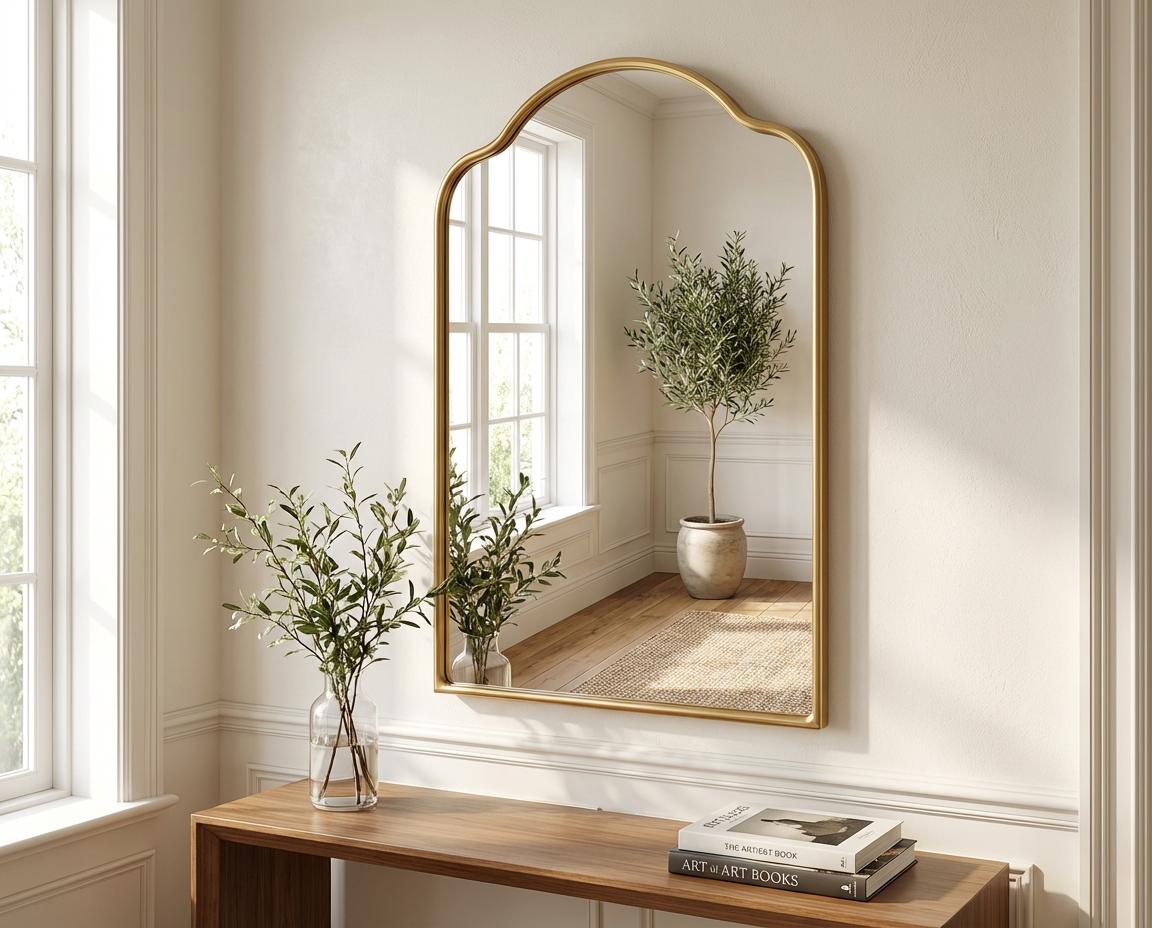
A plain arch already softens a wall by removing the top corners. Add scalloping to that curve, and the whole shape starts to feel almost water-like — a series of small, repeating curves that catch the eye and slow it down. The scalloping is decorative, but it's not just decoration. It changes how the mirror reads as an object, from one gesture (the arch) to a composition (the arch plus the scallops).
A reader named Fionnuala described the effect as "the mirror looking like it had been designed on purpose. A plain arch reads as simple. A scalloped arch reads as something someone chose."
- The scalloping slows the eye along the curve, making the mirror feel more considered
- The repeated scallops create a rhythm that a plain arch doesn't have
- Works at any size — a small scalloped arch mirror reads as a decorative detail, a large one reads as a wall feature
- Pairs especially well with warm metals and matte finishes
A Single Full-Length Scalloped Arch Mirror

The most dramatic version is a full-length scalloped arch mirror running from just above the floor to near the ceiling. Because it's the full height of the wall, it reads as an architectural element — a decorative opening cut into the wall — rather than as a mirror doing a job. The scalloping keeps the very top of the arch from disappearing into the ceiling, since the small curves mark the top edge clearly even when the mirror is nearly full height.
A reader named Cormac installed one in his hallway and said it "turned the whole wall into a feature. It goes from the baseboard to almost the ceiling, and the scalloped top gives it an edge that a rectangle or a plain arch wouldn't have."
- Measure from just above the baseboard to roughly 12 inches below the ceiling, so the full-length effect reads clearly.
- Choose a lighter-weight frame or a frameless version — a full-length mirror is already heavy, so a thick frame makes it harder to mount.
- Anchor into studs on both sides — a mirror this large needs genuine structural support, not standard drywall anchors.
A Half-Length Scalloped Arch Over a Console
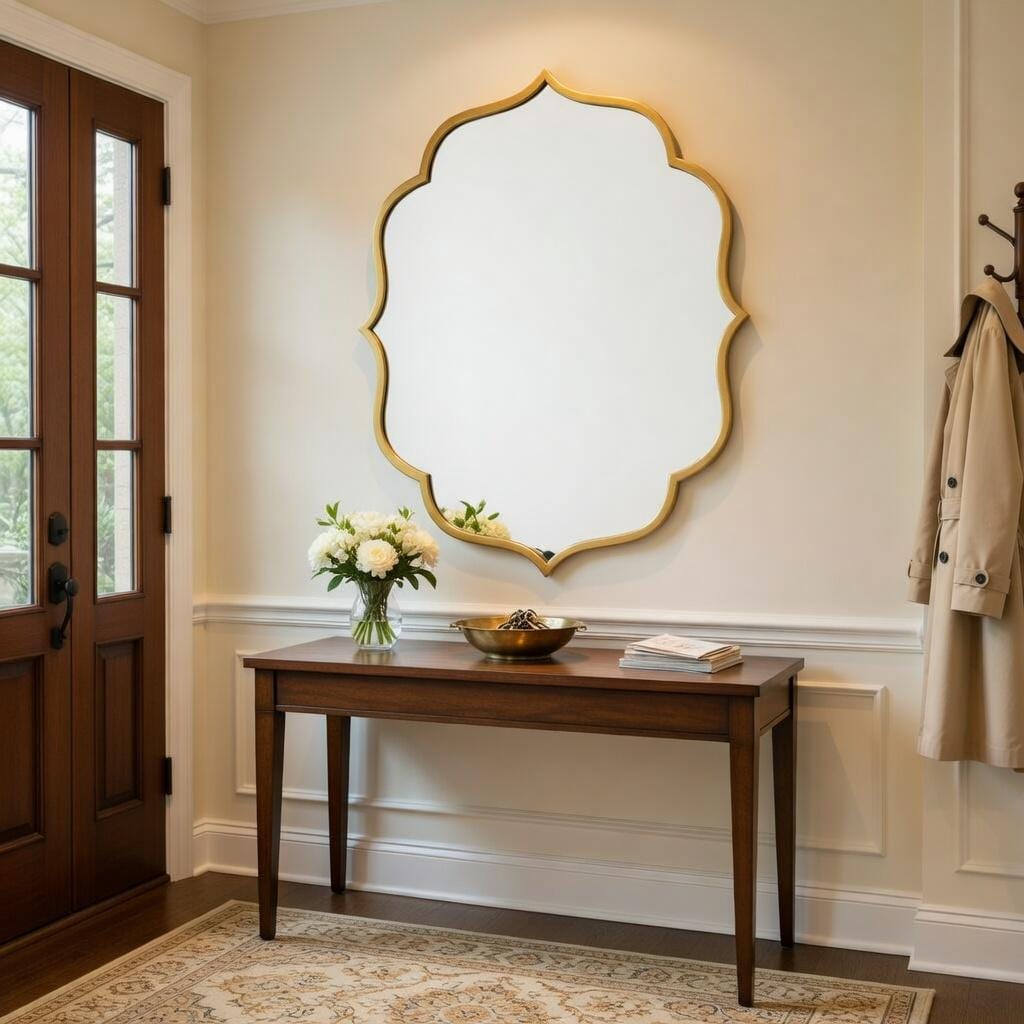
The half-length version, mounted above a console, is the most common placement for a scalloped arch mirror, and it's also the one with the most flexibility. The console gives the mirror something to reflect, and the mirror gives the console a focal point. Together, the two pieces make a small zone read as a designed feature rather than as random furniture.
A reader named Caoimhe placed hers above a slim console in her entryway, with a small ceramic lamp to one side. "The mirror reflects the lamp," she said, "which means it also reflects light. When I turn the lamp on in the evening, the whole entryway gets twice as bright."
- Choose a console that's narrower than the mirror by roughly 6 to 8 inches on each side, so the mirror reads as the focal point.
- Mount the mirror so its bottom edge sits 6 to 10 inches above the console top — this keeps the console's surface usable.
- Place a small light source on the console, a lamp, a candlestick, or a small display object — the mirror needs something worth reflecting.
A Stacked Pair or Cluster of Scalloped Arches
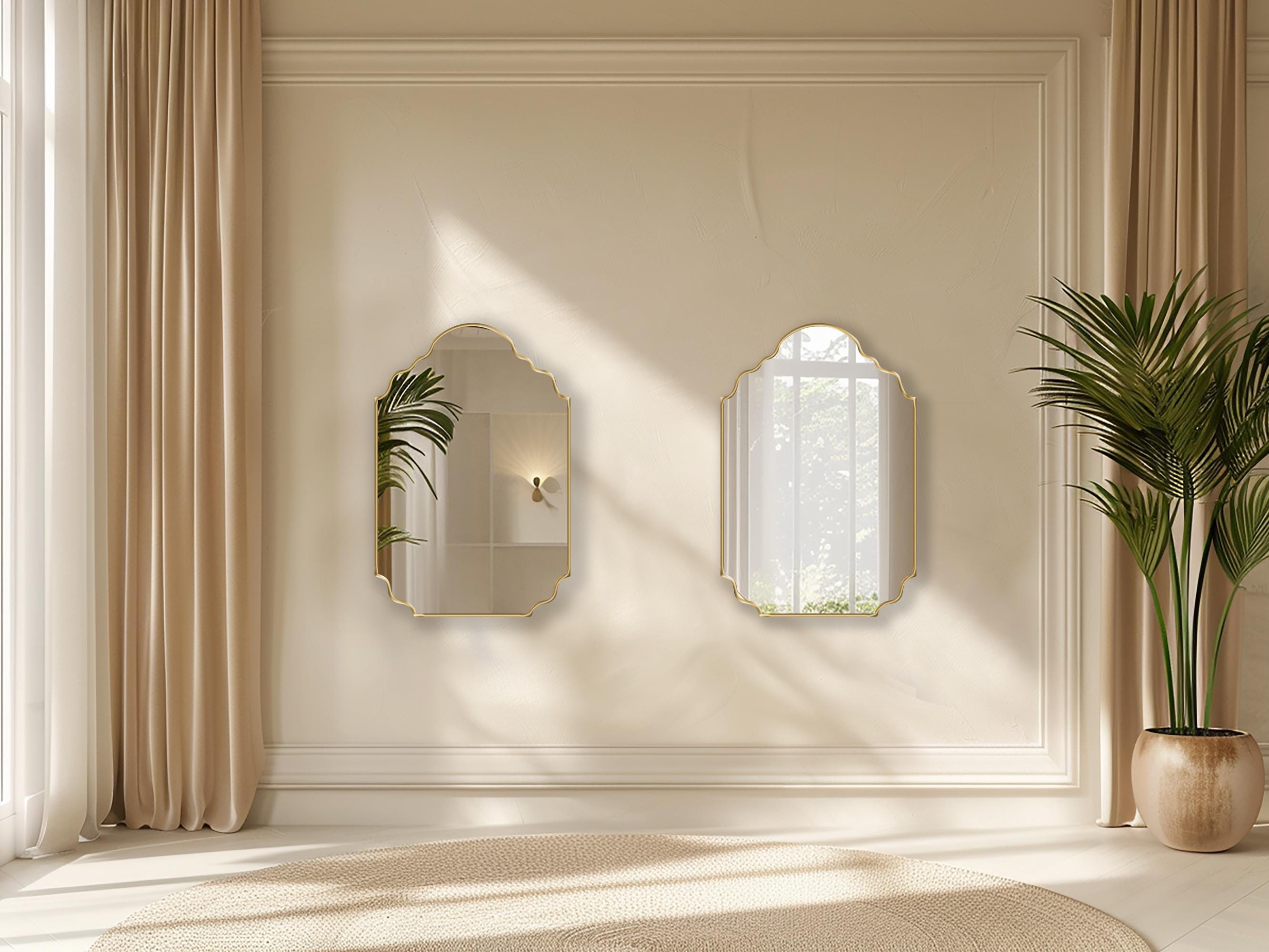
Where a single scalloped arch mirror reads as one gesture, a pair or cluster reads as a composition. Two scalloped arches stacked vertically — the smaller one above the larger one, both sharing a frame finish — turn a wall into a designed arrangement. A group of three at varying sizes works the same way, as long as they're all scalloped and all framed the same, so the repetition of the scallop becomes the visual thread that holds them together.
A reader named Sorcha hung two stacked scalloped arches in her dining room and described the effect as "the wall becoming a gallery. The scalloping on both mirrors ties them together, and the empty space between them is doing as much work as the mirrors themselves."
- Choose mirrors of proportional but different sizes — a pair usually works best with one roughly 60 to 70 percent the size of the other.
- Stack them exactly centered on each other, or offset them slightly on purpose. Avoid the accidental near-symmetry that reads as a mistake.
- Leave at least 6 to 8 inches of wall between stacked mirrors, so each reads as its own object rather than as one tall piece.
- Match the frame finish exactly, small differences between frames make the whole arrangement feel unresolved.
Brass Frame, Warm and Quiet
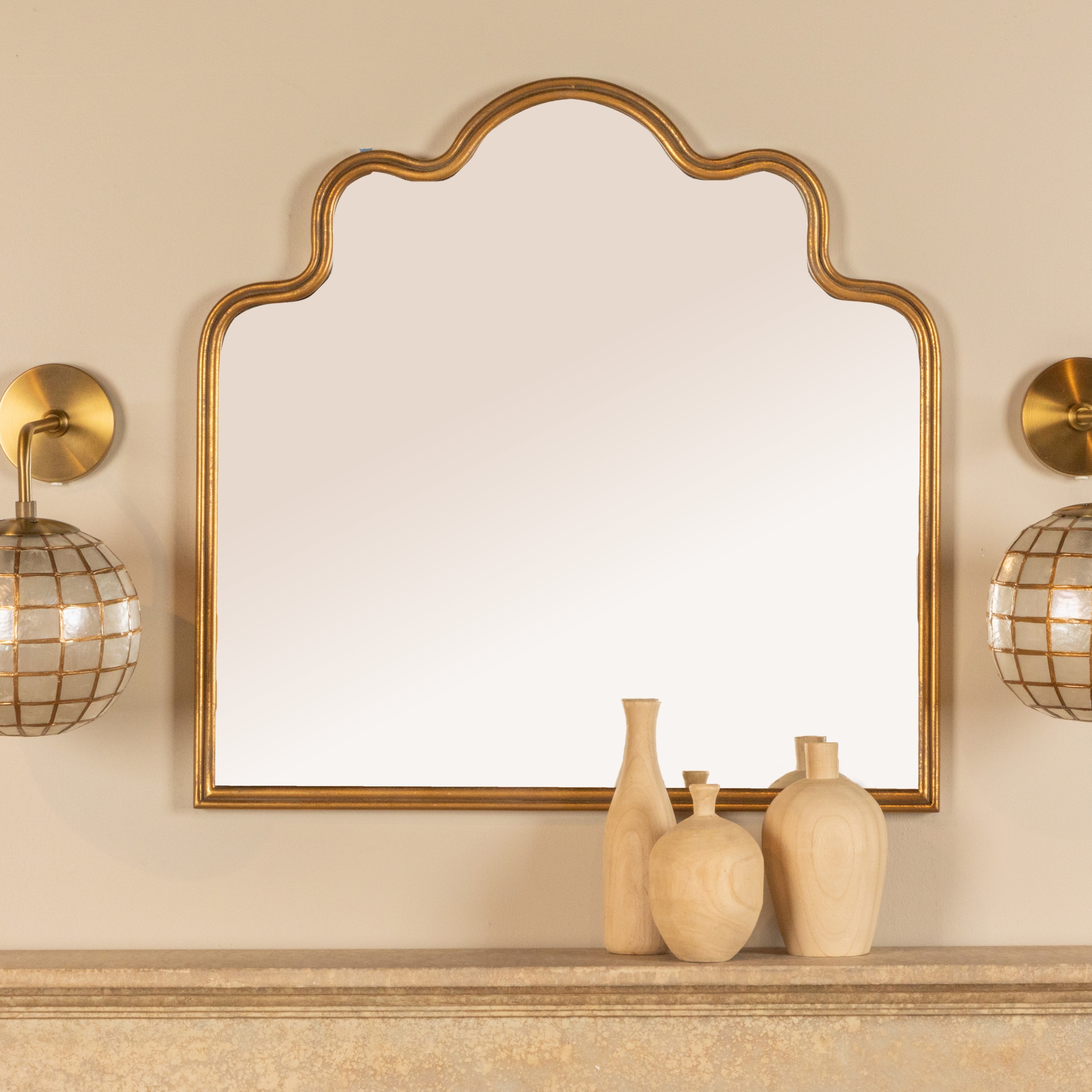
The single most reliable choice for a scalloped arch mirror is a thin brass frame. Brass reads warm against the small curves of the scalloping, and it looks intentional rather than decorative — the small curves don't have to fight a bright or cold metal. Chrome tends to feel a little clinical on a scalloped shape, since the curve itself is already soft and the metal doesn't need to be cold on top of it. Matte black works too, but it reads sharper and more graphic, which suits some rooms and not others.
A reader named Fionn chose brass for his scalloped arch mirror and said it "reads as an heirloom. The scalloping already makes it feel old-world, and the brass makes the whole thing feel like it was made at the same time."
- Choose a thin frame — thin brass reads refined on a scalloped shape, thick brass starts to feel heavy.
- Match the frame to the room's other metals, so the mirror feels like part of the room rather than as a standalone object.
- Consider unlacquered brass if you like the idea of the frame developing a patina over time — scalloped mirrors especially look good as they age.
Frameless Scalloped Arch for Narrow Walls
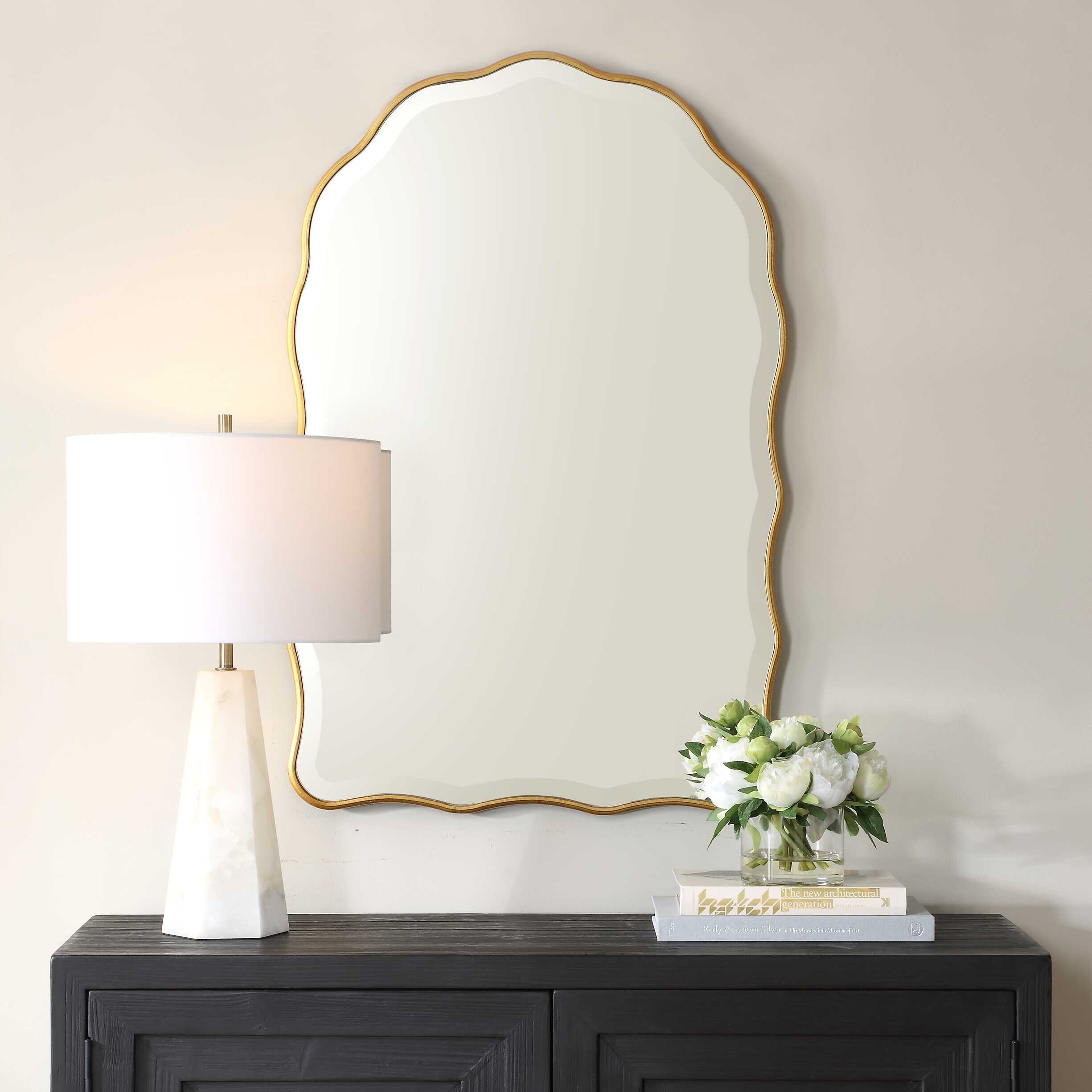
On a narrow wall, a framed scalloped arch mirror loses part of its visual width to the frame itself, which can make the wall feel more crowded rather than less. A frameless scalloped arch, edge-polished and mounted flush against the wall, gives the full reflective surface without the frame's added footprint, and reads as a genuine architectural opening rather than as a framed object.
A reader named Bláthnaid used a frameless version in her 34-inch hallway and said it was "the version that finally felt right. Every framed mirror I tried made the hallway feel more closed in, and the frameless one read as a window instead."
- Confirm the mirror is edge-polished rather than raw-cut — polished edges make frameless mirrors look intentional.
- Use mirror clips rather than a wire hanger, so the mirror sits flush against the wall.
- Anchor directly into studs — frameless scalloped arches are often larger and heavier than they look.
Pair It With a Painted Reveal or Accent Wall
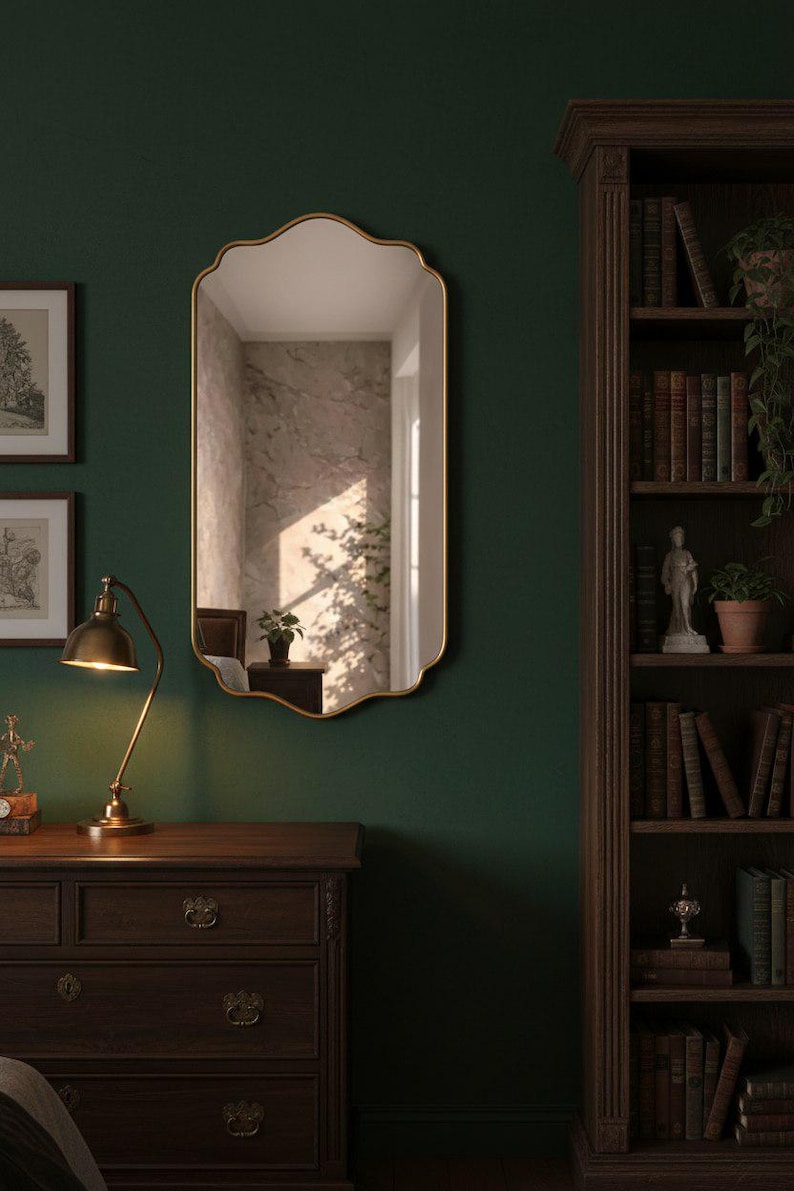
A scalloped arch mirror against a plain white wall is beautiful but quiet. Against a deep-toned accent wall, it becomes the whole room's focal point. The mirror, being reflective, shows the surrounding room from the angle you'd never see otherwise, and the accent wall behind it sets the whole composition in a frame of color. The scalloped edge against a deep tone reads as a soft-edged shape cut out of a dark surface.
A reader named Aisling painted the wall behind her scalloped arch mirror a deep forest green. "It looks like the mirror has been framed twice," she said. "The brass is the inner frame, and the green wall is the outer one."
- Choose a warm deep color — forest green, burgundy, ink navy, terracotta — rather than a cool grey or blue-grey.
- Use matte or at most eggshell finish, so the wall doesn't compete with the mirror's reflection.
- Paint only the wall directly behind the mirror, not the whole hallway or room, so the contrast reads as intentional.
Layered With a Sconce on Each Side
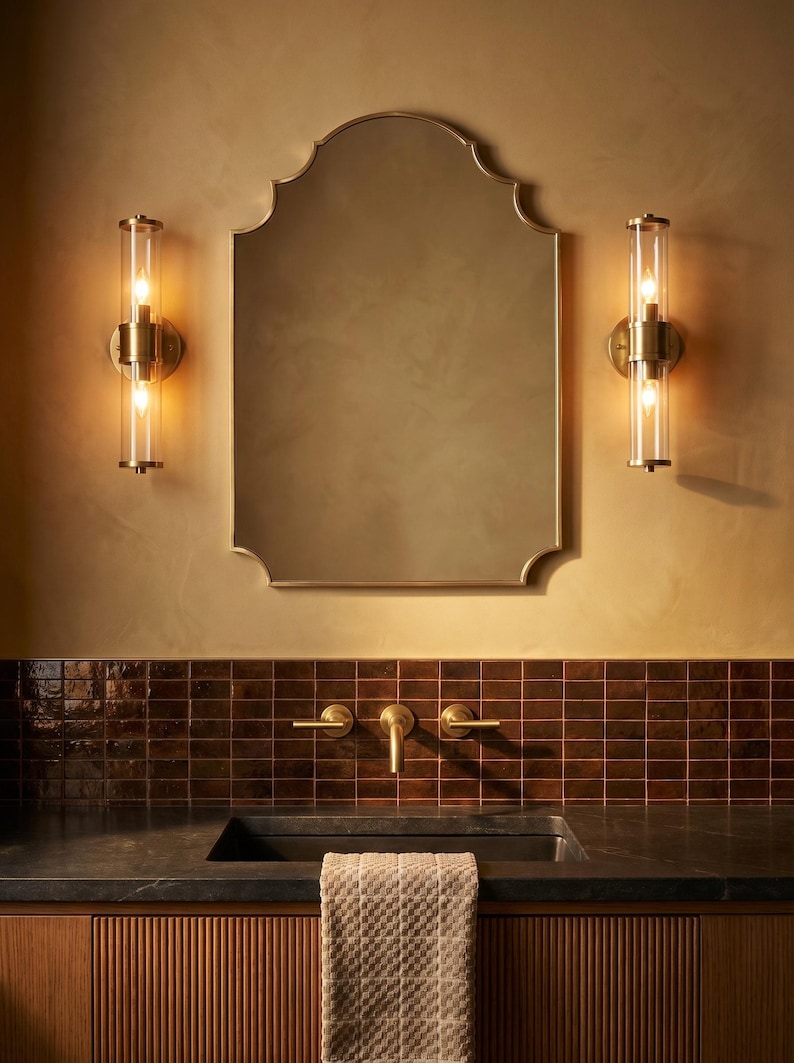
A scalloped arch mirror flanked by two matching sconces is the version that turns the wall into a lit composition. The sconces light the mirror's frame on both sides, warm the reflection, and give the wall a symmetry that a scalloped mirror already asks for. Even a single sconce beside the mirror — as long as the mirror is slightly off-center to balance it — accomplishes much of the same effect.
A reader named Éabha added two small brass sconces beside her scalloped arch mirror and said the change was immediate. "The mirror looked fine on its own," she said, "but with the sconces, the whole wall feels lit. It's the difference between a mirror in a room and a mirror as a feature."
- Mount each sconce 6 to 10 inches away from the mirror's frame edge, close enough to light the frame, far enough not to crowd it.
- Match the sconces' metal finish to the mirror's frame, this is the detail that makes them read as one installation.
- Choose warm bulbs (2200–2700K), cool light will fight the mirror instead of highlighting it.
Above a Bench or Dining Sideboard
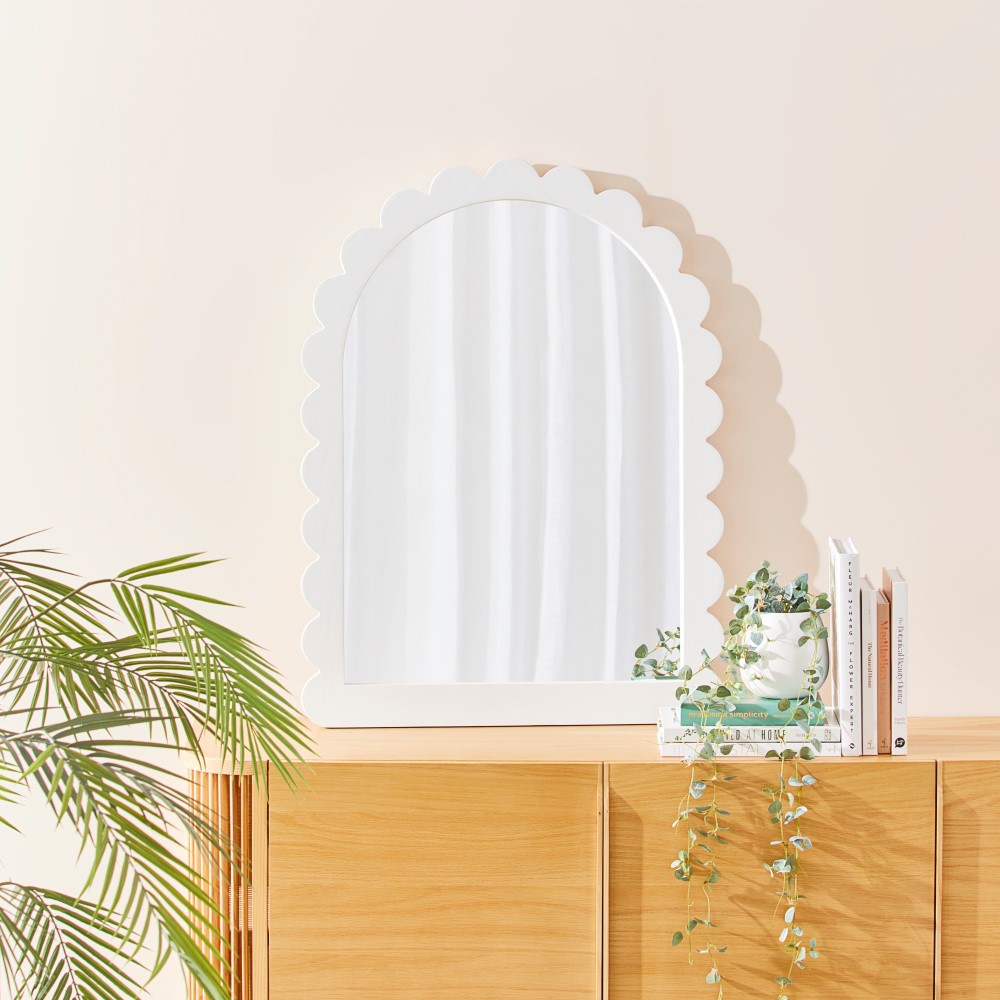
A scalloped arch mirror isn't only for hallways. Placed above a bench or a dining sideboard, it turns an underused wall into a designed wall. The scalloped edge softens the usually straight-lined composition of a bench or sideboard, and the mirror reflects the room's light back into it. Above a dining sideboard specifically, a scalloped arch mirror also picks up the warm glow of any lamp on the sideboard, making the whole corner feel lit and layered.
A reader named Fionn hung one above his dining room sideboard and said "it doesn't look like a mirror. It looks like a piece of decor that happens to reflect. The dining room finally has a wall that feels finished."
- Center the mirror exactly above whatever it sits above — a bench, a sideboard, or a console. Exact symmetry is what makes the composition feel intentional.
- Keep the mirror's width roughly 50 to 70 percent of the sideboard's width, so it reads as a feature of that object.
- Leave at least 8 to 12 inches between the mirror's bottom edge and the surface below, so the surface remains usable.
What Almost Always Fails
- A scalloped arch mirror too small for the wall it's on. The scalloping detail disappears when the mirror is small, and the wall reads as having a random decorative object on it.
- A scalloped arch mirror against a cool grey or blue wall. Cool tones push the warmth out of the shape, and the mirror reads as vaguely clinical rather than as a considered decorative object.
- Mixing scalloped and straight-edged mirrors in the same composition. The two styles fight each other, and both lose.
- Placing it where it reflects nothing. A mirror that reflects a blank wall just occupies wall space. It needs something worth reflecting.
- Framing it in chrome when the room's other metals are brass. Small metals matter, especially in a small composition. Match them.
- Hanging it too high. A scalloped arch mirror hung near the ceiling loses the visual effect of the arch, and the arch is the point.
Common Questions
Is a scalloped arch mirror just a trend, or is it going to last? Scalloped edges and arched shapes are both well-established architectural forms, not single-season trends. The particular combination is having a revival right now, but the shape itself is unlikely to date in the way a bright color or a specific pattern might.
What's the difference between a scalloped mirror and a regular arched mirror? A plain arch has one smooth curve at the top. A scalloped arch has that curve broken into a series of smaller, repeated bumps. Scalloping adds rhythm and detail to the arch, which makes it read as more decorative and more considered.
What wall color works best behind a scalloped arch mirror? Warm tones — cream, warm greige, clay, sage, forest green, burgundy, terracotta — bring out the shape's softness. Cool tones — cool grey, blue-grey, stark white — push the shape toward decorative and make it read a little less intentional.
Should the mirror be mounted flat on the wall, or leaning? Both work. Wall-mounted reads as more architectural and more planned. Leaning reads as more casual and more collected. For a small space, wall-mounted is usually stronger, since it uses the wall's full height without eating floor space.
Can I use a scalloped arch mirror in a bathroom, or is it a living area thing? Both work. Bathroom vanities often use scalloped arch mirrors above the sink, and they read the same way in a bathroom as in a living space — soft, considered, and a little bit special. The scalloping also visually softens the hard surfaces of most bathrooms.
How high should I hang a scalloped arch mirror? For a half-length or vanity-style mirror, center it around 60 to 66 inches from the floor, so the mirror's visual center lands at the average adult's eye height. For a full-length mirror, hang it about 4 to 6 inches above the floor and let it extend upward, using the full wall height to reinforce the arch.
What I kept noticing, looking at scalloped arch mirrors in different rooms, was that the ones that looked best weren't necessarily the most expensive or the most elaborate. They were the ones where the mirror had been placed with something to reflect, mounted at the right height, and framed in a metal that matched the rest of the room. Everything else was just the shape doing its own quiet work.
If you only do one thing, position the mirror so it reflects a light source or an interesting adjacent room, and warm up the wall around it before you choose a frame finish. Everything else on this list is really just detail on top of that single decision.
— written after hanging a scalloped arch mirror three times in the same spot, shifting it two inches each time, until the reflection finally landed on something worth looking at
Shop the Story
- scalloped arch mirror brass frame
- full length scalloped mirror
- frameless scalloped arch mirror
- scalloped mirror pair for wall
- warm brass wall sconce
- matte deep toned hallway paint