
Arched Wall Niche Shelf Styling Ideas
How to test the look before cutting into a wall, and the restraint that keeps a niche from turning into clutter with a curved frame around it
I almost cut into a wall I'd have regretted committing to. What stopped me wasn't a styling photo, it was a genuinely useful piece of practical advice I found while researching this, a way to test the whole idea before anything permanent happened. That's where I'd tell anyone else to start too, before a single styling decision.
Table of Contents
- Test It Before You Commit
- The Restraint Principle Behind Every Niche That Works
- Paint the Interior a Rich Tone
- Let Lighting Do Real Work
- Real Room-by-Room Combinations
- When to Skip Shelves Entirely
- Common Mistakes
- Common Questions
Test It Before You Commit

This is the single most useful thing I found in all my research, and it comes before any styling advice at all.
- Mount a shallow arched shelf directly on the wall where you're considering a real niche, live with it for a few weeks before deciding.
- Try a recessed-look arched mirror in the same spot as an alternative test, it gives you a sense of the curve's visual weight without any construction at all.
- Only move to an actual cut-in niche once you're confident the shape and scale genuinely suit the wall and the room around it.
The Restraint Principle Behind Every Niche That Works

Once the shape is settled, styling is where most niches actually succeed or fail, and current guidance is specific about the underlying discipline behind it.
- Choose two or three textures at most for whatever you place inside, ceramic, woven fiber, glass, rather than a different material for every object.
- Leave visible empty space between objects rather than filling every inch of shelf, that negative space is specifically what reads as calm rather than crowded.
- If the niche's shape or paint color is already a strong statement on its own, resist adding more than a small handful of objects inside it.
- Gives you a genuine editing rule rather than a vague "less is more" suggestion
- Works whether the niche is large and dramatic or small and modest
- Prevents the single most common way a niche stops looking intentional
Paint the Interior a Rich Tone

Color inside the niche does more work than almost any single object you'd place on its shelves.
- Paint the interior of the niche, including its curved surfaces, in a deep, saturated color rather than leaving it the same white as the surrounding wall.
- Add one trailing plant, ivy or a pothos, letting it spill slightly over a shelf edge for the layered, storybook quality current guidance describes.
- Trust the rich color to do more work than extra objects would, current guidance is specific that the paint choice itself is what elevates simple pieces, not a denser collection of them.
Let Lighting Do Real Work
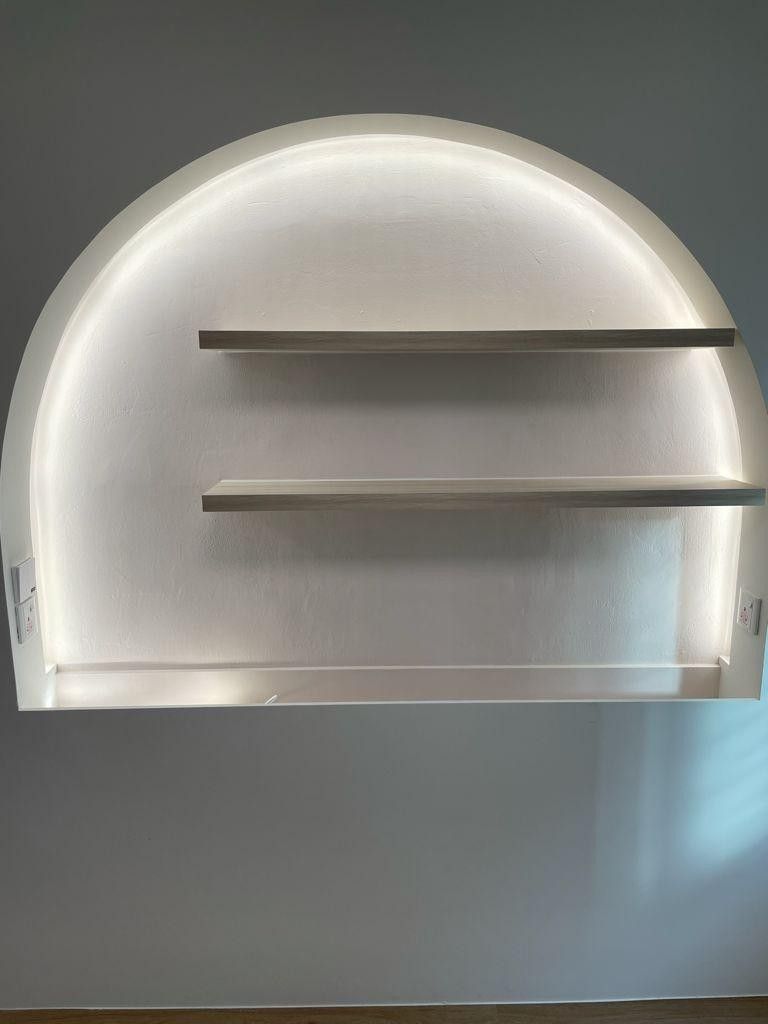
Wall shelving in general has shifted in how it's treated in 2026, and a niche specifically benefits from that shift more than a flat, open shelf would.
- Add a small directional light or LED strip inside the niche, positioned to catch the curve of the arch itself as well as whatever's displayed on the shelf.
- Consider a soft under-shelf glow specifically if the niche includes a floating or ledge-style shelf rather than a fully enclosed one.
- Use the lighting to reinforce the niche's shape at night, not just to illuminate objects, current guidance treats light as part of the architecture, not an afterthought added once styling is done.
Real Room-by-Room Combinations
Rather than guessing at what belongs in a niche, it's worth knowing what's actually been documented room by room.
Below, the same principle shown as two different room combinations, an entryway-style seating nook and a kitchen ledge with a gallery wall:


- In an entryway, combine seating, a shelf, and a single lamp rather than styling the niche as pure display, current guidance treats it as a functional mini-room, not just a decorative feature.
- In a small office nook, keep it to three elements, a sconce, one piece of art, one plant, exactly as documented, rather than adding a desk's worth of supplies into the same space.
- In a kitchen, let the niche's ledge hold a rotating gallery of art or objects rather than permanent storage, that's the documented use alongside marble and charcoal cabinetry.
And in a bathroom, the same idea again, with an arched niche housing a built-in vanity and storage shelves:

When to Skip Shelves Entirely

This matters because it's easy to assume every niche needs its own internal shelving structure. A smaller niche, styled with a single vase or a stack of two or three books directly on its base, often reads cleaner than one crammed with an added shelf it never really needed.
Common Mistakes
- Cutting into a wall before testing the look. A wall-mounted arched shelf or mirror is a real, reversible way to check first.
- Filling every inch of shelf space. Current guidance is specific that negative space is what makes styling feel serene rather than crowded.
- Adding a built-in shelf to a niche small enough to function as one on its own. This often adds visual clutter rather than removing it.
- Ignoring wall structural limitations. Underestimating installation complexity is named specifically as a common source of DIY arched niche problems.
Common Questions
Is there a way to try this without committing to actual construction? Yes, a shallow wall-mounted arched shelf or a recessed-look arched mirror is a specifically recommended way to test the look before cutting into a wall.
How many objects should realistically go inside a styled niche? Current guidance favors a small, tightly edited number, matte vases, stacked bowls, and a single anchoring print, rather than a dense collection, especially when the niche's shape or color is already a strong feature on its own.
Does every niche need its own built-in shelf? No, a genuinely small niche can function as a single shelf on its own without any additional shelving built in.
What's the most common mistake people make with a DIY arched niche? Poor design integration, ignoring the wall's structural limitations, and underestimating how complex the installation actually is are the three specifically named causes of most DIY problems.
Is lighting really necessary, or is it just a nice extra? It's treated as a real design feature in current 2026 guidance, not an optional extra, since it's specifically what draws attention to displayed objects and reinforces the niche's shape, especially after dark.
What changed my plan wasn't a photo of a finished niche, it was permission to try the shape first without any real commitment. That one piece of advice did more for my confidence in this project than every styled shelf photo combined.
Before you style anything, test the shape itself with a mounted shelf or mirror. Everything else on this list only matters once you're sure the niche belongs in that spot at all.
— written after testing the shape on the wall before touching a single tool
Shop the Story
- shallow wall mounted arched shelf
- recessed arched mirror
- battery LED strip light
- matte ceramic vase set
- trailing pothos plant
- rich tone interior paint