
Arched Mirror Hallway Ideas to Elevate Small Spaces
A hallway is the one room in a small home nobody actually decorates, which is exactly why it's the one that can change how the whole house feels
A hallway is the most overlooked room in a small home. It's the space you pass through, not the space you live in. It rarely gets a rug, rarely gets real lighting, rarely gets anything but whatever art or mirror happened to end up on the wall when you moved in. I spent years treating ours that way, until a friend pointed out that it was the one room every single guest walked through twice, once on the way in and once on the way out, making it the single highest-traffic wall in the entire house.
That's when the arched mirror idea started to feel less like a trend and more like a genuine design opportunity. An arched mirror does two things simultaneously in a hallway: it reflects light and depth back into a space that usually has neither, and it becomes the one intentional object in a room that otherwise has no focal point at all. Nothing else in a small hallway does both jobs at once.
What follows is the version I've landed on and the variations I've since collected, from modest full-length arches to gallery arrangements, each one addressing a different kind of small hallway problem.
Table of Contents
- Why the Arch Specifically Works in a Hallway
- A Full-Length Arch Mirror, Floor-to-Trim
- A Slim Half-Length Arch Above a Console
- Position It to Reflect a Light Source
- Choose a Brass Frame for Warmth, Black for Definition
- Layer It With a Painted Reveal Behind
- A Pair of Matching Arches for a Longer Hall
- Add a Light Source Directly Beside It
- A Gallery of Small Arches Above a Bench
- Frameless for Genuinely Tight Walls
- What to Avoid
- Common Questions
Why the Arch Specifically Works in a Hallway

The case for an arched mirror over a rectangular one in a hallway comes down to two things: softness and height. A rectangular mirror has hard corners that echo the architecture of a hallway, which is already full of them, door frames, baseboards, floor transitions. An arch introduces a curve, and that curve is what keeps a narrow space from feeling like a corridor of right angles.
The height element matters just as much. Most hallway mirrors are short, mounted at eye level and stopping there. An arched mirror naturally extends upward, which draws the eye up, and drawn-up eyes make a low-ceilinged hallway feel taller than it is. It's a small psychological shift, but in a hallway that's barely wider than your shoulders, it's the whole effect.
- The curve softens a space that is otherwise entirely made of right angles
- The upward extension makes a low ceiling feel taller
- It reads as an intentional design choice, not just a mirror doing a functional job
- It reflects light back into a hallway that usually has none
A Full-Length Arch Mirror, Floor-to-Trim

The most effective version of the idea is also the most demanding: a full-length arched mirror that runs from just above the floor to near the ceiling or the top of the trim. A reader named Fionnuala described hers as "the single object that made our hallway feel like a real room. It goes from floor to almost ceiling, and now the whole corridor feels twice as tall."
Because the mirror runs the full height, it reflects almost the entire hallway in one continuous plane, which reads as depth rather than as reflection. In a narrow space, that continuous vertical is doing the same architectural work a full-height window or floor-to-ceiling curtain would do, it extends the room visually by an entire dimension.
- Measure from just above the baseboard to at least 12 inches below the ceiling, or up to the crown if there is one. The full-length effect is achieved by leaving only a small gap at top and bottom, not by matching a standard size.
- Choose a lighter-weight frame or a frameless version. A full-length mirror is heavy, and adding a thick frame on top makes it significantly harder to mount safely.
- Anchor into studs on both sides if possible, or use heavy-duty anchors rated for the mirror's full weight.
- Hang it at chest height from the center, so your reflection is visible from the widest possible range in the hallway, not just from the doorway.
A Slim Half-Length Arch Above a Console

If the full-length version feels like a commitment, the half-length arch mounted above a slim console is the more traditional answer and it still does most of the same work. A reader named Cormac described this as "the version that let us have a hallway lamp, which meant the mirror actually reflected something worth seeing. Without a light source nearby, a hallway mirror just shows a dark corridor."
That detail matters more than most people realize. A mirror only creates visual depth when it has something to reflect. A half-length arch above a console with a small lamp on it reflects the lamp and the light it produces, which turns the mirror into a light source rather than a dark pane on the wall.
- Choose a console that is narrower than the mirror, roughly 6 to 8 inches on each side, so the mirror reads as the focal point rather than the furniture.
- Mount the mirror so its bottom edge sits about 6 to 10 inches above the console top, this keeps the console's surface functional.
- Place a small lamp, a candlestick, or a low planter on the console, this is the object the mirror will reflect, and it's what makes the mirror feel alive.
Position It to Reflect a Light Source
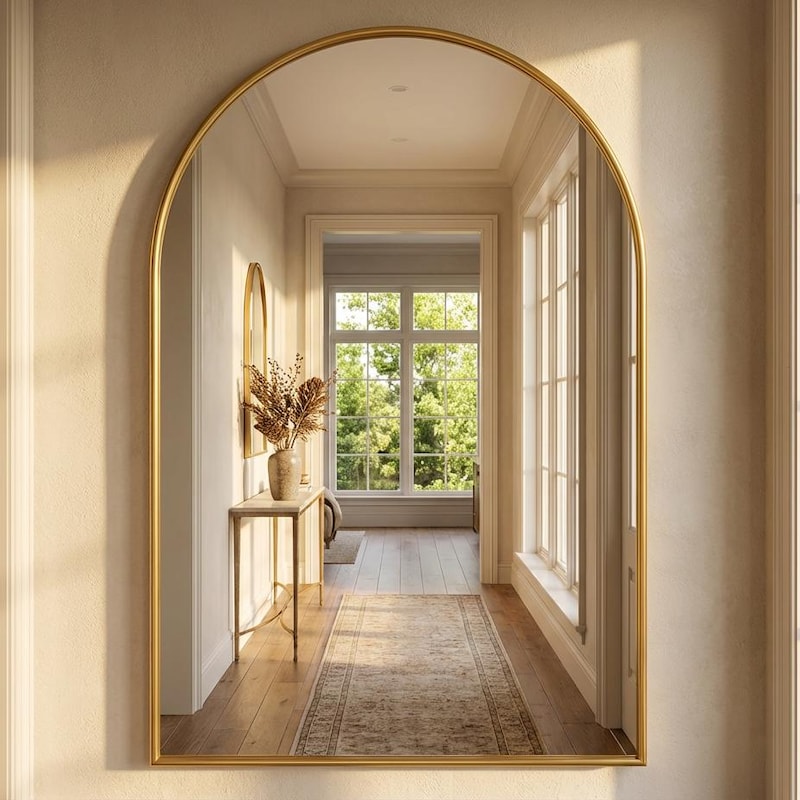
This is the single most important decision in the whole installation, and it costs nothing to get right. An arched mirror placed directly across from a window, a doorway to a lit room, or a lamp reflects that light back into the hallway, doubling the brightness of the whole corridor. A mirror placed across from a blank wall reflects a blank wall.
A reader named Caoimhe described walking into her sister's hallway for the first time and assuming there was a window at the end. There wasn't, there was an arched mirror reflecting the kitchen window at the other end of the house. "It felt like the hallway had an extra source of light," she said, "and it genuinely didn't. That's the whole point of where the mirror goes."
- Walk the hallway slowly and note every source of light, windows, doorways to lit rooms, lamps, even a fixture at the end of the corridor.
- Position the mirror so it reflects the brightest of those sources, not the darkest wall in the house.
- If no light source is available, add one. A small wall sconce opposite the mirror achieves the same effect as a window.
Choose a Brass Frame for Warmth, Black for Definition

Frame color is the difference between a mirror that feels like a design object and one that feels like a piece of hardware. A thin brass frame reads warm and considered, and it works especially well with the same palette a hallway usually has, warm woods, cream walls, and slightly aged lighting. A thin black frame reads more contemporary and architectural, drawing a sharper line against the wall.
What surprised me most in comparing the two options was how much the frame color changed the whole hallway's mood, even when the shape and size of the mirror stayed identical. Same mirror, same wall, completely different feeling.
- Match the frame to the other metals in the hallway or adjacent rooms, brass to brass pulls, black to black sconces, chrome to stainless details. A hallway is a pass-through space, so it should feel connected to what's around it.
- Choose a thin frame rather than a thick one. In a narrow hallway, a thick frame eats into the visual width of the mirror's reflection.
- If the hallway is genuinely dark, brass tends to read warmer against shadow than black does. Black can visually disappear into a dark wall, which sometimes weakens the mirror's presence.
Layer It With a Painted Reveal Behind
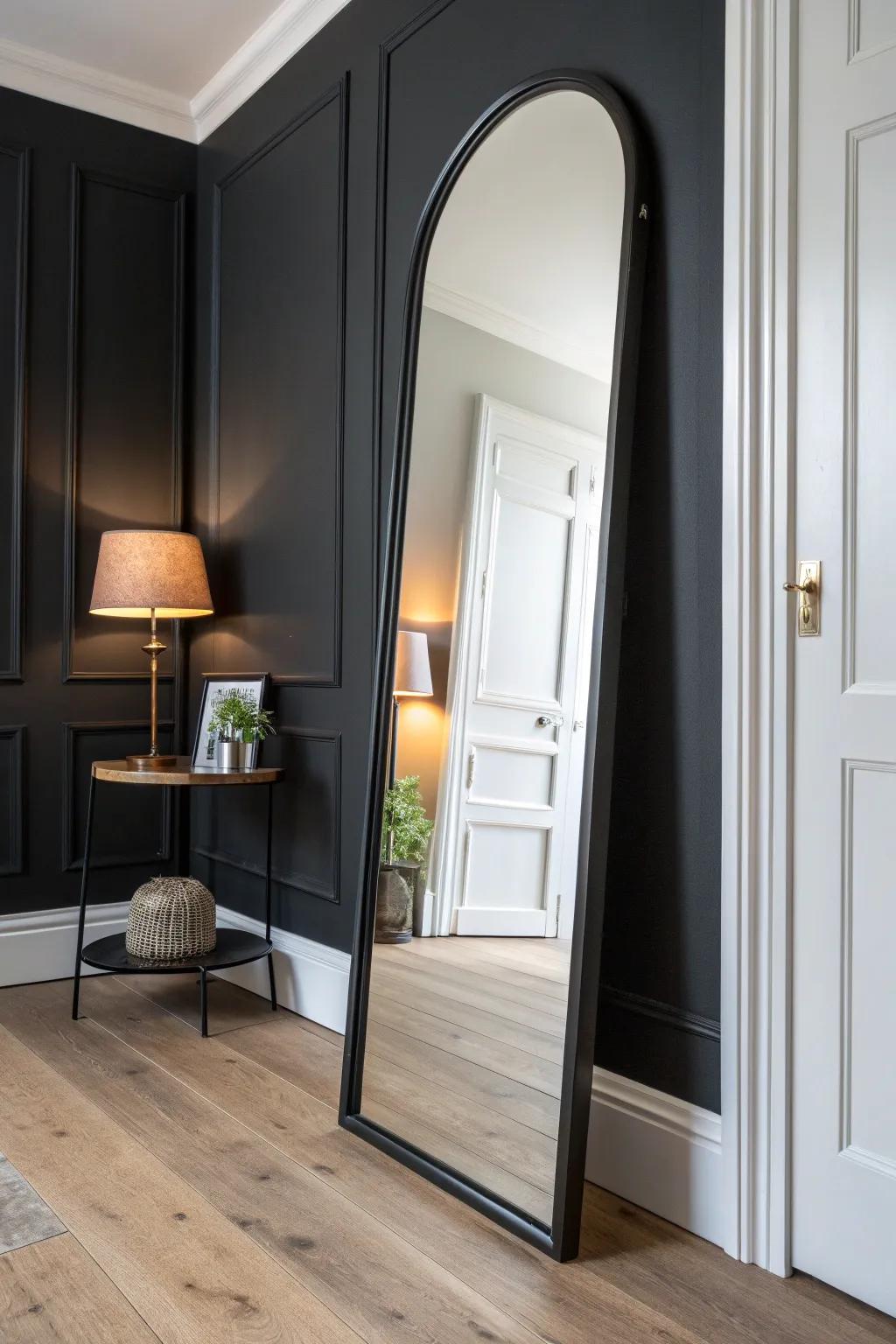
A single painted accent wall behind an arched mirror is the cheapest, most dramatic change you can make to a small hallway. The wall goes dark, burgundy, forest green, ink navy, in a way most people never risk in a pass-through space, and the mirror becomes a bright, arched opening inside that dark field. It's the visual equivalent of a window cut into a deep-colored wall.
A reader named Sorcha painted the wall behind her hallway mirror a deep terracotta. "It was the one wall in the whole house nobody ever looked at," she said, "and now it's the wall everyone comments on. The mirror is what makes it work, without it the wall would just be a dark stripe."
- Choose a color one shade darker than the moodiest tone in the adjacent room, this makes the hallway feel connected, not disconnected.
- Keep the paint matte, or at most eggshell. A gloss finish will fight the mirror's reflection for attention.
- Paint only the wall directly behind the mirror, not the whole hallway. The contrast only reads as intentional when it's contained to a single surface.
A Pair of Matching Arches for a Longer Hall

For a hallway longer than roughly eight feet, a single arched mirror at one end leaves the rest of the wall feeling underused. A pair of matching arches placed symmetrically along the corridor creates rhythm, giving the eye something to move along rather than landing at a single point.
A reader named Fionn described this as "the version that finally made our long hallway stop feeling like a tunnel. One mirror read as an afterthought. Two mirrors, matching, spaced evenly, read as an intentional design decision."
- Measure the total wall length and divide it into three roughly equal segments. Place each mirror at the center of the outer two segments.
- Use identical mirrors in identical frames, exact symmetry is what makes a pair read as intentional. Slightly different sizes will read as mismatched.
- Hang them at exactly the same height from the floor, the eye is far more sensitive to height mismatch than to width mismatch.
Add a Light Source Directly Beside It
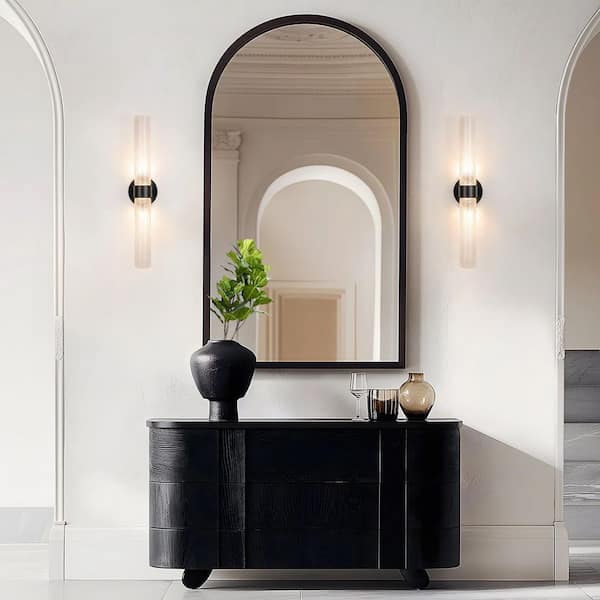
A sconce mounted directly beside an arched mirror does something no amount of paint or framing can: it turns the mirror into a small, warm, self-illuminated feature. The light hits the mirror's frame, reflects off the surface, and is picked up by anyone walking past. Even a single small sconce transforms the entire hallway wall from a thing you walk past into a thing you notice.
A reader named Éabha put a single brass sconce beside her hallway arch, wired to the same switch as her kitchen light. "I'd always thought hallway lighting was basically a corridor thing," she said, "something you turn on so you don't trip. This one light changed the whole wall. It's the thing I notice when I walk in at night."
- Mount the sconce about 6 to 10 inches away from the side of the mirror frame, close enough to light the frame, far enough not to crowd it.
- Match the sconce's metal finish to the mirror's frame, this is the detail that makes the pairing read as a single installation.
- Choose warm bulb temperatures, generally in the 2200–2700K range, cool-toned bulbs will fight the mirror rather than highlight it.
- If you can't add hardwired lighting, a small plug-in sconce with a discreet cord cover works well and can be added to almost any hallway without electrical work.
A Gallery of Small Arches Above a Bench
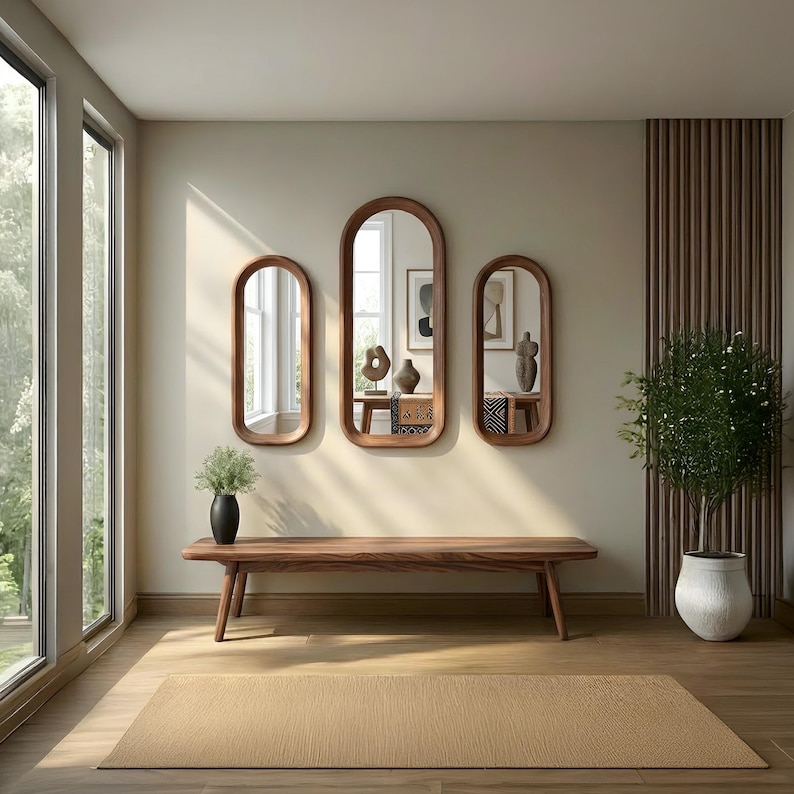
For a genuinely narrow hallway, one that can't accommodate a full-length mirror without hitting a doorframe, a curated cluster of small arched mirrors above a low bench or slim console is the answer. Three to five small arches at varying heights, all sharing a single frame finish, form a gallery composition that reads as an intentional arrangement rather than as a mirror doing a job.
A reader named Aisling described her version as "the one that felt most like art. It's not a mirror doing a functional job anymore, it's a wall composition that happens to include mirrors. That shift made the whole hallway feel elevated."
- Choose three to five mirrors of varying but proportional sizes, all sharing the same frame finish, this is what holds the composition together.
- Arrange them so the largest sits slightly off-center, then step the sizes down around it. Perfectly centered arrangements tend to feel stiff.
- Mount them so the bottom edge of the lowest mirror sits about 12 to 18 inches above whatever furniture is beneath, this is what makes the composition feel anchored rather than floating.
Frameless for Genuinely Tight Walls
If the hallway is genuinely narrow, under 36 inches wide, a framed mirror is going to eat into the visual width it's supposed to expand. A frameless arched mirror mounted flush against the wall gives you the full reflective surface without the frame's added footprint, and it reads as a genuine architectural opening rather than as a framed object.
A reader named Bláthnaid went with a frameless arch in her 34-inch hallway and said it was the version that finally felt right. "Every framed mirror I tried made the hallway feel more closed in," she said. "The frameless one read as a window. The hallway feels wider now, not narrower."
- Confirm the mirror is edge-polished rather than raw-cut. Frameless mirrors with polished edges look intentional, raw-cut mirrors look unfinished.
- Use mirror clips rather than a wire hanger. Clips mount the mirror flush against the wall, which is the whole point of the frameless look.
- Anchor directly into studs, frameless mirrors tend to be larger and heavier than they look.
What to Avoid
- Mounting a mirror across from a blank wall. It will reflect a blank wall, and the hallway will feel exactly as it did before.
- Choosing a mirror whose width is more than about 60% of the hallway's width. It stops reading as a feature and starts reading as a panel.
- Hanging it flush at the very top of the ceiling. The reflection gets cut off at the top, which visually shrinks the space instead of extending it.
- Pairing a thick, ornate frame with a genuinely narrow hallway. The frame's own width competes with the mirror for the wall's visual width.
- Placing the mirror in direct sunlight. The reflection will flare and become more of a glare point than a design feature, worth avoiding if a hallway window faces the wall directly.
Common Questions
Does an arched mirror genuinely make a hallway look bigger, or is that just marketing? It does, but only when placed to reflect a light source or an adjacent room. A mirror reflecting a blank wall doesn't expand a hallway at all, it just occupies wall space.
What's the best height to hang an arched hallway mirror? Center it so your eye and upper body are visible from the middle of the hallway, typically about 60 to 66 inches from the floor to the mirror's center for a half-length mirror, full-length mirrors are typically hung 4 to 6 inches off the floor.
Is one big mirror better than several small ones? For a narrow or short hallway, one mirror is usually stronger, it reads as a single design gesture. For a longer hallway, a pair or a small gallery reads as more intentional than one lonely mirror at the end.
What do I do if my hallway has no light source to reflect? Add one, a wall sconce, a small table lamp on a console, or a plug-in pendant all work without electrical work, and the mirror will immediately have something to reflect.
Can I put a mirror on the same wall as the front door? Yes, but position matters. A mirror directly beside the front door, angled slightly to reflect the hallway beyond, gives the same expanding effect while remaining useful for a quick check before leaving.
Should the mirror match the room at the end of the hallway, or stand alone as a feature? It should feel connected to both. The frame and reflection can reference what's at the end of the hallway while still acting as its own focal point along the way.
What I didn't expect when I started paying attention to hallways was how much of the whole house feels different once the one room everyone walks through twice finally has something to look at. A hallway mirror isn't decoration in the traditional sense, it's a small architectural decision that changes how the space behaves for every single person who passes through it.
If you only do one thing, position the mirror to reflect a light source before you choose a frame color, and let the shape do the rest. Everything else on this list is really just detail on top of that single decision.
— written after walking three different hallways with a tape measure and a light meter, so the pieces here are grounded in what actually changes how a small space feels
Shop the Story
- full length arched mirror brass
- slim arched wall mirror console
- frameless arched mirror polished edge
- small arched mirror set gallery
- brass wall sconce hallway
- matte deep toned hallway paint