8 Living Room Corners You Can Turn Into Useful Space for Under $50
The dead space you've been walking past every day, finally put to work
I counted them once, genuinely curious. Four corners in my living room doing absolutely nothing, empty triangles of floor and wall I'd simply learned not to see anymore, the way you stop noticing a stain on a rug you walk past daily. One held nothing but a lonely floor lamp. Another had become, somehow, permanent storage for a yoga mat I hadn't used in over a year.
What struck me, once I actually started paying attention, was how little it took to fix each one. Not a renovation. Not new furniture in the traditional sense. In most cases, a single well-chosen item under $50 turned a corner I'd been ignoring into a spot I actively used every day.
A quick note before we start: a few of the stories ahead are shared as told to me directly, and a few are offered as illustrative examples to make a principle easier to picture, I've tried to be clear about which is which rather than presenting every anecdote as independently verified.
Here are eight specific corner types nearly every living room has, exactly what to turn each one into, and how to do it without spending more than $50 on any single one.
Table of Contents
- The Dead Corner Behind the Sofa
- The Empty Space Beside a Window
- The Wasted Nook Next to a Bookshelf
- The Blank Wall Opposite Your Main Seating
- The Awkward Space Behind a Door
- The Angled Corner Where Two Walls Meet
- The Forgotten Corner Near the Room's Entry
- The Empty Spot Beside a Fireplace or Media Console
- How to Actually Identify Which Corner Is Worth Fixing First
- Matching a Corner's Size to a Realistic Use
- Common Corner-Fixing Mistakes
- The Full Cost Comparison
- Common Questions
The Dead Corner Behind the Sofa

A slim console turns the overlooked space behind a sofa into useful surface area.
If you've ever floated your sofa away from the wall for the depth-and-warmth effect designers love, you've likely inherited a new problem, a narrow strip of space behind it that instantly became the home for stray cords, a stack of mail, or simply nothing at all.
- Measure the depth of the gap behind your sofa precisely, this space is often narrower than people estimate, typically 10 to 14 inches.
- Choose a console table specifically labeled "slim" or "narrow depth," rather than a standard console sized for a wider space.
- Style the surface with one small lamp and one or two intentional objects, following the same restraint principles that work anywhere else in the room.
- Use the space beneath the console, if any, for a slim basket holding blankets or magazines.
- Confirm the table doesn't block walking paths on either side of the sofa before finalizing placement.
- Turns a narrow, awkward gap into genuine functional surface space
- Adds a lighting layer, useful for the room's overall warmth
- Prevents the space from becoming a catch-all for stray items
Search terms: "slim console table narrow," "small table lamp warm," "narrow storage basket"
The Empty Space Beside a Window

A naturally lit corner can become one of the most inviting spots in the room.
A homeowner shared that the corner beside her living room window had sat empty for two years, she'd always assumed it needed a large piece of furniture to feel intentional, until she realized a single chair and a small side table were genuinely all it needed to become the most-used seat in the house.
- Measure the corner's available floor space, confirming a chair will fit without blocking the window or a walking path.
- Choose one genuinely comfortable chair, prioritizing comfort over size, a smaller, well-cushioned chair often works better than a large but stiff one.
- Add a small side table within arm's reach for a drink or a book.
- Position the chair to actually face the window or the room, not simply wherever it fits, this determines whether the spot gets used daily.
- Add one small floor lamp if the corner lacks adequate reading light in the evening.
- Uses existing natural light as the corner's main asset, no extra lighting cost
- Creates a genuine, personal-use spot, not just decor
- Scales easily to whatever size chair or stool actually fits
Search terms: "small accent chair," "compact side table," "small reading floor lamp"
The Wasted Nook Next to a Bookshelf
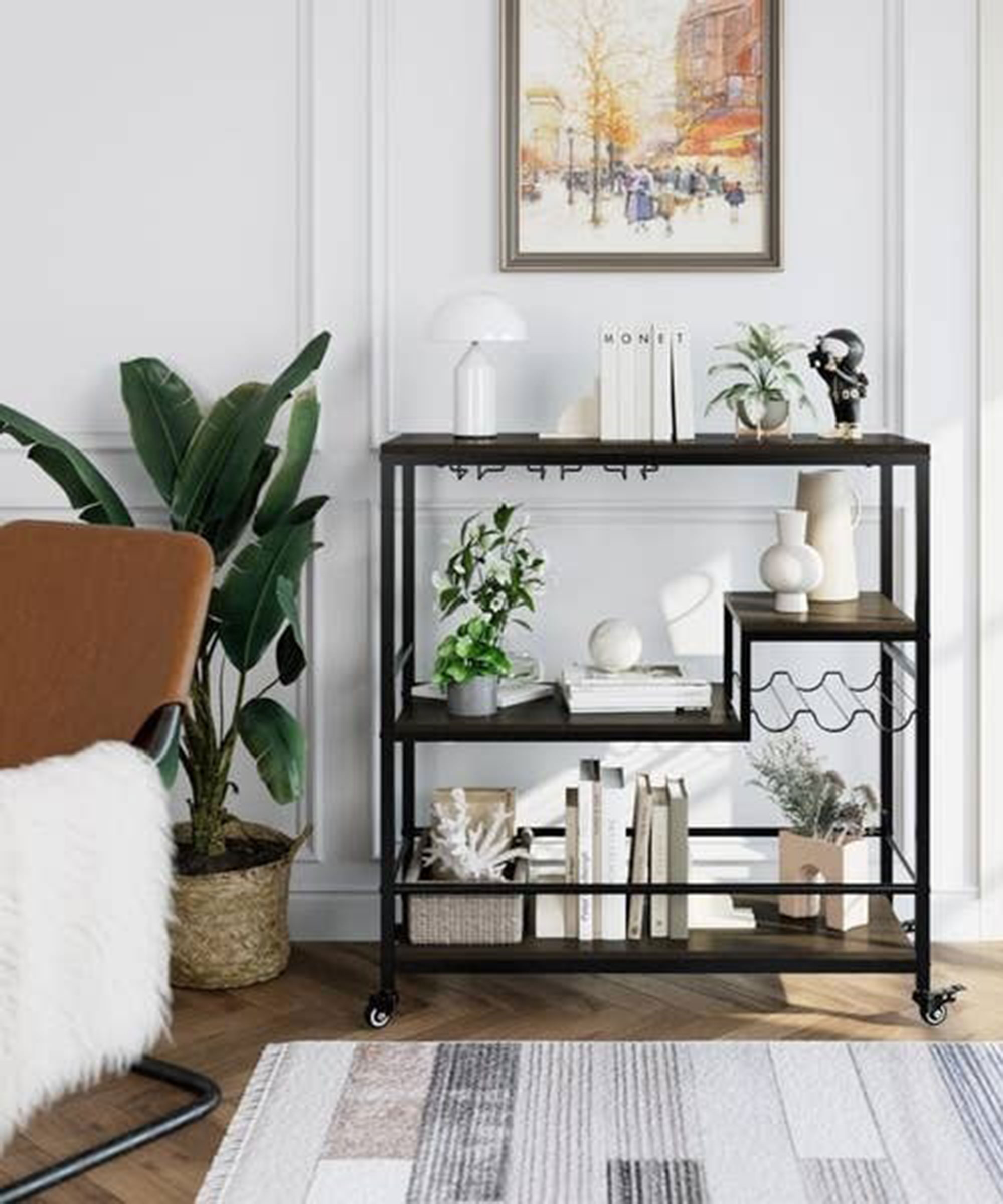
A narrow wheeled cart can turn an awkward gap beside larger furniture into useful storage or display space.
Imagine a reader whose bookshelf left an oddly shaped sliver of space beside it, too narrow for another piece of standard furniture, too visible to ignore entirely. A narrow bar cart, wheeled into that exact gap, turned dead space into her favorite spot for evening drinks.
- Measure the exact width and depth of the nook, oddly shaped gaps beside built-in or large furniture are often narrower than a full standard piece would need.
- Choose a narrow bar cart, plant stand, or slim shelf unit specifically sized to that measurement.
- If choosing a bar cart, style the top shelf simply, glasses, one bottle, a small plant, rather than crowding every surface.
- If choosing a plant stand instead, group two or three plants at varying heights for genuine visual interest in a small footprint.
- Confirm the piece doesn't obstruct access to the bookshelf itself before finalizing placement.
- Matches furniture specifically designed for narrow, irregular gaps
- Adds genuine function, storage, display, or a beverage station, to unused space
- Often mobile on wheels, adding flexibility other furniture lacks
Search terms: "small bar cart narrow," "narrow plant stand tiered," "slim wire shelf unit"
The Blank Wall Opposite Your Main Seating
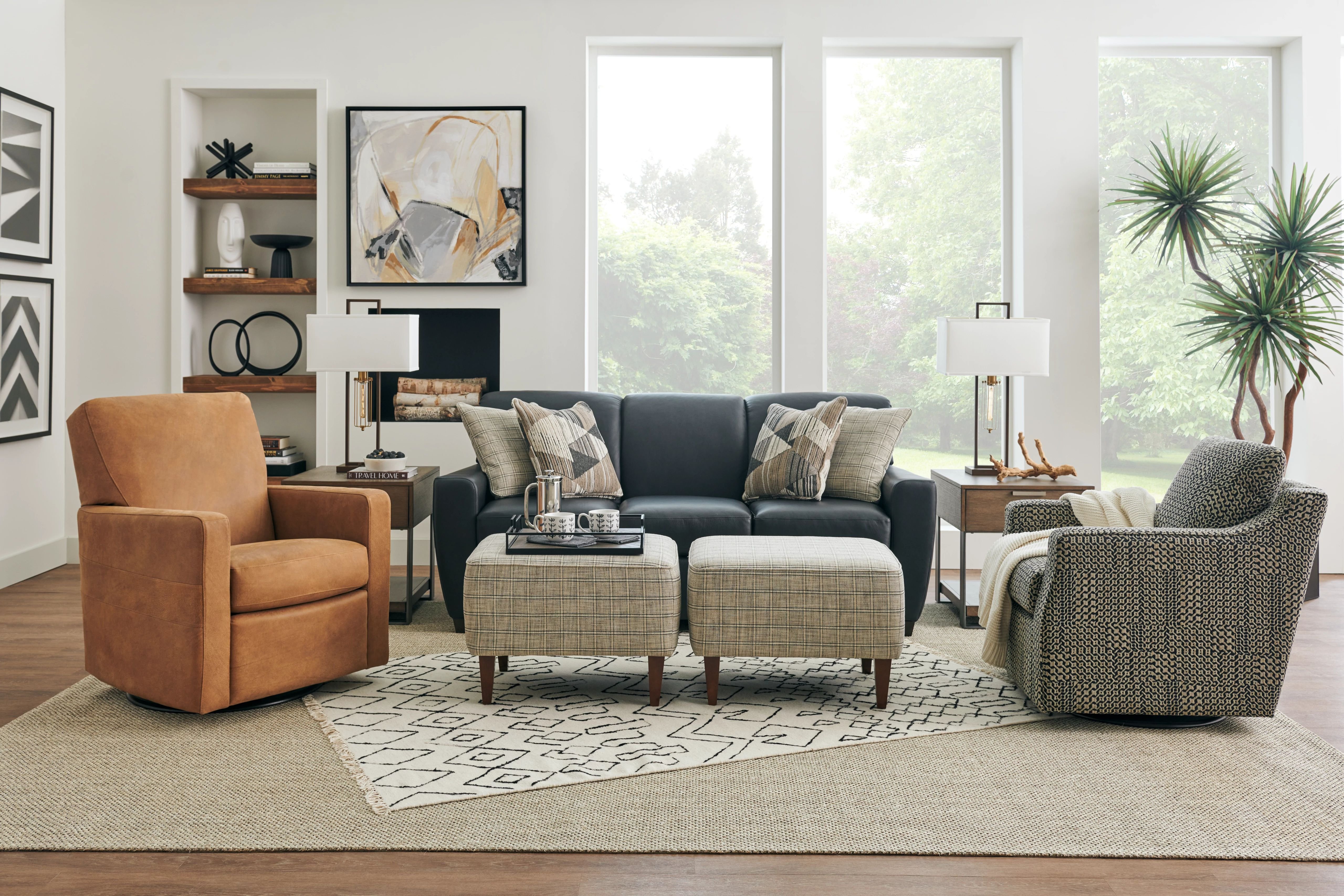
Additional accent seating can turn a one-sofa layout into a more conversational living room.
A homeowner shared that the wall directly across from her sofa stayed completely bare for over a year, she genuinely didn't know what belonged there beyond "eventually, art." A single, confident accent chair angled into that space instead turned her one-sofa living room into a genuine two-seating-zone conversation area.
- Measure the distance between this wall and your sofa, confirming enough space for a chair plus a comfortable walking path.
- Choose a chair with genuine visual presence, since it will be a focal point directly facing the room's main seating.
- Angle the chair slightly toward the sofa and any coffee table, rather than positioning it flush and square against the wall.
- Add a small side table or floor lamp beside it if the spot will be used regularly for reading or conversation.
- Consider a swivel-base chair specifically if the spot needs to flex between facing the sofa and facing a TV or window depending on use.
- Adds genuine seating capacity, not just decoration
- Creates an actual conversation-facing layout, not a room facing only the TV
- Solves the "blank wall" problem with function, not just art
Search terms: "accent chair slim profile," "swivel accent chair," "small side table round"
The Awkward Space Behind a Door
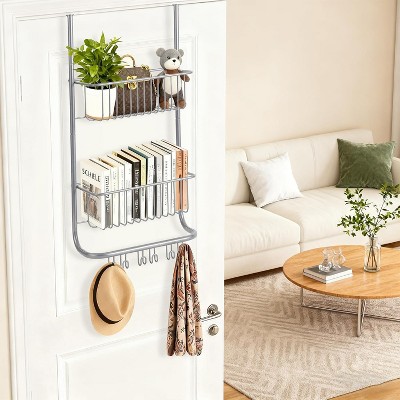
An over-the-door organizer uses vertical space without consuming valuable floor area.
Imagine a reader whose living room door, when fully open, swung directly into a small, entirely dead triangle of space nobody could furnish without blocking the door itself. A slim, over-the-door organizer and a small wall hook solved a corner that genuinely couldn't hold any freestanding furniture at all.
- Confirm the door's full swing path to identify exactly how much space genuinely remains unusable for freestanding furniture.
- Choose an over-the-door organizer or hook system rated for the door's thickness and your intended use, blankets, bags, or a throw.
- Install according to the product's specific instructions, most require no tools beyond hanging the unit over the door itself.
- Keep the visible contents genuinely tidy, this spot is seen constantly since it's directly beside a frequently used door.
- Consider a slim wall-mounted hook beside the door frame instead if an over-the-door option doesn't suit your specific door style.
- Solves a space genuinely too constrained for any freestanding furniture
- Requires no tools or permanent installation
- Adds real storage function where none previously existed
Search terms: "over the door organizer," "wall mounted hook rack," "slim door hook set"
The Angled Corner Where Two Walls Meet

A corner-specific shelf follows the geometry of the walls instead of leaving an awkward unused gap.
A homeowner shared that the ninety-degree corner where two of her living room walls met had never held anything, standard rectangular furniture simply didn't fit that geometry naturally. A dedicated corner shelf unit, built specifically for this exact angle, finally used the space without fighting its shape.
- Measure both walls forming the corner, from the corner point outward, to determine the available footprint on each side.
- Choose a corner-specific shelf unit or plant stand, these are built with an angled or triangular back specifically to fit flush against both walls.
- Style each shelf level with a small, curated grouping rather than filling every level to capacity.
- Consider a corner floor lamp instead if shelving isn't the priority, corner-specific lamp bases are similarly designed to fit this exact geometry.
- Confirm the unit's height doesn't compete visually with other tall elements already in the room.
- Fits the corner's actual geometry with zero wasted gap
- Uses genuinely dead space that standard furniture can't address well
- Available in styles ranging from minimal shelving to plant display
Search terms: "corner shelf unit," "corner plant stand," "corner floating shelf"
The Forgotten Corner Near the Room's Entry
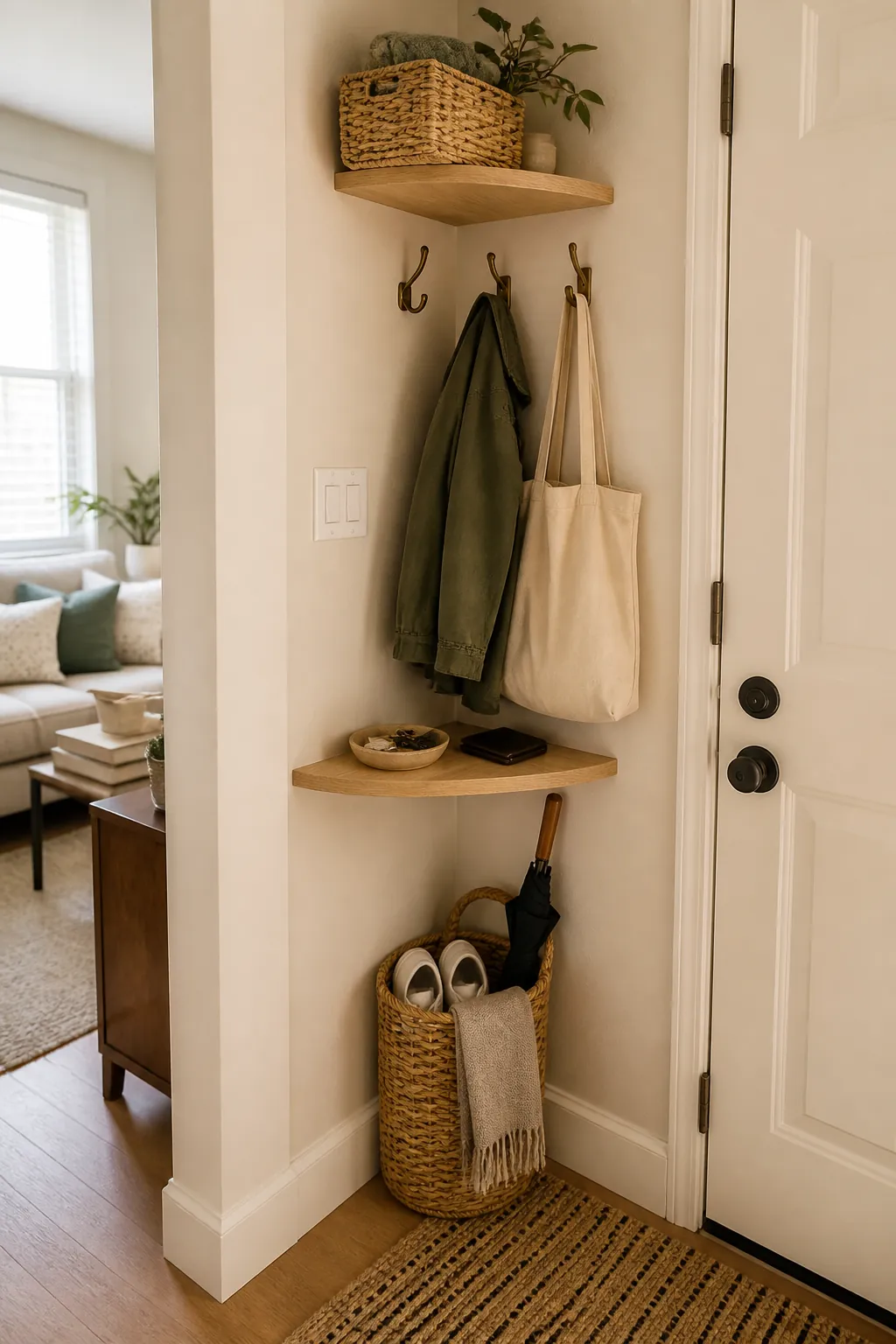
A basket, shelf and hooks create a compact drop zone without requiring a full entryway.
Imagine a reader whose living room's entry point, the spot just inside the doorway, had become an accidental catch-all, shoes kicked off, a bag dropped, nothing intentional about any of it. A small designated basket and a slim hook turned pure accident into an actual, functional mini drop zone.
- Accept that this corner will naturally attract dropped items regardless of what you do, and design around that reality instead of fighting it.
- Add one small basket specifically for the most common dropped item, shoes, bags, or blankets.
- Add a single wall hook or small stand nearby for anything hung rather than placed in the basket.
- Keep the system genuinely small and specific, one basket, one hook, rather than attempting a full entryway setup in a space that isn't actually an entryway.
- Reset this spot as part of the nightly two-minute tidy habit, since it will refill naturally each day.
- Works with natural household habits instead of fighting them
- Contains clutter to one small, designated spot
- Extremely low cost relative to the daily function it provides
Search terms: "small woven basket," "adhesive wall hook heavy duty," "shoe basket entryway"
The Empty Spot Beside a Fireplace or Media Console
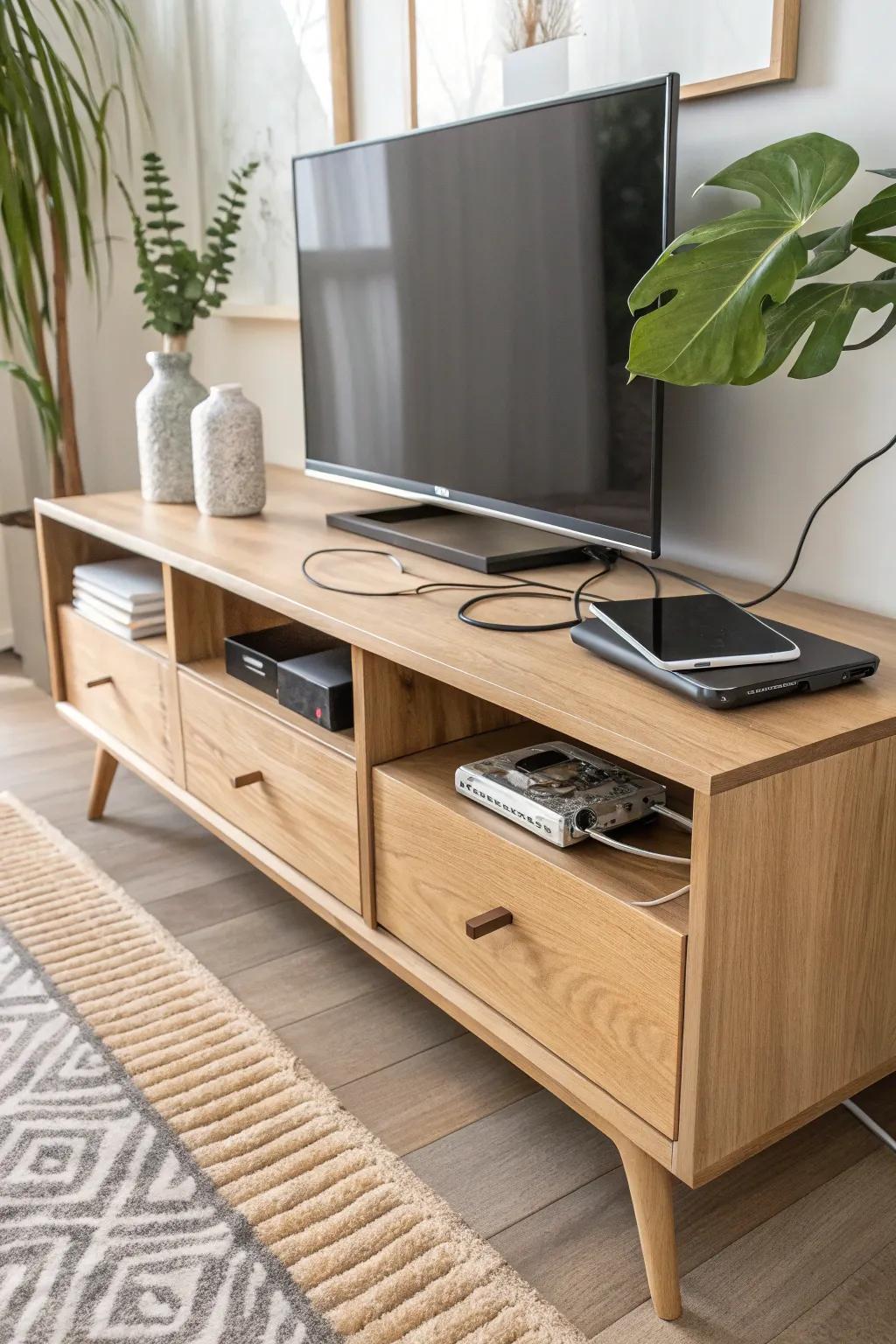
A dedicated charging area keeps devices and cables from taking over the space beside a media console.
A homeowner shared that the narrow gap beside her media console had become an unofficial cable graveyard, chargers and remotes with nowhere else to go. A small charging station tray, placed exactly there, gave every cord and device a genuine, visible home instead of a hidden mess.
- Measure the available gap beside your console or fireplace, this is often narrow enough to rule out standard furniture but perfect for a small tray or slim shelf.
- Choose a small charging station tray or organizer sized specifically to that footprint.
- Route cords along the back or underside of the console to keep them out of sight, rather than letting them trail visibly across the floor.
- Alternatively, if charging isn't the priority, use this same spot for a small plant or a single styled object, following the restraint principles that work anywhere else.
- Confirm any electrical outlet is within reach before finalizing this as a charging-specific solution.
- Contains a genuinely common clutter source, cords and devices, in one spot
- Flexible, works equally well as a charging station or a small display moment
- Uses a footprint too narrow for most other furniture options
Search terms: "charging station tray," "cable management box," "small decorative tray"
How to Actually Identify Which Corner Is Worth Fixing First
Walk through your living room and pay attention to two specific things: which corners your eyes actually skip over without registering, and which corners have quietly become informal storage for items with nowhere else to go. The first category, corners you've genuinely stopped seeing, are usually the ones with the biggest potential visual payoff once addressed, since even a small change there will be immediately noticeable to anyone who visits the room regularly. The second category, accidental storage corners, are usually the ones with the biggest functional payoff, since fixing them solves an actual daily annoyance, not just an aesthetic gap. Prioritize whichever category matters more to how you personally experience the room, some people are bothered more by visual incompleteness, others by functional clutter, and there's no wrong answer between the two.
Matching a Corner's Size to a Realistic Use
- Under 12 inches deep: wall-mounted or over-the-door solutions only, freestanding furniture genuinely won't fit comfortably.
- 12 to 20 inches deep: slim console tables, narrow bar carts, and corner shelving all become realistic options.
- 20 to 30 inches deep: a small accent chair or a compact side table setup fits comfortably with room to actually use it.
- Over 30 inches deep: most standard furniture pieces work, though restraint, one intentional piece rather than several, still matters for how considered the corner ultimately feels.
Common Corner-Fixing Mistakes
- Buying furniture before measuring precisely: the single most common reason a "solution" doesn't actually fit the corner it was meant for.
- Overfilling a small corner with too many items: undermines the intentional feel a well-chosen single piece would achieve instead.
- Ignoring the corner's natural tendency: fighting a natural drop-zone habit instead of designing a small system around it.
- Choosing decor over function in a genuinely functional gap: a cord-cluttered spot needs a charging solution, not simply a plant placed on top of the mess.
- Forgetting to check walking paths: a new piece that blocks natural movement through the room creates a new problem while solving the old one.
The Full Cost Comparison
| Corner Fix | Typical Cost |
|---|---|
| Slim console table | $30–50 |
| Small accent chair + side table | $40–50 (secondhand) |
| Narrow bar cart or plant stand | $25–45 |
| Statement accent chair for blank wall | $45–50 (secondhand) |
| Over-the-door organizer + hook | $15–30 |
| Corner shelf unit | $25–45 |
| Basket + wall hook for entry drop zone | $15–30 |
| Charging station tray | $15–35 |
| Typical cost per corner | Nearly all fall under $50 |
Common Questions
Should I fix all eight corners at once, or one at a time? One at a time is genuinely more sustainable, live with each change for a week or two before moving to the next, this also keeps each individual purchase within the $50 target.
What if my living room only has two or three of these corner types? That's normal, most rooms don't have all eight; focus specifically on the ones your actual space includes rather than trying to force a corner type that doesn't exist in your layout.
Do these fixes work in rented apartments? Nearly all of them, freestanding furniture, wall hooks, and over-the-door organizers require no permanent installation or landlord permission in most cases.
How do I know if a corner is better left empty rather than filled? If you've read the negative-space reasoning in other minimalist-focused articles and genuinely prefer a calmer, less filled room, some corners can absolutely stay empty, these eight ideas are for corners that feel like wasted potential, not every corner needs a fix.
A living room's dead corners were never actually unusable, they were simply unmeasured and unconsidered. Every fix here proves the same point: the space was there the whole time, waiting for a single well-chosen, genuinely affordable piece to finally put it to work.
Start with the cheapest one this weekend, a basket and a hook by the door, and notice how much of the rest of the room starts feeling more finished once even one corner stops being ignored.
Shop the Story
- slim console table narrow
- small accent chair
- small bar cart narrow
- corner shelf unit
- over the door organizer
- charging station tray
- small woven basket
- adhesive wall hook heavy duty
- compact side table
- narrow plant stand tiered