6 Small Entryway Ideas That Make a Tiny Foyer Feel Designed
Space-saving ideas for even the smallest foyer, no square footage required
My entryway was, generously, three feet wide. A closet door on one side, a wall on the other, and a floor that became a landing pad for shoes, mail, and whatever I was carrying the moment I walked in. For a long time I assumed a "real" entryway, the kind with a console table and a proper bench, simply wasn't possible in a space that size.
What actually changed it wasn't more space. It was realizing an entryway isn't defined by square footage at all, it's defined by whether it has a system. Even three feet of wall, used correctly, does the same job a full foyer does.
A quick note before we start: a few of the stories ahead are shared as told to me directly, and a few are offered as illustrative examples to make a principle easier to picture, I've tried to be clear about which is which rather than presenting every anecdote as independently verified.
Here are six ways to make even the tightest entryway feel genuinely designed, not just squeezed into.
Table of Contents
- A Wall-Mounted Drop Zone Instead of a Console
- Vertical Shoe Storage, Not Floor Space
- One Oversized Mirror to Open the Space
- A Slim Bench With Hidden Storage
- Layered Lighting at the Door
- A Vertical Accent That Draws the Eye Up
- The Four Zones Every Entryway Needs
- Common Small Entryway Mistakes
- The Full Cost Comparison
- Common Questions
A Wall-Mounted Drop Zone Instead of a Console
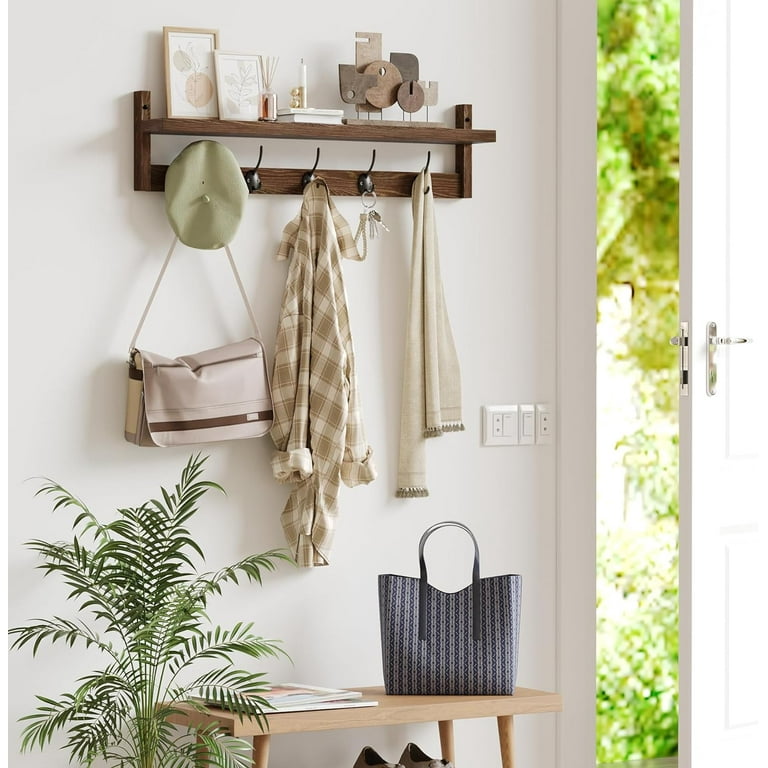
I spent months wanting a console table before realizing my entryway simply didn't have the floor depth for one without blocking the door's swing entirely. A wall-mounted shelf with hooks beneath it did the exact same job, keys, mail, a quick spot to set something down, using zero floor space at all.
- Measure your available wall width and choose a shelf sized to fit without obstructing the door swing.
- Mount at a height that clears coat hooks placed beneath it, typically 42 to 48 inches from the floor.
- Add three to five hooks below, spaced for coats, bags, and keys separately.
- Keep the shelf surface itself styled sparingly, one tray for keys, one small dish, rather than letting it become new clutter.
- Empty and reset the drop zone nightly as a two-minute habit, this is what keeps a small space from feeling cluttered.
- Delivers full console-table function with zero floor footprint
- Keeps the door's swing path completely clear
- Scales to genuinely narrow walls other furniture can't fit
Search terms: "floating entryway shelf," "wall mounted coat hooks," "adhesive wall hooks heavy duty"
Vertical Shoe Storage, Not Floor Space

A homeowner shared that her entryway floor had become an ever-growing pile of shoes, since a traditional shoe rack simply didn't fit her available width. Switching to a slim, vertical shoe cabinet solved it, the same shoe capacity, using a fraction of the floor footprint.
- Measure your available wall width precisely, narrow vertical cabinets are often available in surprisingly slim profiles.
- Choose a design with angled or tilted internal shelves specifically built for shoe storage, maximizing capacity per inch of depth.
- Position it where the door can still swing fully open without obstruction.
- Reserve the top surface for a small tray or single decorative object, keeping it from becoming an additional clutter zone.
- Store only in-season, frequently worn shoes here, rotating seasonal pairs to a closet elsewhere.
- Maximizes shoe capacity in minimal floor footprint
- Keeps the entry floor genuinely clear and walkable
- Doubles as a styling surface on top
Search terms: "narrow vertical shoe cabinet," "over the door shoe organizer," "slim entryway shoe storage"
One Oversized Mirror to Open the Space
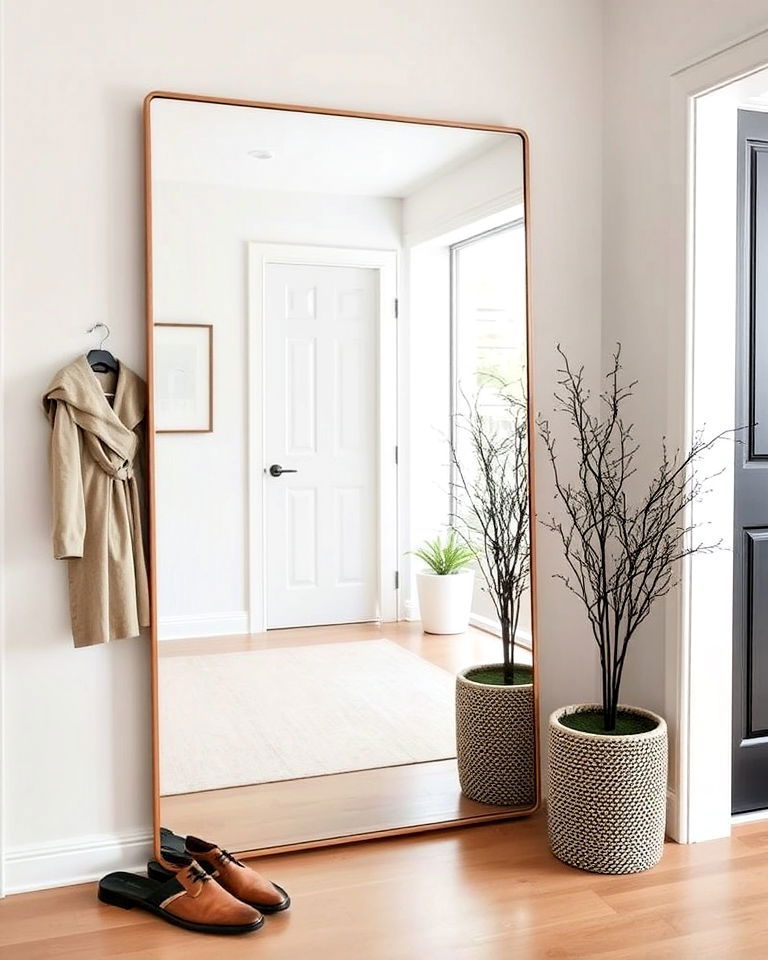
Imagine a reader whose narrow entryway felt genuinely claustrophobic, a hallway more than a room, until she leaned a single large mirror against the one open wall she had. The space didn't get any bigger. It simply stopped feeling like a corridor.
- Measure your available wall height and width, choosing a mirror as large as the space reasonably allows.
- Position it across from or adjacent to your entry door, so it reflects incoming light rather than a blank wall.
- Lean rather than mount, if floor space allows, for an effortless, editorial look with zero wall damage.
- Anchor the base with a small stack of books or a slim console piece for stability if leaning.
- Keep the wall around the mirror otherwise uncluttered, letting it be the singular visual moment in the space.
- Reflects light, making a dim entry feel noticeably brighter
- Creates the visual sense of a larger, less corridor-like space
- Doubles as a genuinely useful last-look mirror before heading out
Search terms: "large leaning floor mirror," "oversized wall mirror entryway," "museum putty"
A Slim Bench With Hidden Storage
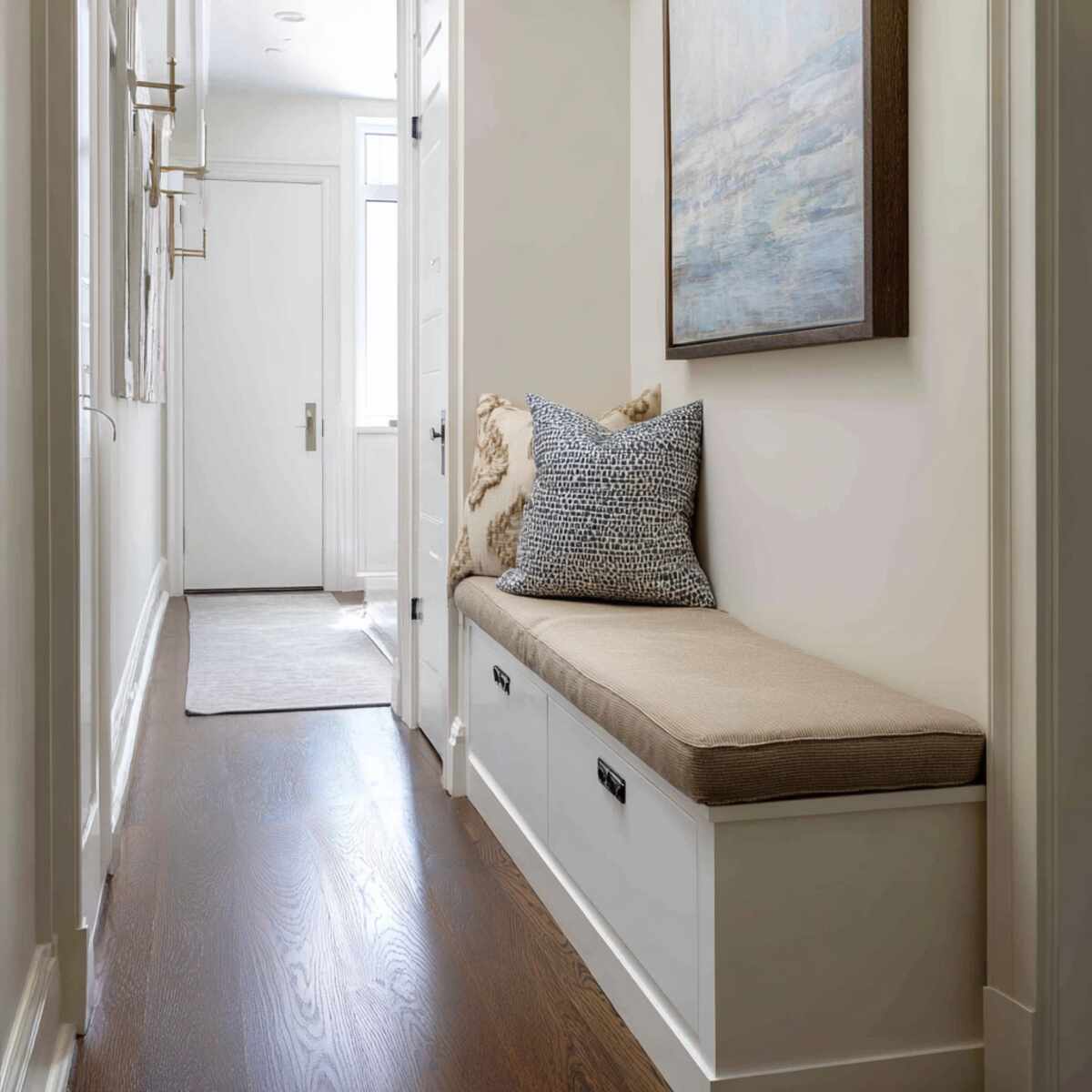
One homeowner shared that she'd resigned herself to standing while putting on shoes for years, since a full bench felt impossible in her narrow entry. A slim storage bench, sized specifically to fit the available depth, gave her somewhere to sit and somewhere to hide clutter, both at once.
- Measure the exact depth available between the door's swing and any opposite wall or furniture.
- Choose a bench specifically labeled slim or narrow-depth, rather than a standard entryway bench sized for larger foyers.
- Prioritize a lift-top or drawer-style storage compartment underneath for hiding daily clutter.
- Position it where it doesn't obstruct the door's full swing or the main walking path.
- Use the top surface as your seated shoe-changing spot, keeping it otherwise clear rather than styled with decor.
- Adds genuine seating function to a space that seemed to have no room for it
- Hides daily clutter inside rather than leaving it visible
- Makes the daily shoe-changing routine noticeably easier
Search terms: "narrow depth storage bench," "slim entryway bench with storage," "wall mounted flip down seat"
Layered Lighting at the Door
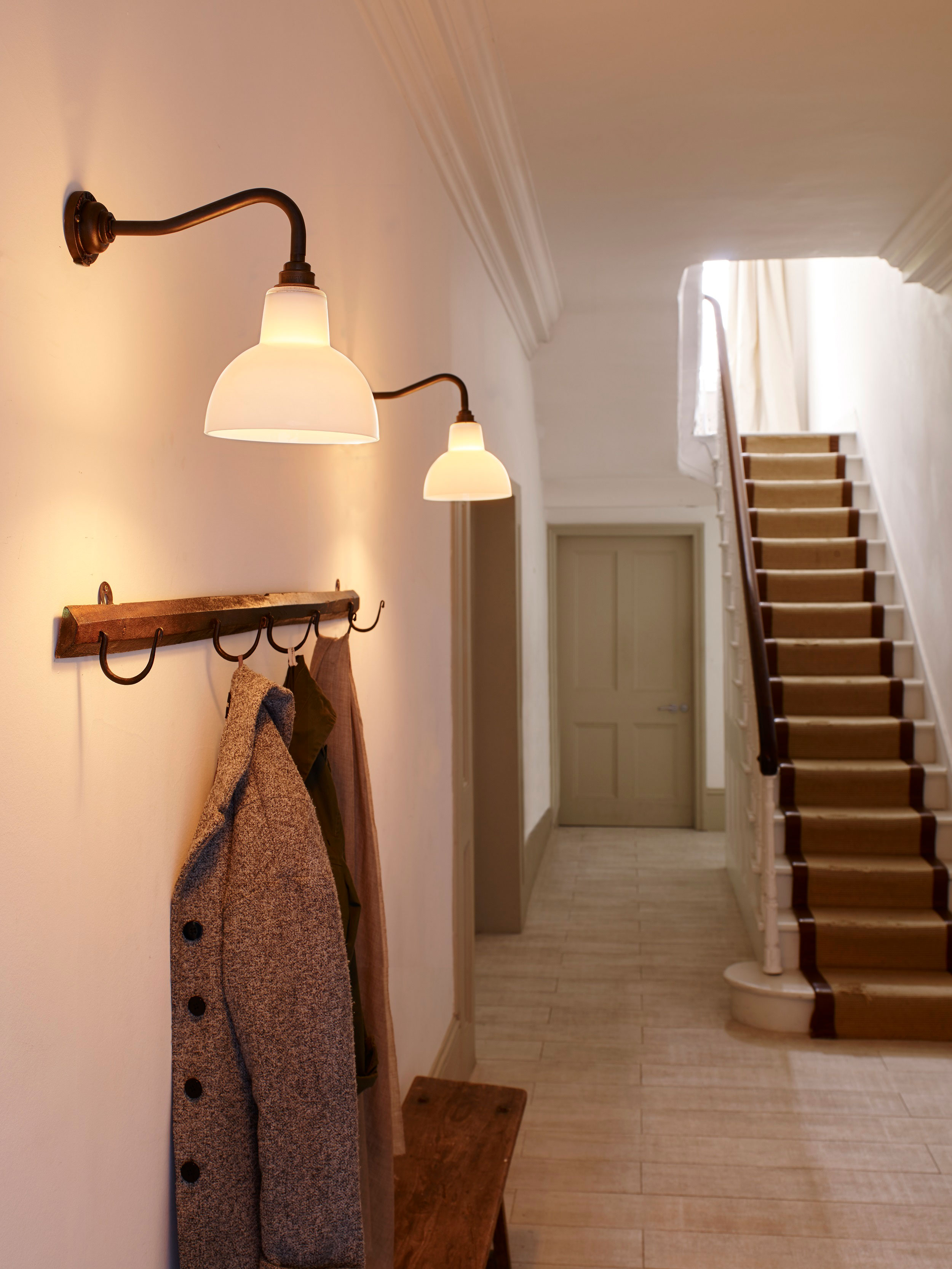
My entryway relied on a single, harsh overhead bulb for years, the kind that made the space feel like a hallway you passed through quickly rather than a room worth pausing in. Adding one small wall sconce at eye level changed the whole feel of walking in the door.
- Add one wall sconce or small plug-in lamp at a lower height than your existing overhead fixture.
- Choose warm white bulbs (2700K to 3000K) throughout, consistent with the rest of your home's lighting tone.
- Position the additional light source to illuminate the mirror or drop zone specifically, not just the floor.
- Use battery or plug-in sconces if drilling for hardwired fixtures isn't an option in a rental.
- Test the full setup in the evening specifically, since entryways are often used most right at dusk or after dark.
- Creates a warmer first impression than a single overhead bulb
- Illuminates the mirror and drop zone specifically, where it's needed
- Achievable without any hardwiring in a rental
Search terms: "battery operated wall sconce," "warm white LED bulb," "plug in entryway lamp"
A Vertical Accent That Draws the Eye Up
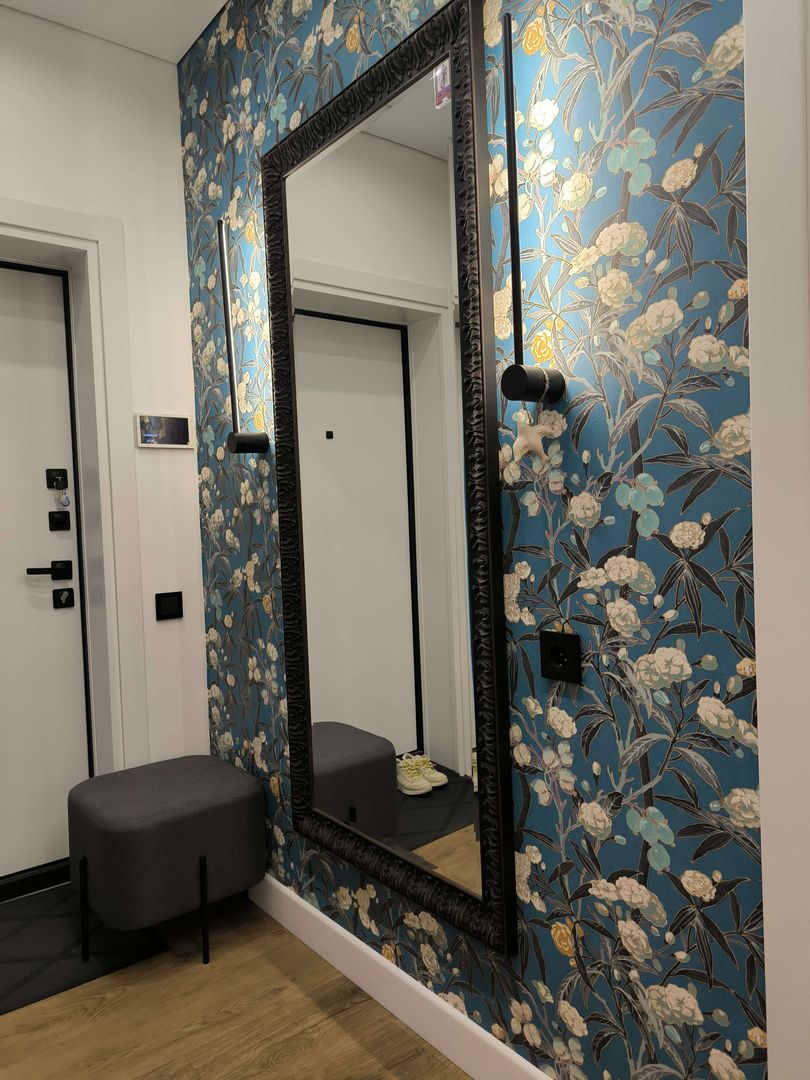
A homeowner shared that her narrow entryway felt tunnel-like until she added one tall, narrow element, a slim decorative mirror stacked above her console shelf, drawing the eye upward the same way it does in a low-ceilinged room.
- Choose one tall, narrow element specifically, rather than another wide, horizontal piece.
- Consider a vertical-striped or textured removable wallpaper on just one accent wall if floor space is too tight for additional furniture.
- Position the vertical element where it's the first thing seen upon entering, not tucked in a corner.
- Keep everything else in the space deliberately low-profile so the vertical piece isn't visually competing with anything.
- Extend the element as close to the ceiling as reasonably possible for maximum height impact.
- Counters the tunnel-like feeling of a narrow entry
- Draws the eye upward the moment someone walks in
- Works alongside, not instead of, the other five ideas here
Search terms: "vertical stripe removable wallpaper," "tall narrow wall mirror," "slim decorative wall panel"
The Four Zones Every Entryway Needs
Regardless of square footage, a genuinely functional entryway covers four zones, even if they're compressed into just a few feet of wall: a landing spot for keys and small items (Idea 1), storage for shoes (Idea 2), a moment to check your appearance before leaving (Idea 3), and somewhere to sit while changing shoes (Idea 4). A truly tiny foyer can combine these, a bench with storage underneath covers two zones at once, but skipping a zone entirely, rather than compressing it, is usually what makes a small entryway feel unfinished rather than simply small.
Common Small Entryway Mistakes
- Buying furniture sized for a larger foyer: standard console tables and benches often simply don't fit; always measure before shopping, not after.
- Skipping a mirror entirely: assuming there's no room, when even a narrow leaning mirror does real work in a tight space.
- Letting the drop zone become permanent clutter: without a nightly reset habit, any small system fills up and stops functioning.
- Relying on one harsh overhead light: the same lighting mistake that flattens living rooms applies here too.
- Ignoring the door's swing path: furniture that blocks the door from opening fully defeats the purpose of any entryway upgrade.
The Full Cost Comparison
| Idea | Typical Cost |
|---|---|
| Floating shelf + hooks | $25–65 |
| Vertical shoe storage | $40–120 |
| Large leaning mirror | $30–100 |
| Slim storage bench | $60–160 |
| Battery wall sconce + bulbs | $20–50 |
| Vertical wallpaper accent | $35–90 |
| Typical full small-entryway setup | Most setups fall under $350 total |
Common Questions
What if my entryway is genuinely under 10 square feet? Prioritize the wall-mounted drop zone and a leaning mirror first, both work in even the narrowest sliver of wall space; a bench may not be realistic below a certain width, and that's fine to skip.
Which idea makes the biggest difference for the least cost? The large leaning mirror consistently delivers the most noticeable transformation relative to its price on this entire list.
Do I need permission from my landlord for any of this? Adhesive hooks, leaning mirrors, freestanding benches, and battery sconces typically require no permission; always confirm before drilling for a hardwired fixture or mounted shelf.
Can I combine several of these ideas in a genuinely tiny space? Yes, a wall-mounted shelf, a leaning mirror beside it, and one sconce above is a complete, functional setup that fits in a surprisingly narrow footprint.
A tiny foyer was never actually disqualified from feeling designed. Every idea here proves the same point: an entryway's real job was never about square footage, it was about whether it has an actual system behind it.
Start with the cheapest one this weekend, a leaning mirror or a single floating shelf, and let the smallest wall in your home finally earn its keep.
Shop the Story
- floating entryway shelf
- wall mounted coat hooks
- narrow vertical shoe cabinet
- large leaning floor mirror
- narrow depth storage bench
- battery operated wall sconce
- vertical stripe removable wallpaper
- over the door shoe organizer
- museum putty
- warm white LED bulb