
7 TV Wall Tricks That Make the Screen Feel Less Noticeable
Real ways to soften a TV's presence, without hiding it behind a cabinet door
My television sat dead center on the largest wall in my living room for years, a flat black rectangle I'd built my entire seating arrangement around without ever really questioning it. Every design magazine photo I admired seemed to feature rooms without a single visible screen, and I genuinely believed that meant those homeowners simply didn't own one, or hid it away in some other, less photographed room.
Then I actually visited a friend's home and realized her TV wasn't hidden at all, it was mounted in plain sight, on the same wall I'd have put mine, and I hadn't even registered it as the room's focal point until she pointed it out. The screen was still there. It had simply stopped being the loudest thing in the room.
A quick note before we start: a few of the stories ahead are shared as told to me directly, and a few are offered as illustrative examples to make a principle easier to picture, I've tried to be clear about which is which rather than presenting every anecdote as independently verified.
Here are seven real tricks that reduce how much a TV visually dominates a room, none of which require replacing the TV itself or building a hidden cabinet.
Table of Contents
- Paint the Wall Behind It to Match the Bezel
- Build a Gallery Wall Around It, Not Just Beside It
- Flank It With Symmetrical Open Shelving
- Conceal Every Visible Cord
- Style the Console Beneath It to Draw the Eye Down
- Use a Frame or Art Cover Specifically Designed for This
- Mount It Lower and More Integrated Than You Think
- The Design Logic: Why a Screen Reads as Intrusive in the First Place
- Matching Your Wall Color to Your Specific TV's Bezel
- A Room-Type Guide for Which Tricks Matter Most
- Common TV Wall Styling Mistakes
- The Full Cost Comparison
- Common Questions
Paint the Wall Behind It to Match the Bezel
The single most effective, and most overlooked, trick on this entire list costs nothing but a can of paint. Most TVs have a black or very dark gray bezel, the thin frame around the screen itself, and most walls are a light neutral. That contrast is precisely what makes a TV read as a stark, floating black rectangle rather than something that belongs to the wall.

- Identify your TV's exact bezel color, most are a true black or very deep charcoal, check in natural daylight rather than under a bright showroom-style light.
- Choose a wall paint in that same dark family for the specific section directly behind and around the TV, either the full wall or a defined accent zone.
- Test a sample patch first, exactly as with any paint decision, dark colors shift meaningfully depending on your room's actual lighting.
- Consider a matte or eggshell finish rather than gloss, gloss can create unwanted reflections directly behind a screen.
- Extend the dark color at least several inches beyond the TV's actual edges on all sides, a tight, exact match to the TV's outline can look accidental rather than intentional.
- Removes the harsh contrast that makes a screen visually jump forward
- One of the cheapest fixes on this entire list
- Works regardless of TV size or mounting style
Search terms: "deep charcoal paint," "matte black wall paint," "near black interior paint"
Build a Gallery Wall Around It, Not Just Beside It
A homeowner shared that she'd always kept art well away from her TV, assuming the two didn't belong in the same visual grouping. When she finally tried surrounding the screen with a loose cluster of frames instead, the TV stopped reading as a separate, dominant object and became simply one more rectangle within a larger, intentional composition.

- Choose frames in a similar dark tone to the TV's bezel, so the screen doesn't read as the one obviously different rectangle in the grouping.
- Arrange frames in a salon-style cluster directly around the TV, treating its position as one "frame" within the layout, not a separate element beside it.
- Lay the full arrangement out on the floor first, including a cutout or placeholder for the TV's actual dimensions, before committing to any wall placement.
- Keep spacing between frames and the TV consistent with the spacing between the frames themselves, this consistency is what sells the "part of one composition" effect.
- Choose art with some visual weight and color, entirely blank or white-mat-heavy frames can look washed out beside a bright, active screen.
- Reframes the TV as one element within a composition, not a standalone object
- Adds genuine personality and warmth to an otherwise media-dominated wall
- Scales from a dense salon cluster to a minimal two-piece flanking arrangement
Search terms: "dark frame gallery set," "printable wall art download," "matching black picture frames"
Flank It With Symmetrical Open Shelving
Imagine a reader whose TV sat alone on a large, otherwise bare wall, with nothing to visually anchor it into the room's broader design. Adding matching open shelving on either side, styled with books and small objects, turned the whole wall into a single, deliberate composition, the same way a fireplace with flanking built-ins reads as considered rather than accidental.
- Measure equal distances on either side of the TV for symmetrical shelf placement.
- Choose matching floating shelves or slim vertical units, identical on both sides for genuine symmetry.
- Style each side with a small, cohesive grouping, books, a plant, one or two decorative objects, mirrored loosely rather than identically item for item.
- Keep shelf height positioned so the TV remains the visual center, not overwhelmed by taller shelving units on either side.
- Maintain the styling over time, per the odd-number and restraint principles that work anywhere else in a home, an overstyled shelf undermines the calm, considered effect.
- Mimics the classic built-in look associated with considered, custom design
- Adds genuine storage and display function alongside the visual softening
- Makes the TV feel like the planned center of a room, not an afterthought
Search terms: "floating shelf pair," "matching wall shelves," "slim vertical shelving unit"
Conceal Every Visible Cord
A homeowner shared that no amount of styling around her TV made much difference until she finally addressed the tangle of cords hanging visibly down the wall beneath it, a detail she'd stopped noticing entirely until a photo of the room made it suddenly, embarrassingly obvious.
- Identify every visible cord, power, HDMI, any streaming device cables, running from the TV down to the console or outlet.
- Choose a paintable cord cover channel that runs flush along the wall, paintable to match your wall color exactly, from the TV down to the outlet or console.
- For a more finished look, consider an in-wall cord management kit, which routes cords genuinely inside the wall between two outlet plates, though this requires more installation effort.
- Bundle any remaining loose cords behind the console itself with simple cable ties or a cord sleeve.
- Confirm cord covers are rated for your specific cable types and quantity before purchasing, overloaded channels can bulge or fail to sit flush.
- Removes one of the most common, most visually distracting elements of a TV wall
- Makes every other styling effort actually register, rather than being undercut by visible clutter
- Achievable at nearly any budget level, from a simple paintable channel to a full in-wall kit
Search terms: "paintable cord cover channel," "in wall cable management kit," "cord sleeve organizer"
Style the Console Beneath It to Draw the Eye Down
Imagine a reader whose TV console held nothing but the media equipment itself, a stack of black boxes beneath an equally black screen, doubling down on exactly the visual weight she'd been trying to reduce. Adding warm, textured styling to the console, a woven basket, a plant, a stack of books, gave the eye somewhere else to land besides straight at the screen.

- Assess what's currently visible on your console, if it's purely dark media equipment, this compounds the TV's visual weight rather than balancing it.
- Add warm, textured elements specifically, a woven basket, a wood-toned object, a plant, in contrast to the console's likely dark or neutral surface.
- Position styled items to one side rather than centered directly beneath the screen, centering doubles down on the TV's central visual weight instead of counterbalancing it.
- Keep styling genuinely restrained, per the coffee table and shelf styling principles used throughout, two or three items is usually sufficient.
- Consider a textured console material itself, rattan, woven front panels, warm wood, if you're in the market for a new piece, rather than a sleek, dark, uniform surface.
- Gives the eye a warm, textured landing point besides the screen itself
- Counterbalances rather than compounds the TV's visual weight
- Uses a surface that's already directly in the same sightline as the TV
Search terms: "woven storage basket," "console table decor," "small potted plant warm tone"
Use a Frame or Art Cover Specifically Designed for This
A homeowner shared that she'd resisted the idea of a decorative TV frame or cover for years, assuming it would look gimmicky, until she saw a genuinely well-made version in person and realized the difference between a cheap novelty product and one designed with real material quality was significant.
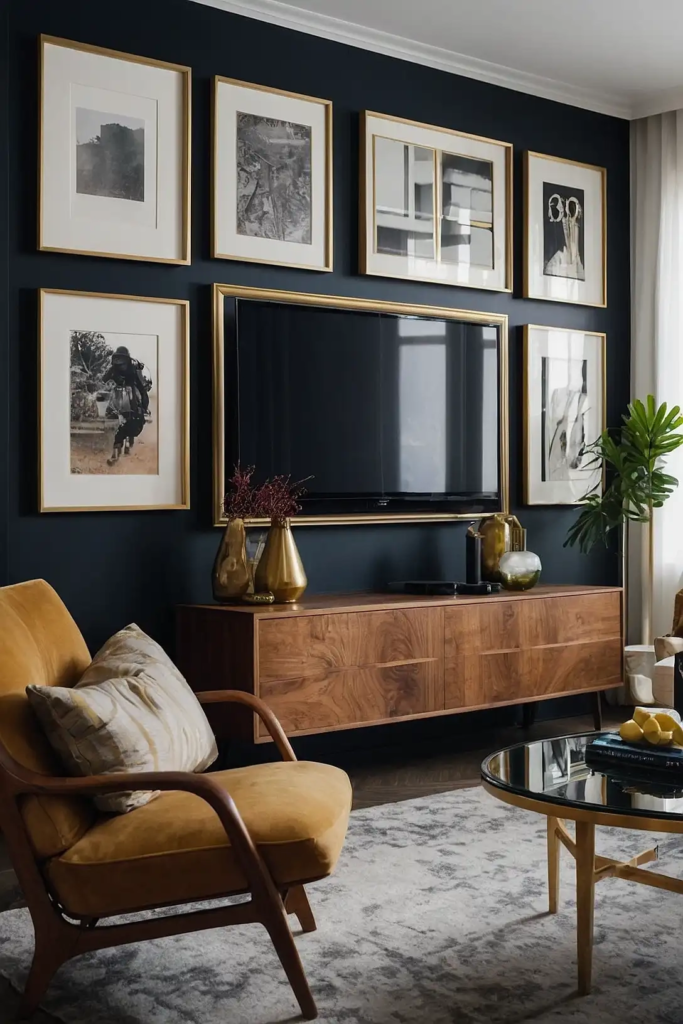
- Measure your specific TV model precisely, these products are generally sized to exact screen dimensions, not universal fits.
- Choose a frame material and finish that matches your existing room's other wood tones or hardware finishes, rather than a mismatched or generic option.
- For an art-cover style product, verify compatibility with your specific TV's mounting system before purchasing.
- Check genuine buyer reviews and photos specifically, rather than only manufacturer marketing images, to confirm how convincing the product looks in a real home setting.
- Budget for the higher end of this specific category if pursuing it at all, this is one trick where lower-cost versions tend to undermine rather than achieve the intended effect.
- Directly addresses the screen's appearance even when powered off
- Higher-quality versions integrate convincingly into a considered room
- Can be combined with several other tricks on this list for a layered effect
Search terms: "TV frame wood mount," "decorative TV bezel frame," "TV art cover panel"
Mount It Lower and More Integrated Than You Think
Imagine a reader whose TV had been mounted noticeably higher than her actual seated eye level, a common installer default that left the screen floating alone near the top of the wall, isolated from the console and furniture below it. Remounting it several inches lower, closer to eye level from the sofa, immediately integrated it into the room's overall furniture line rather than leaving it visually stranded above everything else.
- Sit in your actual main seating position and note where your eyes naturally rest looking forward, this is your target center height for the screen.
- Measure your TV's specific dimensions to calculate where the mounting bracket needs to sit for the screen's center to land at that eye-level point.
- Remount using the existing bracket if the height adjustment is modest, or a new bracket if a significant height change is needed.
- Reassess the console and any flanking shelving heights once the TV is remounted, these may need slight adjustment to maintain visual balance at the new position.
- Confirm the new height still allows comfortable viewing from every seat in the room, not just the primary sofa position.
- Integrates the TV into the same visual line as furniture, rather than floating separately
- Improves genuine comfort and neck strain during actual viewing, not just appearance
- Free if adjusting an existing bracket rather than buying a new one
Search terms: "TV wall mount bracket," "low profile TV mount," "adjustable height TV mount"
The Design Logic: Why a Screen Reads as Intrusive in the First Place
A television is, visually speaking, an unusual object in most rooms for a specific reason: it's a flat, uniformly dark rectangle with hard, geometric edges, sitting among furniture and decor that's almost entirely soft-edged, textured, and irregular by comparison. Our eyes are naturally drawn to contrast and to sharp, regular geometry set against a busier, more organic background, which is precisely why a TV, even a relatively small one, tends to pull visual attention disproportionate to its actual size. Every trick on this list works by addressing one specific piece of that contrast: matching the wall color removes the dark-against-light edge contrast; the gallery wall and flanking shelving break up the TV's isolated geometric shape by surrounding it with other rectangles and organic textures; styling the console adds warmth and texture directly in the same sightline; and lowering the mount integrates the TV into the room's existing furniture line rather than leaving it as an isolated element near the ceiling. None of these tricks make the TV physically smaller, they all work by reducing the specific visual contrast that makes a screen read as intrusive in the first place.
Matching Your Wall Color to Your Specific TV's Bezel
Not every TV has the same bezel tone, and matching correctly matters for how convincing Trick 1 ultimately looks. Most modern TVs use a true or near-true black bezel, pairing well with a deep charcoal or near-black warm brown wall tone. Some older or budget models use a slightly warmer dark gray or brown-black bezel, worth checking against your wall paint sample directly rather than assuming pure black is always the correct match. If your TV's bezel is genuinely thin or nearly edge-to-edge, this trick matters less, since there's less visible frame contrast to begin with, and your effort may be better spent on the gallery wall or console styling tricks instead.
A Room-Type Guide for Which Tricks Matter Most
- Small apartments with one main living space: prioritize wall color matching (Trick 1) and cord concealment (Trick 4), both work in any layout and cost the least.
- Formal or frequently photographed living rooms: the gallery wall (Trick 2) and a quality frame or art cover (Trick 6) deliver the strongest visual transformation.
- Rooms with a wide, blank wall dedicated to the TV: flanking shelving (Trick 3) makes the biggest structural difference, giving the wall genuine architectural purpose.
- Rented spaces with mounting restrictions: focus on wall color, cord concealment, and console styling, tricks 1, 4, and 5, none require any wall modification.
- Any room where the TV was installed without input on placement: start with remounting at proper eye level (Trick 7) before layering in any other trick.
Common TV Wall Styling Mistakes
- Styling everything except the wall color: the single highest-impact, lowest-cost trick is also the most commonly skipped.
- Leaving cords visible while investing in other styling: undermines every other effort by drawing the eye to the messiest element.
- Mounting height decided by an installer, not by actual seated eye level: leaves the TV visually stranded regardless of what else changes.
- Choosing a low-quality TV frame or cover product: can look more gimmicky than the plain screen it was meant to soften.
- Overstyling the console directly beneath the screen: too many objects compete with, rather than complement, the TV above.
The Full Cost Comparison
| Trick | Typical Cost |
|---|---|
| Wall paint matching bezel | $10–40 |
| Gallery wall around the TV | $60–200 |
| Symmetrical flanking shelving | $50–150 |
| Cord concealment (channel or kit) | $15–80 |
| Console styling | $20–60 |
| Dedicated TV frame or art cover | $150–500+ |
| Remounting at correct height | $0–40 |
Common Questions
Which single trick delivers the most noticeable change for the least cost? Matching wall paint to the TV's bezel color consistently delivers the strongest impact relative to cost, since it directly addresses the sharpest visual contrast in the room.
Can I combine several of these tricks at once? Yes, and most compound well together, wall color matching, cord concealment, and console styling in particular work as a natural combined starting point before considering the higher-cost options.
Does screen size affect which tricks matter most? Larger screens generally benefit most from wall color matching and flanking elements, since they have more edge and surface area creating contrast; smaller screens may need less intervention overall.
Will these tricks work with a projector setup instead of a traditional TV? Several apply well, particularly wall color matching behind a retractable screen and cord concealment, though a projector's different mounting and screen mechanics mean some tricks, like flanking shelving, may need adjustment to the specific setup.
Is it worth doing this if I plan to upgrade my TV soon anyway? Most of these tricks, wall color, gallery wall, shelving, cord concealment, remain equally relevant regardless of the specific TV model, since they address the wall and surrounding space, not the screen itself.
A TV was never actually required to dominate a room just because it's the largest flat, dark object most homes contain. Every trick here proves the same point: it's not the screen itself that reads as intrusive, it's the sharp, isolated contrast around it, and that contrast is entirely within your control to soften.
Start with the free one this weekend, hold a dark paint swatch against the wall beside your TV, and notice how much of the screen's visual weight was really just contrast the whole time.
Shop the Story
- deep charcoal paint
- dark frame gallery set
- floating shelf pair
- paintable cord cover channel
- woven storage basket
- TV frame wood mount
- adjustable height TV mount
- in wall cable management kit
- printable wall art download
- console table decor