7 Entryway Upgrades Under $40 That Change a Guest's First Impression
Budget upgrades that make an entryway feel pulled-together instantly
The entryway is the only room in your home that every single guest sees, and it's also the room most of us spend the least time and money on. We pass through it dozens of times a day without really looking at it. But guests stop there. They take off their shoes, hang their coat, and in those first thirty seconds, they form an impression of your entire home that no amount of living room styling can fully undo.
I learned this the hard way when a friend, someone whose design opinion I genuinely respect, walked into my apartment for the first time, paused in the entryway, and simply said, "Oh." Not the good kind of oh. The kind that means "this is not what I expected after seeing your living room photos." My entryway was a dark corner with a single bare hook, a pile of shoes, and a light bulb I'd been meaning to replace for months. It was sending a message about my home that the rest of my apartment had to work twice as hard to overcome.
What surprised me most was how little it cost to fix. None of the changes that transformed that space required a renovation, an electrician, or even a single item over forty dollars. The entryway, it turns out, is one of the most forgiving rooms to upgrade on a budget, because it's typically the smallest footprint in the home, meaning a few well-chosen pieces genuinely fill and finish the space.
A quick note before we start: a few of the stories ahead were shared with me directly, and a few are offered as illustrative examples to make a principle easier to picture. I've tried to be clear about which is which, rather than presenting every anecdote as independently verified.
Here are seven entryway upgrades that change how the entire home feels the moment someone walks through the door, each one genuinely under forty dollars, each one achievable in a single afternoon.
Table of Contents
- A Console Table Where None Exists
- A Mirror That Multiplies Light and Space
- A Single Warm Light Source
- A Small Rug That Grounds the Entry
- A Hooks-and-Baskets Drop Zone System
- One Piece of Personal Art or a Photo
- A Small Living Element for Freshness
- The Psychology of a Good Entryway
- Entryway Upgrades by Footprint Size
- The Full Cost Comparison
- Common Questions
A Console Table Where None Exists
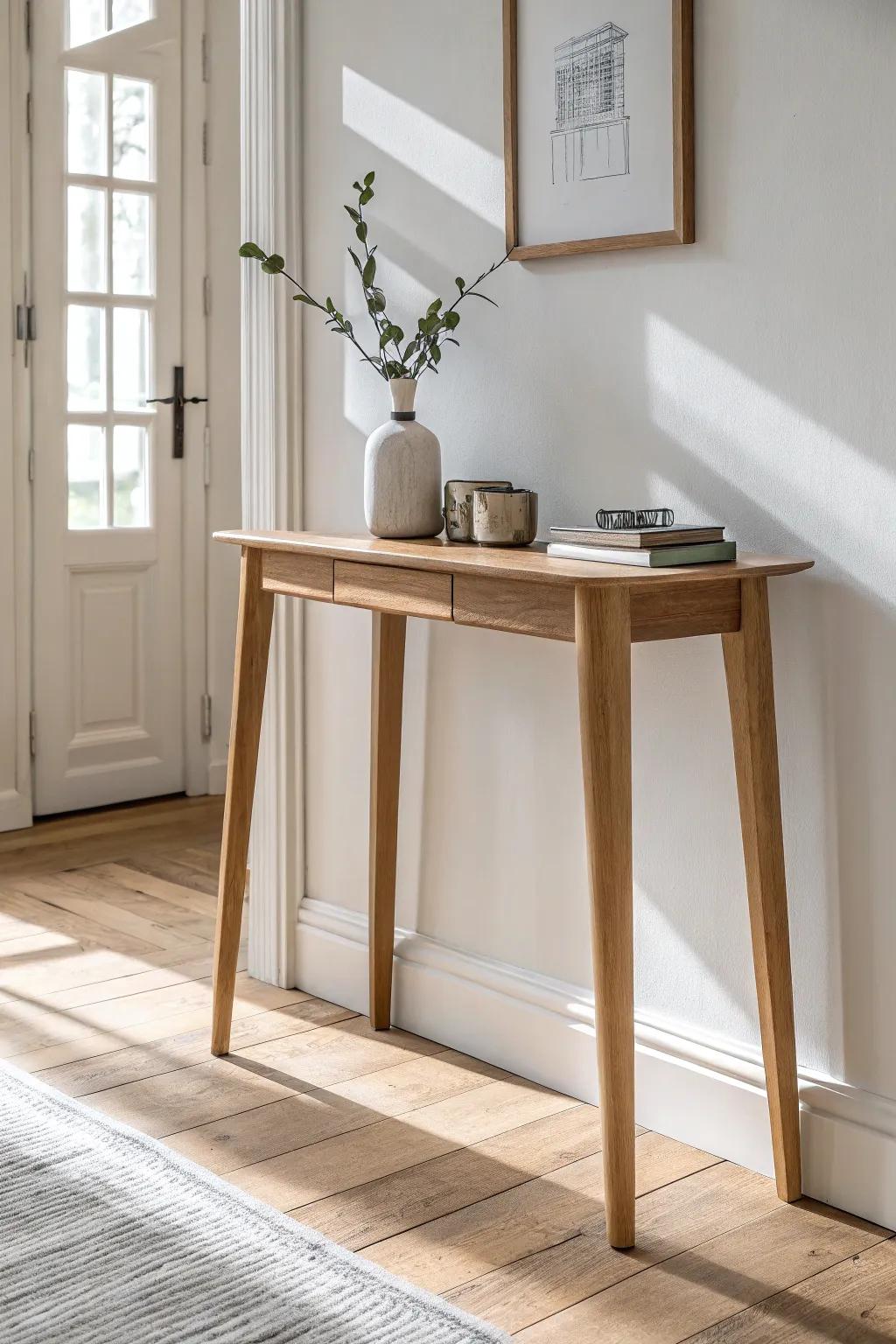
The single change that transformed my entryway from a pass-through hallway into an actual room was adding a surface, any surface, that said "this is a place, not just a corridor." A narrow console table, even an extremely slim one, gives the eye somewhere to land and the hand somewhere to set down keys or mail.
What I didn't understand before was that an entryway surface isn't just decorative. It serves a genuine functional purpose. Without one, the entry feels transient, a space you hurry through. With one, it feels like the home has already begun before you've taken three steps inside. This is also the surface that organizes the daily clutter that otherwise ends up scattered across the kitchen counter or dining table. A designated drop zone at the entry intercepts that clutter at the door, before it migrates deeper into the home. If your entryway is genuinely too narrow for even a slim console, a small wall-mounted shelf at the same height serves the identical function in a smaller footprint, and often costs even less.
- Measure your entryway's usable depth first, not just the visual impression of "too narrow."
- Choose a console table with a slim profile, ideally 10 inches deep or less for genuinely tight spaces.
- If even a slim table won't fit, mount a wall shelf at standard console height (around 30 inches) instead.
- Style with a small tray for keys and one decorative object, not a full coffee-table arrangement.
- Keep a small basket or bin beneath the table or shelf for shoes or everyday grab-and-go items.
- Gives the eye a landing point the moment the door opens
- Creates a designated drop zone that intercepts clutter at the door
- Instantly makes the entryway read as a defined room, not a hallway
Search terms: "narrow console table slim," "floating wall shelf with brackets," "small entryway table 10 inch depth"
A Mirror That Multiplies Light and Space
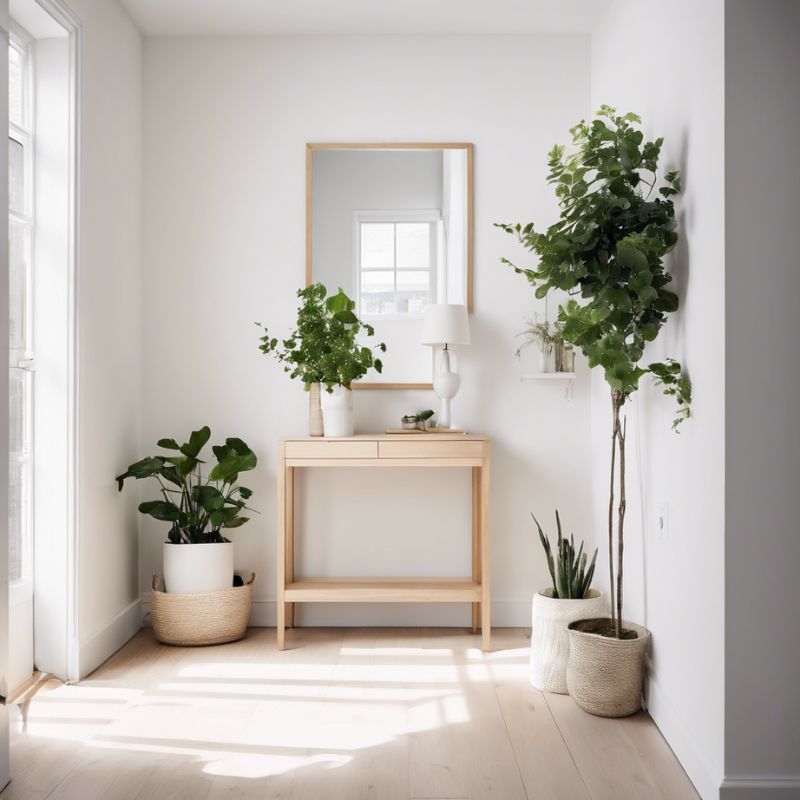
My entryway had no natural light at all. It was a dark corner between the front door and a hallway, and even during the brightest part of the day, it felt dim and slightly unwelcoming. A single mirror, hung directly across from the nearest light source, changed that entirely.
Mirrors do two things in an entryway that no other single piece can do as effectively. First, they bounce whatever light exists, natural or artificial, deeper into the space, making the area feel noticeably brighter than it actually is. Second, they create the illusion of depth, making a narrow or cramped entry feel significantly more open than its actual square footage. This dual function, light amplification and spatial expansion, makes a mirror one of the highest-impact purchases per dollar in almost any entryway, regardless of size or style. A frameless mirror reads as modern and clean. A vintage or thrifted framed mirror adds warmth and character. Either works, as long as it's positioned to reflect light, not a blank wall or a dark corner.
- Stand in the entryway at the exact spot a guest first sees the space, typically just inside the front door.
- Identify the nearest light source, a window, a lamp, or even a bright adjacent room visible from the entry.
- Position the mirror on the wall directly opposite or adjacent to that light source so it reflects brightness, not darkness.
- Hang at eye level with the center around 57 to 60 inches from the floor.
- If no light source is nearby, position the mirror to reflect the entryway's own console or styled surface instead, amplifying the intentional decor rather than light.
- Makes the space feel brighter by reflecting available light
- Creates the illusion of depth in narrow or cramped spaces
- Functions as both decor and a practical last-check-before-leaving surface
Search terms: "large wall mirror entryway," "thrifted vintage mirror," "frameless mirror for hallway"
A Single Warm Light Source

Nothing signals "unfinished rental" faster than a bare ceiling bulb with a cool white temperature in an otherwise styled entryway. Swapping that single bulb for a warm-toned one and adding a small table lamp on the console changed the entire feeling of the space in under ten minutes.
Lighting in an entryway matters even more than in other rooms because there's typically no natural light source to compensate. A single harsh overhead bulb flattens the space and makes even beautiful decor look clinical. A warm, layered light source, even if it's just one small lamp on a console, creates a pocket of warmth that reads as intentional and welcoming from the moment the door opens. This is also one of the few spaces where a light on a timer or a smart bulb set to turn on before you arrive home genuinely transforms the experience of walking through the door at the end of a long day. The light is already on. The space already feels alive. You're arriving somewhere, not just entering a dark room.
- Check the Kelvin (K) rating on your current entryway bulb. Anything 4000K or higher should be replaced.
- Swap to a warm white bulb (2700K to 3000K) for an immediately softer, more welcoming tone.
- Add a small table lamp on your console or a plug-in wall sconce if a table lamp requires surface space you don't have.
- Consider a smart bulb or a simple plug-in timer so the entryway light is on when you arrive home in the evening.
- Test the lighting at the actual time of day you most often arrive home, not during a bright afternoon when the entry looks different.
- Changes the entire emotional temperature of the entryway in seconds
- Signals warmth and welcome before any decor is even noticed
- One of the cheapest and fastest upgrades on this entire list
Search terms: "warm white LED bulb 2700K," "small table lamp entryway," "battery operated lamp rechargeable"
A Small Rug That Grounds the Entry

Imagine a reader whose entryway floor was bare hardwood, beautiful on its own, but the space still felt unfinished no matter what else she added. A small, durable runner rug, just large enough to define the entry footprint, was the missing piece that finally made the space feel complete.
An entryway rug does more visual work per square inch than almost any other rug in the home. It defines the entry footprint, signaling "this is where the home begins." It catches the dirt, debris, and moisture that would otherwise track deeper into the house. And it adds the first layer of texture and color a guest encounters, setting the palette for the entire home before they've seen another room. The key is material: an entryway rug takes more abuse than any other textile in the house, so durability and cleanability matter more here than in a living room or bedroom. Low-pile, washable, or easily shake-out-able materials are the practical choice.
- Measure the usable floor space in your entry, accounting for door swing clearance so the rug doesn't catch on the door.
- Choose a low-pile, durable, washable material rated for high-traffic areas.
- Select a color or pattern that either grounds the entry's palette or introduces the home's broader color story.
- Use a non-slip rug pad underneath, especially on hard flooring, for both safety and keeping the rug in place.
- Shake out or vacuum weekly, entryway rugs accumulate dirt faster than any other textile in the home.
- Defines the entry footprint and visually grounds the space
- Catches dirt and moisture at the door before it spreads
- Adds the first layer of color and texture a guest encounters
Search terms: "washable entryway runner rug," "non slip rug pad small," "low pile door mat indoor"
A Hooks-and-Baskets Drop Zone System
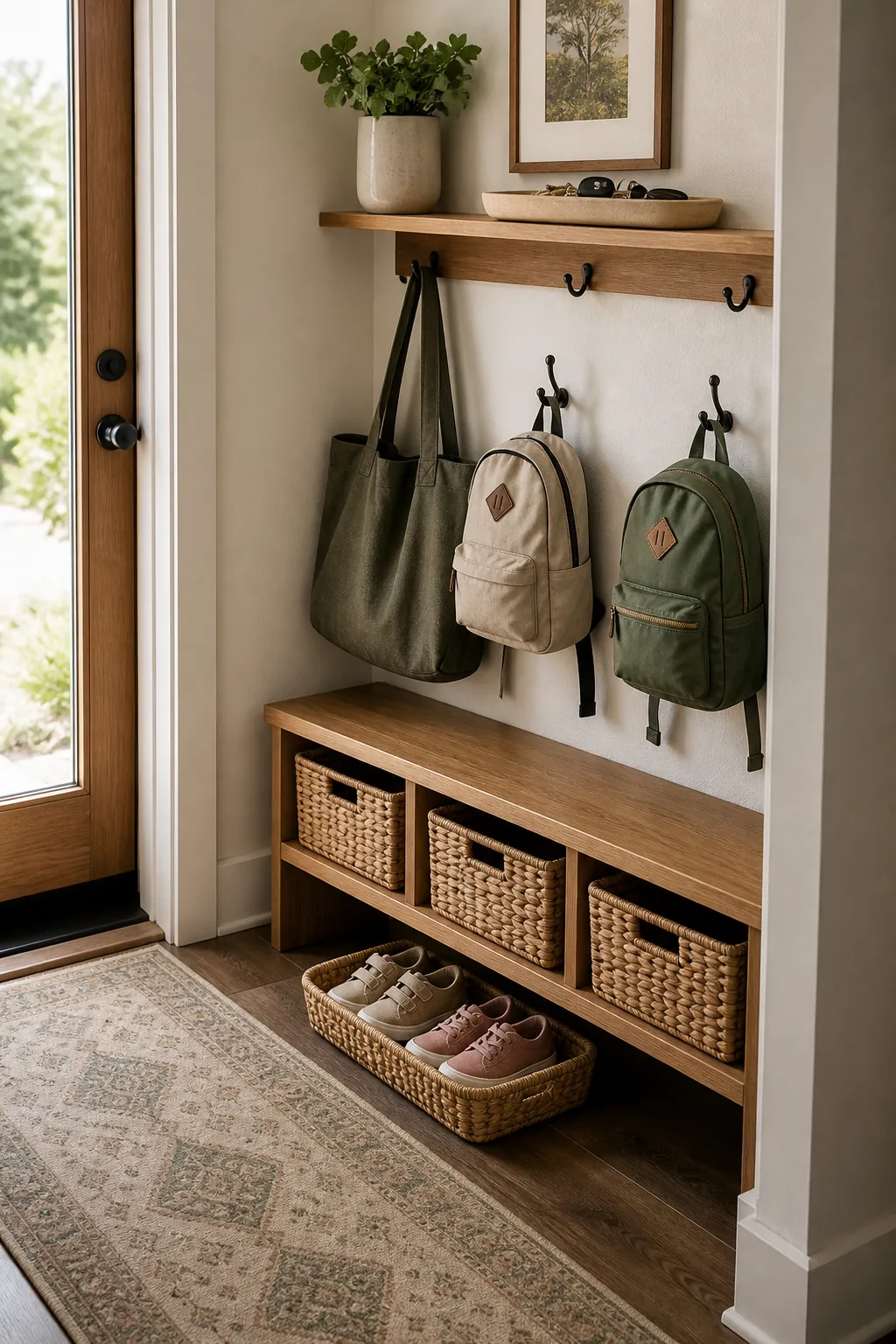
My entryway used to accumulate coats on the back of a chair, shoes in a pile by the door, and mail scattered across whatever surface was closest. A simple wall-mounted hook rail and one small basket beneath it solved all three problems in a single afternoon.
A drop zone system doesn't need to be elaborate or expensive. It just needs to be present. The hook rail catches coats, bags, and dog leashes before they land on furniture. The basket corrals shoes, gloves, or umbrellas into one contained spot. Together, they create a simple, visible system that every member of the household can follow, because the designated spot is right there, at the door, exactly where the items are being shed. This is one of the highest-function-per-dollar upgrades on this entire list, and it's also one of the most universally useful, regardless of entryway size or style.
- Mount a wall hook rail with at least three to four hooks at a comfortable reaching height for all household members.
- Position a small basket, bin, or crate directly beneath the hooks for shoes, umbrellas, or bags.
- If wall mounting isn't possible, an over-the-door hook rack achieves the same function without any hardware.
- Keep the system intentionally simple, coats on hooks, shoes in the basket, nothing else.
- Add a small tray on the console above for keys and mail, completing the full drop zone in one compact area.
- Intercepts clutter at the door before it spreads into the home
- Creates a simple, visible system every household member can follow
- Functions for coats, bags, shoes, and mail in one compact footprint
Search terms: "wall hook rail coat rack," "woven storage basket small," "over the door hook rack"
One Piece of Personal Art or a Photo
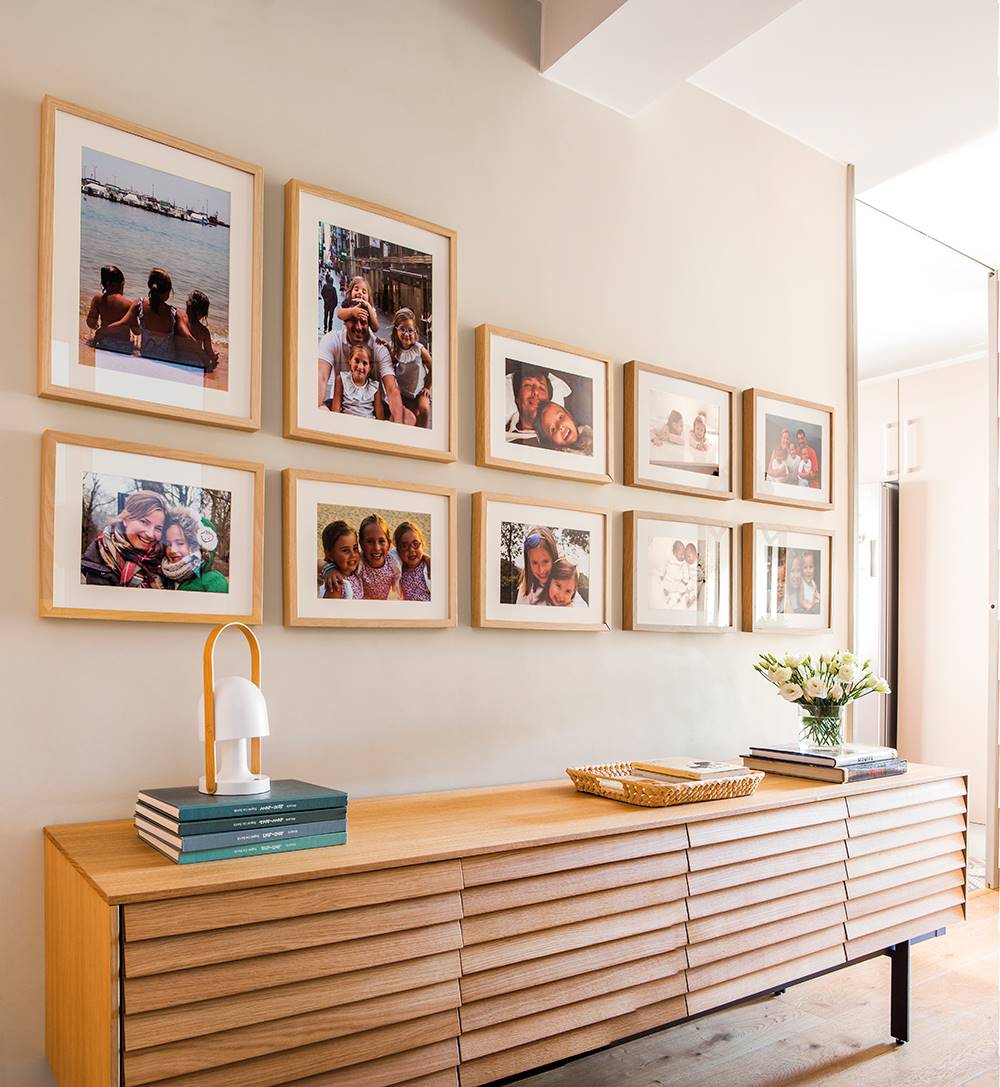
A homeowner shared that her entryway felt like a hotel lobby, clean and functional but entirely impersonal, until she hung a single framed photograph from a trip she'd taken years ago. That one piece, she said, was what finally made the entry feel like her home, not just a well-styled space.
The entryway is the first place a guest encounters what your home is actually about. Generic decor, a mass-produced print, a mirror with no personality, communicates nothing about the people who live there. A single personal piece, a family photo, a travel snapshot, a child's drawing in a simple frame, tells a story before the guest has taken three steps inside. This doesn't need to be expensive or professionally framed. A simple frame from a craft store, holding a photo you already have, costs under twenty dollars and does more to personalize a space than any generic decor object on this list. The entryway is the right place for the personal piece, not hidden in a bedroom, because it sets the tone for every room that follows.
- Choose one piece with genuine personal meaning, a photo, a postcard, a small piece of art you love.
- Frame it simply, even an inexpensive frame works when the content inside is what carries the weight.
- Position it at eye level on the wall beside the console or above the hook rail.
- Keep it to one or two pieces maximum in a small entry, more than that starts to compete with the rest of the space.
- Rotate the piece seasonally or when you want a small refresh without changing anything else.
- Sets a personal tone before any other decor is seen
- Costs almost nothing if using an existing photo and simple frame
- Makes the entry feel like a home, not a staged space
Search terms: "simple picture frame 8x10," "gallery wall frame single," "floating frame for photo"
A Small Living Element for Freshness

Imagine a reader whose entryway had all the right functional pieces, a console, a mirror, a lamp, a rug, but still felt slightly static, like a well-organized hotel room rather than a living home. A single small plant on the console was the change that finally made the space feel alive.
A living element in the entryway does something no manufactured object can replicate. It signals that the space is cared for daily, not just styled once and forgotten. It adds a soft, organic shape that contrasts with the hard lines of furniture and frames. And it changes, slightly, day to day, a new leaf, a shifting stem, which makes the entry feel dynamic rather than static. For entryways with low natural light, a low-maintenance plant like a snake plant or ZZ plant thrives in conditions that would kill most other greenery. For entryways with no natural light at all, a high-quality faux plant with a matte, non-glossy finish or a simple bowl of real, seasonal fruit provides the same living-element effect without needing sunlight.
- Assess your entryway's actual natural light honestly, a plant suited to the space's light level will thrive where a mismatched one will fail.
- Choose a genuinely low-maintenance, low-light plant like a snake plant, ZZ plant, or pothos if any natural light is present.
- If the entry has zero natural light, a high-quality, matte-finish faux plant or a bowl of real seasonal fruit provides the same effect.
- Position on the console or a small plant stand beside it, off-center for a more natural look.
- Water sparingly, overwatering in low-light conditions is the most common cause of entryway plant failure.
- Adds life and organic softness no manufactured object can replicate
- Signals ongoing care and attention to the space
- Changes slightly day to day, keeping the entry feeling dynamic
Search terms: "snake plant small pot," "low light houseplant," "ZZ plant entryway," "matte finish faux plant"
The Psychology of a Good Entryway
The entryway isn't just a functional pass-through. It's the transition zone between the outside world and the refuge of home, and that transition matters more than its square footage suggests. Cross from a public sidewalk into a private house and your mind starts shifting from alertness to ease; a well-designed entryway supports that shift instead of working against it. It offers a place to physically shed the outside world, coat on a hook, keys on a tray, shoes in a basket, and visually signals that you've arrived somewhere safe, calm, and cared for. A neglected entryway does the opposite: it extends the stress of the outside world further into the home, because there's no clear boundary where "outside" ends and "inside" begins.
This is why the seven upgrades above aren't just about aesthetics. Each one serves a genuine functional purpose: the console gives the eye a resting point, the mirror expands a cramped space, the warm light signals safety, the rug defines the boundary, the hooks-and-baskets create order from chaos, the personal art tells you whose home this is, and the living element reminds you that someone cares for this space daily. Together, they transform an entryway from a hallway you pass through into a threshold you arrive into.
Entryway Upgrades by Footprint Size
- No entryway at all (door opens directly into living room): A wall-mounted shelf at console height, a small mirror above it, and a hook rail on the adjacent wall create a defined entry zone in zero floor footprint.
- Narrow hallway entry (3–4 feet wide): A slim console (10 inches deep or less), a runner rug sized to the hallway width, and a mirror on the longest visible wall.
- Small defined entry (4–6 feet square): All seven upgrades fit comfortably; prioritize the console, mirror, rug, and hooks first, with the lamp, art, and plant layering in afterward.
- Generous entryway or foyer (6+ feet square): Scale each element up proportionally, a larger console, a bigger mirror, a wider rug, but resist the urge to fill the extra space with additional furniture that competes with the core seven pieces.
The Full Cost Comparison
| Upgrade | Budget Range | Typical Cost |
|---|---|---|
| Slim console table or wall shelf | $20–40 | $30 |
| Wall mirror | $15–40 | $25 |
| Warm light source (bulb + small lamp) | $8–35 | $20 |
| Small entry rug (2x3 or 3x5) | $15–40 | $25 |
| Hook rail + basket | $15–35 | $25 |
| Personal art or photo + frame | $5–20 | $12 |
| Small plant + pot | $10–25 | $18 |
| Full entryway makeover (all seven) | $88–235 | Around $155 |
Prices are typical ranges based on common budget and secondhand options, actual cost will vary by retailer and region. Choosing your top four from the list above keeps the total under $100 while still transforming the entry's first impression. Prioritize the console or shelf, mirror, light, and hooks-and-basket system if you can only do a few right now.
Common Questions
What if my entryway is genuinely just a wall with no floor space at all? Prioritize the wall-mounted upgrades: a floating shelf at console height, a mirror above it, a hook rail nearby, and a rechargeable lamp. The full drop-zone function fits into zero floor footprint this way.
Which upgrade makes the biggest difference if I can only do one? The warm light source and the mirror together deliver the highest impact per dollar, but if limited to a single choice, the mirror does the most work across the widest range of entryway types.
How do I style an entryway that's also a main hallway used constantly? Keep everything compact and wall-mounted where possible. A slim shelf is better than a table that blocks the walking path. A runner rug should be narrow enough that foot traffic stays entirely on it without catching edges.
Are these upgrades renter-friendly? Nearly all of them use no permanent installation: adhesive hooks, over-the-door racks, freestanding furniture, and battery-operated lamps all leave zero wall damage. Check your specific lease before mounting anything with screws or anchors.
How do I keep an entryway from feeling cluttered when it's also the main drop zone for a family? The hooks-and-baskets system (Upgrade 5) is the single most important functional piece here. Without it, clutter has no home and spreads. With it, everything has a designated spot, and a two-minute reset at the end of the day keeps the system functioning.
An entryway was never about square footage. Every upgrade here proves the same point: a guest's first impression is shaped by what the space communicates, not how large it is. Warm light, a place to set things down, a reflection of light and personality, these things cost very little and do more real work than any expensive piece of furniture placed without intention.
The entryway is the first room your guests see and the last one you pass through on your way out the door. It deserves to feel like part of your home, not just the space between the door and everything else.
Start with the one that costs you the least and takes under an hour this weekend, swapping a bulb, hanging a mirror, or mounting a hook rail, and let that single change shift how the entire home feels the moment you walk through the door.
Shop the Story
- narrow console table slim
- floating wall shelf with brackets
- large wall mirror entryway
- warm white LED bulb 2700K
- small table lamp entryway
- washable entryway runner rug
- wall hook rail coat rack
- woven storage basket small
- simple picture frame 8x10
- snake plant small pot