8 Cabinet Hardware Swaps That Make Builder-Grade Kitchens Look Custom
The fastest, cheapest kitchen upgrade — see the pulls and knobs designers reach for first

Every builder-grade kitchen I've ever lived in came with the exact same knobs. Small, brushed nickel, slightly rounded, the kind you stop noticing within a week because there's nothing to notice. Mine came with 42 of them, and for two years I genuinely didn't think about changing a single one.
Then I helped a friend swap hers over a Saturday afternoon, just knobs, nothing else touched, same cabinets, same paint, same layout, and the kitchen looked like a different room by dinner. Not a nicer version of the same kitchen. A different kitchen entirely.
Hardware is genuinely called "the jewelry of the kitchen" by people in the industry for a reason, it's the detail that tells you whether a space was finished or just built. And unlike almost everything else in a kitchen, it's a swap you can do yourself in an afternoon with a screwdriver and zero renovation budget.
Here are the eight swaps that do the most work, starting with the one designers reach for first.
Table of Contents
- Unlacquered Brass Pulls
- Matte Black Bar Pulls
- Mixed Metal Hardware
- Oversized, Sculptural Pulls
- Bin Cup Pulls
- Backplate and Knob Combos
- Long Appliance-Style Pulls
- Leather and Woven Pulls
- How the Finishes Compare
- How to Actually Do the Swap
- Common Questions
Unlacquered Brass Pulls

If there's one finish defining 2026 kitchens, it's this one. Unlike lacquered brass, which stays shiny and static forever, unlacquered brass is a "living finish" that develops a soft, one-of-a-kind patina over years of actual use, the exact opposite of anything builder-grade.
- Choose "unlacquered" or "living finish" specifically in the product listing, not standard polished brass.
- Expect it to darken and develop character over months of handling, this is the intended look, not a flaw.
- Pair with white, cream, or deep navy cabinets, brass reads warmest against cool or neutral bases.
- The single most requested finish in current designer kitchens
- Warms up cool white or gray cabinetry instantly
- Gets better looking with age instead of dating
Search terms: "unlacquered brass cabinet pulls," "living finish brass hardware"
Matte Black Bar Pulls

Where brass is warm and soft, matte black is the graphic, confident opposite, and it's held its position as a modern-kitchen staple for years now precisely because it never reads as trendy for long, it reads as intentional.
- Stick to true matte or satin black, not gloss or chrome-black.
- Use bar-style pulls for a cleaner, more modern line than rounded knobs.
- Keep the rest of the kitchen's metal (faucet, light fixtures) in the same black family if possible.
- Reads as confidently modern, not trend-chasing
- Creates strong, clean contrast against light cabinets
- Widely available at nearly every price point
Search terms: "matte black bar cabinet pulls," "matte black kitchen hardware"
Mixed Metal Hardware

This is the trend designers keep pointing to for 2026 specifically: two finishes instead of one, used deliberately rather than accidentally. It sounds risky. Done with restraint, it's what makes a kitchen look curated instead of matched-from-a-catalog.
- Pick one primary finish for most of the kitchen, brass or black usually.
- Reserve the second finish for one controlled zone, the island, a pantry wall, or a single row.
- Keep faucet and light fixture metals aligned with one of your two chosen finishes, not a third.
- Adds visual depth a single finish can't achieve alone
- Stays flexible if you update the room later
- The exact detail that separates "curated" from "matched"
Search terms: "mixed metal cabinet hardware," "brass and black kitchen hardware"
Oversized, Sculptural Pulls
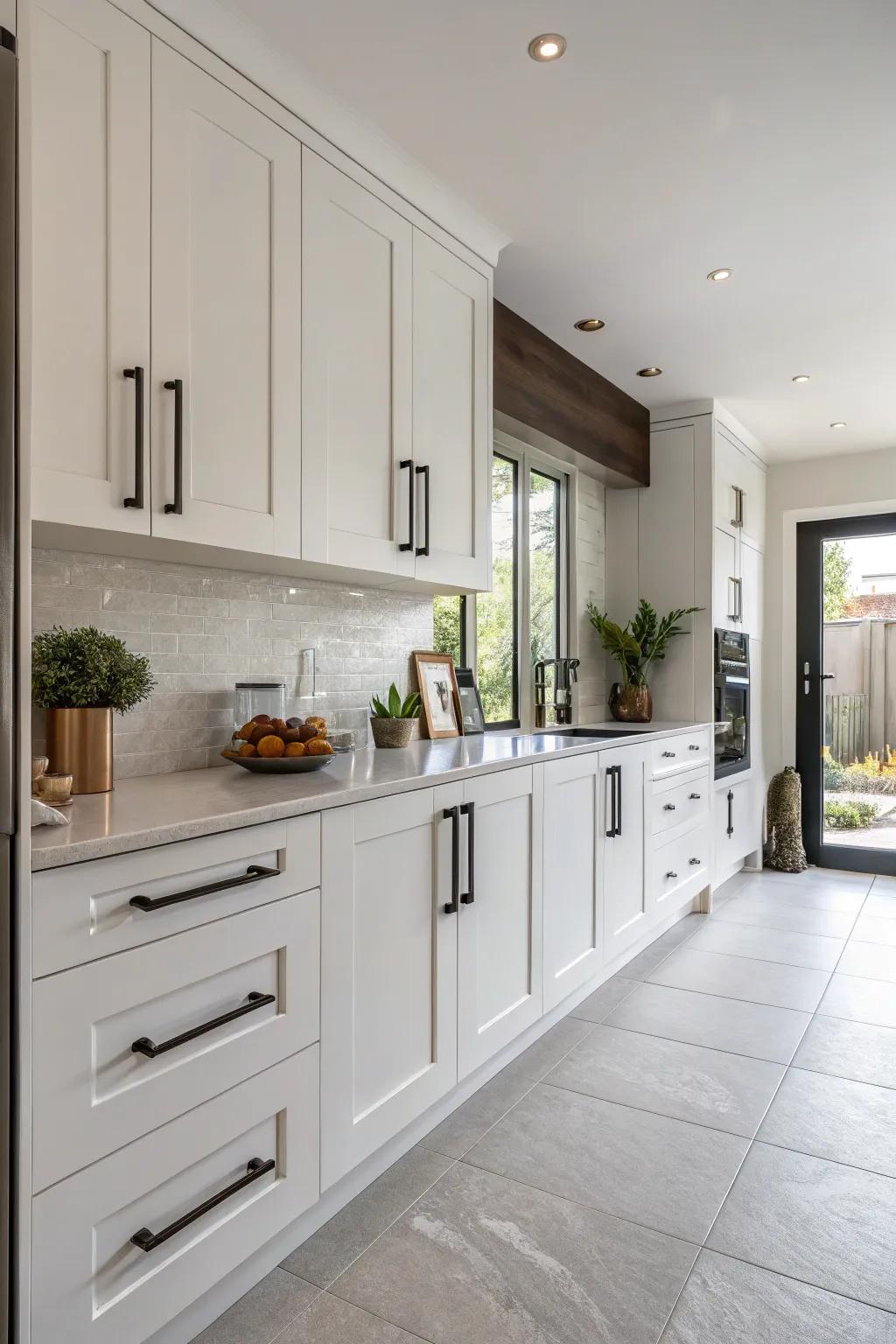
Builder-grade kitchens default to one small pull size for every single door and drawer, regardless of size. Designers are moving away from that entirely, sizing hardware to the piece it's on, and it's a scale shift that reads as custom the moment you notice it.
- Use longer pulls on deep drawers, roughly a third to half the drawer's width.
- Reserve knobs or short pulls for smaller upper doors.
- Treat appliance-style pulls as a deliberate visual choice, not an afterthought, on any larger panel.
- Immediately signals thoughtful, custom sizing
- Improves everyday usability on deep drawers
- One of the clearest "designer eye" details
Search terms: "oversized cabinet pulls," "long drawer pulls kitchen"
Bin Cup Pulls

Bin cup pulls, the half-moon, cupped style borrowed from vintage apothecary and industrial furniture, bring genuine warmth and history to a kitchen that would otherwise read as brand new. They're the pick for anyone chasing a farmhouse or traditional feel.
- Use on drawers specifically, bin cups were traditionally a drawer-pull shape.
- Pair with simple knobs on doors rather than matching bin cups everywhere.
- Choose an aged or antique finish over a polished one for the most authentic effect.
- Adds genuine history and character instantly
- Distinct from the bar-pull look everyone already has
- Comfortable, functional grip for daily use
Search terms: "bin cup cabinet pulls," "farmhouse drawer pulls"
Backplate and Knob Combos

A backplate is a small decorative plate sitting behind a knob, and it's one of the more specific details designers point to for 2026, the kind of layered, considered touch that's easy to miss consciously but reads instantly as more finished.
- Match the backplate finish to your chosen knob finish, not a contrasting one, for this specific detail.
- Reserve backplates for a single accent area, an island or a glass-front cabinet, rather than the whole kitchen.
- Choose a simple oval or shield shape over an ornate one for a more current feel.
- Adds a layered, considered detail few builder kitchens have
- Protects the cabinet finish around the knob over time
- Works beautifully as a single-zone accent detail
Search terms: "cabinet knob backplate set," "vintage style cabinet backplate"
Long Appliance-Style Pulls

Borrowed from professional-style refrigerator and oven hardware, these long, slim tubular pulls are the pick for a genuinely sleek, European-modern kitchen, especially on tall pantry cabinets or a full-height panel.
- Reserve for tall pantry doors, panel-front appliances, or wide drawers specifically.
- Choose a slim, minimal profile rather than a chunky one for the cleanest modern line.
- Mount vertically on tall doors, horizontally on wide drawers, for correct proportion.
- Creates a genuinely sleek, professional-kitchen feel
- Makes tall panels and pantry doors feel intentional
- Pairs naturally with slab or flat-front cabinet styles
Search terms: "long appliance style cabinet pull," "tubular pantry door pull"
Leather and Woven Pulls

The most unexpected pick on this list, and the one that gets the most questions: leather-wrapped or woven pulls bring genuine tactile texture into a kitchen, the same instinct behind the wider "textured hardware" trend designers keep naming for 2026.
- Choose leather rated specifically for hardware use, not decorative-only leather.
- Use as an accent on one zone, an island or a bar cart, rather than the entire kitchen.
- Pair with warm wood tones or brass accents for a cohesive, organic feel.
- Genuinely unique, almost nobody else's kitchen has this
- Adds warmth and texture metal alone can't provide
- Fits the broader tactile, textured-finish trend
Search terms: "leather cabinet pulls," "woven cabinet hardware"
How the Finishes Compare
| Style | Best For | Price per Pull |
|---|---|---|
| Unlacquered brass | Warming up white or gray cabinets | $4–$10 |
| Matte black bar pulls | Bold, modern contrast | $3–$8 |
| Mixed metal | A curated, layered look | Varies by pair |
| Oversized pulls | Deep drawers, proportion | $6–$15 |
| Bin cup pulls | Farmhouse, vintage warmth | $4–$9 |
| Backplate + knob | Layered, protected detail | $8–$18 |
| Long appliance pulls | Sleek, European-modern | $10–$25 |
| Leather/woven | Unique tactile accent | $8–$20 |
How to Actually Do the Swap
- 1. Measure before you order. Check center-to-center hole spacing on existing pulls; buying the wrong spacing means drilling new holes.
- 2. Order one sample first. Live with a single new pull on one door for a day before committing to the full kitchen.
- 3. Remove and label as you go. Keep old hardware and screws organized in case you want to reverse the swap at move-out.
- 4. Fill mismatched holes if needed. Wood filler and a touch-up pen handle any spacing changes cleanly.
- 5. Install the whole kitchen in one session. A full, consistent swap reads as far more transformative than a gradual one.
Common Questions
Which single swap gives the most impact for the least money? Unlacquered brass or matte black bar pulls, both are inexpensive per piece and instantly remove the "builder-grade" signal.
Do I need to replace knobs and pulls at the same time? No, but for the most cohesive look, plan a consistent finish across both before you order either.
Is this something renters can do? Yes, it's one of the most renter-friendly upgrades available; keep the original hardware to reinstall before moving out.
How long does a full kitchen actually take? Most kitchens with 20–40 pieces of hardware take a single afternoon with just a screwdriver.
Hardware is the cheapest, fastest lever a kitchen has, and it's also the one most builder-grade homes get most wrong, one small, forgettable finish repeated on every single door and drawer with no thought behind it at all.
Start with one drawer. Try the finish there first, live with it for a day, and if it's right, the rest of the kitchen is just repetition from there.
Shop the Story
- unlacquered brass cabinet pulls
- matte black bar cabinet pulls
- mixed metal cabinet hardware
- oversized cabinet pulls
- bin cup cabinet pulls
- cabinet knob backplate set
- long appliance style cabinet pull
- leather cabinet pulls