
7 Sideboard Styling Formulas That Look Intentional, Not Random
Don't start with the objects. Start with your sideboard's length, depth and height, and let the planner tell you how big, how high and how many.

A styled sideboard looks random for one reason: the objects were chosen one at a time, and nothing links them. A sideboard that looks intentional follows a formula. It has a clear shape, a few repeated details and some empty space. That is why the best sideboard styling ideas are formulas, not shopping lists.
This guide gives you seven formulas, a planner that turns your measurements into art width, hanging height and item count, a diagram of the one height rule that fixes most sideboards, and four tests you can run at home before you buy anything.
Sideboard Styling Formulas: Quick Answer
Find your sideboard length and pick from the ladder:
- Under 48 inches: formulas 7, 3 and 4.
- 48 to 59 inches: formulas 1 (compact), 3, 4, 5 and 7.
- 60 to 71 inches: formulas 1, 2, 3, 4, 5 and 6.
- 72 to 95 inches: all seven formulas.
- 96 inches or more: treat it as two zones and repeat formula 2, 3 or 6 across it.
All seven formulas: 1 asymmetric triangle, 2 matched pair, 3 tray anchor, 4 leaning layer, 5 lamp and mirror, 6 busy above and calm below, 7 one big statement.
The numbers to remember: art about two-thirds to three-quarters of the sideboard length, its bottom edge 6 to 10 inches above the top, tall items beside the art, and about a third of the surface left empty.
Free Sideboard Planner: How Big, How High, How Many?
Measure your sideboard in inches, and the art you plan to hang or lean above it. The planner gives you a size range for the art, where it should hang, how many items to use and how tall the items in front of the art can be.
Sideboard styling planner
The Numbers Behind the Planner and the 2-2-2 Repeat Rule
- Typical sizes: sideboards are commonly 30 to 36 inches high and 16 to 22 inches deep, and 48 to 80 inches long, though sizes vary.
- Art width: about two-thirds to three-quarters of the sideboard length.
- Art height from the top: the art's bottom edge about 6 to 10 inches above the sideboard, so the two read as one group. Many designers aim for the art's center near 57 to 60 inches from the floor.
- Item count: about one object or cluster per 12 to 16 inches of length.
- Empty space: leave roughly a third of the top surface bare. Negative space is what makes the rest look chosen.
- Edge margin: keep objects a couple of inches back from the front edge, and make sure none is wider than the depth minus about 4 inches.
The rule that fixes most sideboards: tall goes beside the art, not in front of it
A tall object in front of the art cuts the picture in half and makes both look cluttered. Keep items in front of the art lower than the bottom third of the art. Put lamps and tall vases in the side zones, just outside the art's edges, where they frame it instead of covering it.
The 2-2-2 repeat rule
Randomness comes from variety with no link. Fix it by repeating three things at least twice each: one color (for example, the same warm white in a vase and a bowl), one material (for example, brass in a lamp base and a candle holder) and one shape (for example, rounded forms in a bowl and a lamp shade). Vary the heights, but repeat the details, and the group will look chosen.
Formula 1: The Asymmetric Triangle

What it looks like: A tall item (a lamp or vase) on one side, a medium cluster beside it (a stack of books with an object on top), and one low item (a bowl or box) on the other side, with centered art above.
Why it works: The eye travels along a triangle from the peak down to the low items, so the group feels balanced without being matched. It is the most natural-looking formula and the easiest to adjust.
Formula 2: The Matched Pair

What it looks like: Two matching lamps or vases, one near each end, a low bowl or tray in the center and a single piece of art or a mirror centered above.
Why it works: Symmetry reads as calm and deliberate. Nobody looks at a matched pair and thinks it was an accident.
Formula 3: The Tray Anchor

What it looks like: One tray holds three small items (such as a candle, a small vase and a box), with one taller item or a plant beside it.
Why it works: The tray draws a line around the small items, so they read as one object and not as clutter. It also lifts everything off in one move when you need the surface.
Formula 4: The Leaning Layer

What it looks like: A large framed piece or mirror leans against the wall on the sideboard, with a couple of objects overlapping its lower edge.
Why it works: Overlap makes the layers look relaxed and collected, and there is nothing to drill. It is the most renter-friendly way to get art above a sideboard.
Formula 5: The Lamp and Mirror
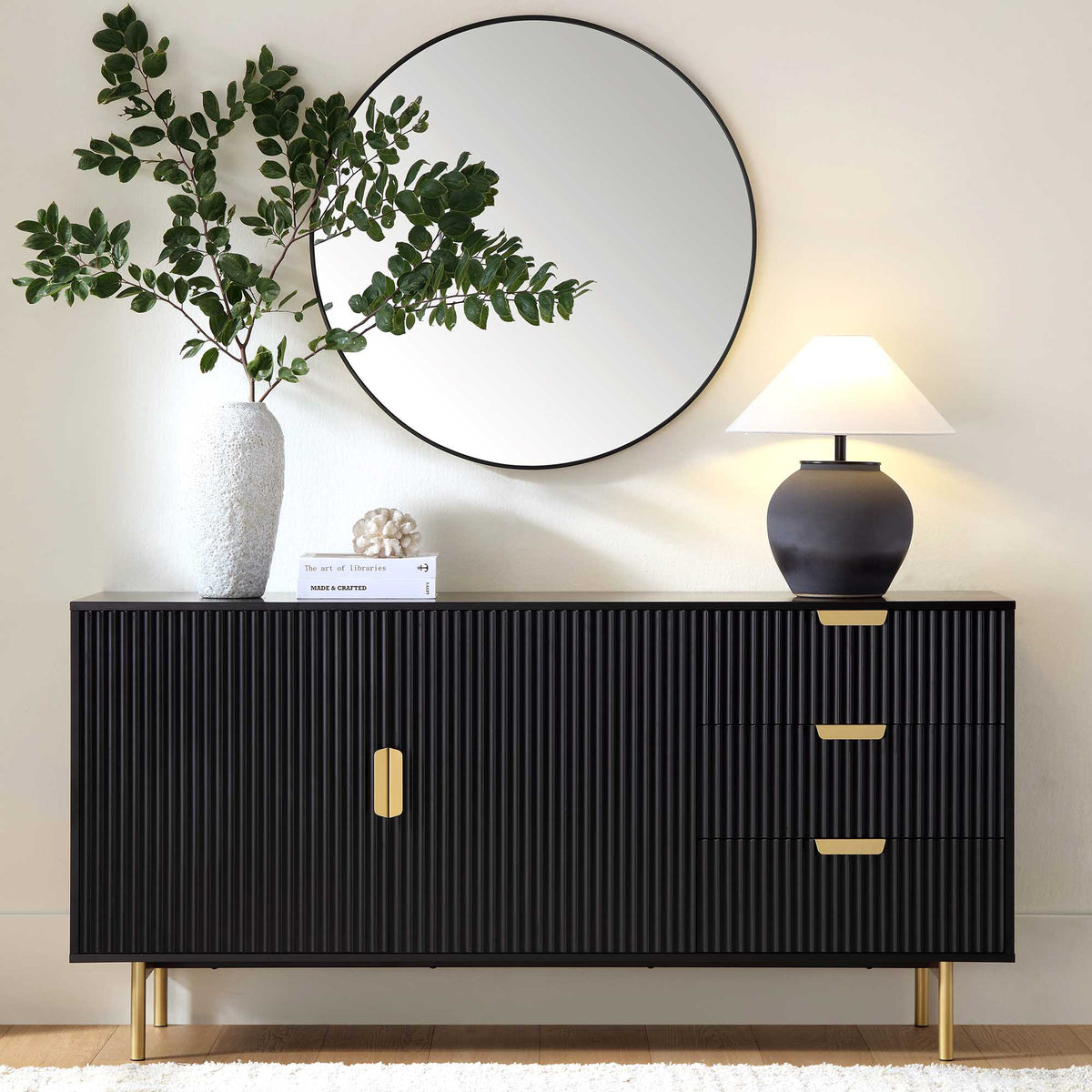
What it looks like: A mirror above the sideboard, one lamp on one side and a plant or a vase on the other.
Why it works: The mirror doubles the light from the lamp, and it brightens a dark corner or hallway in a way art does not.
Formula 6: Busy Above, Calm Below
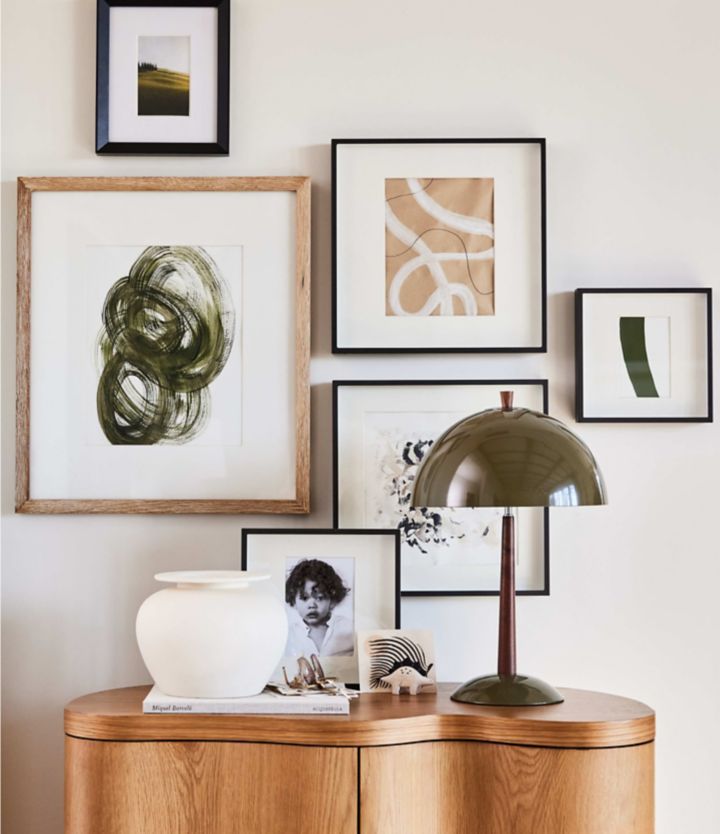
What it looks like: A group of frames above the sideboard, with only two or three simple items below.
Why it works: The eye can handle only one busy area. When the wall is full of art, a calm surface keeps the whole thing from tipping into clutter.
Formula 7: One Big Statement

What it looks like: One large object (a big vase with branches, a sculpture or an oversized bowl) and one or two small items, with most of the surface left empty.
Why it works: One strong shape does all the work, and the empty space makes it look expensive and calm.
Pick in 30 Seconds: Which Formula Fits Your Sideboard?
Find your situation in the left column and read across.
| Your situation | Best formulas | Key check |
|---|---|---|
| Under 48 inches long | 7, 3, 4 | Two or three items at most |
| 48 to 59 inches | 1 (compact), 3, 4, 5, 7 | Three or four items |
| 60 to 71 inches | 1, 2, 3, 4, 5, 6 | Four or five items |
| 72 to 95 inches | All seven | Five or six items |
| 96 inches or more | 2, 3, 6, repeated in two zones | Repeat the 2-2-2 rule across both |
| Shallow, under about 14 inches deep | 3, 4, 7 | Items no wider than depth minus 4 inches |
| Renter who cannot drill | 4, 3, 7 | Secure heavy art and mirrors |
| Sideboard also used for serving | 3, 7, 2 (low center) | Keep the middle third clear |
| Dark hallway or corner | 5, 2 | What the mirror will reflect |
| Want a calm, minimal look | 7, 3 | At least half the surface empty |
| Lots of art or photos | 6 | Calm surface below |
| Kids or pets | 3, 7 (low, stable pieces) | No cords, candles or fragile items at the edge |
| Formal dining room | 2 | Matched heights |
| Relaxed, modern room | 1, 4 | Balance the visual weight |
Mistakes That Make a Sideboard Look Random
- Everything the same height. A row of equal items looks like a shelf in a shop. Vary the heights.
- Art too small or too high. Art under about half the length looks lost, and art more than about 10 inches above the top floats away from the furniture.
- Tall items in front of the art. They cut the picture in two. Move them to the side zones.
- Filling every inch. No empty space means no focal point. Leave about a third bare.
- Too many small objects. Tiny items scattered across the top read as noise. Group them on a tray.
- Nothing repeated. Different colors, materials and shapes with no link look unplanned. Use the 2-2-2 rule.
- Objects pushed to the front edge. They get knocked and look unsteady. Keep them a couple of inches back.
- Visible cords. A cord across the top or down the wall is the first thing people notice. Plan the route first.
- A mirror that reflects clutter. It doubles whatever is opposite. Check the reflection before hanging.
- Styling a sideboard you use. If you serve from it, keep the center clear or use a tray you can lift away.
Test Before You Commit: Four Quick Checks
These take about ten minutes and cost nothing.
- The tape test. Cut paper to the art's size and tape it to the wall at the planner height. Step back and look from across the room, then adjust before you make a hole.
- The black-and-white photo test. Take a photo from the doorway and turn it to black and white, or just squint. If your eye does not land on one clear focal point, you have too many competing items.
- The remove-one test. Take away one item and look again. If the group looks better, leave it out. Repeat until removing something makes it worse.
- The serve-and-reach test. Set a platter or a stack of plates on the sideboard. If you have to move something to do it, shift the styling to the ends or switch to a tray.
Safety Limits
- Hang art and mirrors with hardware rated well above their weight, into studs or proper anchors. If you are not sure what is behind the wall, check first.
- Leaning art and mirrors can tip. Use an anti-tip strap or anchor, keep them out of walkways, and be extra careful with children and pets.
- Anchor tall or top-heavy sideboards to the wall, especially in homes with children, if the sideboard has anti-tip hardware available.
- Use stable lamps, keep cords off the walkway and do not run an extension cord under a rug.
- Keep candles away from art, greenery and dried stems, and never leave a flame unattended. Use LED candles around children and pets.
- Protect wood from water rings, hot dishes and wet vases with felt pads, trivets or a tray.
- Keep heavy items low and toward the back, and keep breakables away from the front edge.
- Renters: check your lease before drilling, and photograph the wall first.
Sideboard Styling FAQ
How do you style a sideboard so it looks intentional?
Use a formula. Pick one layout, vary the heights, repeat one color, one material and one shape at least twice, and leave about a third of the surface empty. If it looks random, remove one item and look again.
How high should art hang above a sideboard?
A common guideline is to hang the bottom of the art about 6 to 10 inches above the sideboard top. Many designers aim for the art's center near 57 to 60 inches from the floor. Adjust a few inches for your ceiling and furniture.
How big should the art or mirror above a sideboard be?
About two-thirds to three-quarters of the sideboard's length. Much narrower art looks lost, and art as wide as the furniture can feel heavy.
How many items should you put on a sideboard?
About one object or cluster per 12 to 16 inches of length, so roughly 4 to 5 on a 60-inch sideboard and 5 to 6 on a 72-inch one. Group small items on a tray and leave about a third bare.
What can you put on a sideboard besides lamps?
A tray with small objects, a low bowl, a stack of books with an object on top, a vase with branches, a sculpture, a plant, a decorative box or leaning art.
Should sideboard styling be symmetrical or asymmetrical?
Symmetry looks formal and calm, and asymmetry looks relaxed and modern. Either works if the visual weight is balanced around the center line and the heights vary.
How do you style a sideboard you also use for serving?
Keep the middle third clear, or use a tray or low bowl you can lift away in one move. Put lamps and tall vases at the ends, and keep the front low so a platter can be set down without moving anything.
Can you lean art on a sideboard instead of hanging it?
Yes, and it suits renters. Use non-slip pads or museum putty under the bottom edge, and secure heavy pieces and mirrors with an anti-tip strap or anchor. Keep them away from walkways, children and pets.
A Simple Takeaway
Measure the sideboard, size the art to about two-thirds to three-quarters of its length, hang it 6 to 10 inches above the top, and keep tall items beside it. Choose one formula, repeat one color, one material and one shape, and leave a third of the surface empty. A sideboard looks intentional when every item has a reason to be there, and the fastest way to find the extras is to remove one.