
DIY Catio Ideas for Small Yards and Patios
Four safety rules first, then nine builds sorted by how they attach to your home, with a planner that counts the mesh, posts and shelves.

Most catio lists are a gallery of beautiful structures that cost a lot and need a big yard. You may have a patio the size of a bath mat, a rented balcony or a strip of grass beside the fence. The catio that fits is the one built around your space, your lease and your cat's habits, and the one that stays escape-proof.
This guide starts with four rules that apply to every design, then gives you nine builds grouped by how they attach to your home: on the house, standing alone and linking and extending. You get a path finder, a planner for mesh, posts and shelves, a "cat's-eye audit" to run before you open the door, and a safety section. For indoor comfort, see our window seat guide and our pet-friendly decor guide.
Start Here: Find Your Path
Three answers give you a shortlist of builds. It is a starting point, so read the safety rules next.
The Four Non-Negotiables
Every design below has to pass these. If a build cannot, do not use it unsupervised.
Free Catio Planner: Mesh, Posts and Shelves
Measure the space you want to enclose, in feet. The planner counts the mesh with 10 percent waste, the posts and roof rafters, and the shelves, and flags the points that matter. Its comfort numbers are our own rule of thumb.
Catio planner
On the House: Ideas 1 to 3
The Window Box Catio
On the house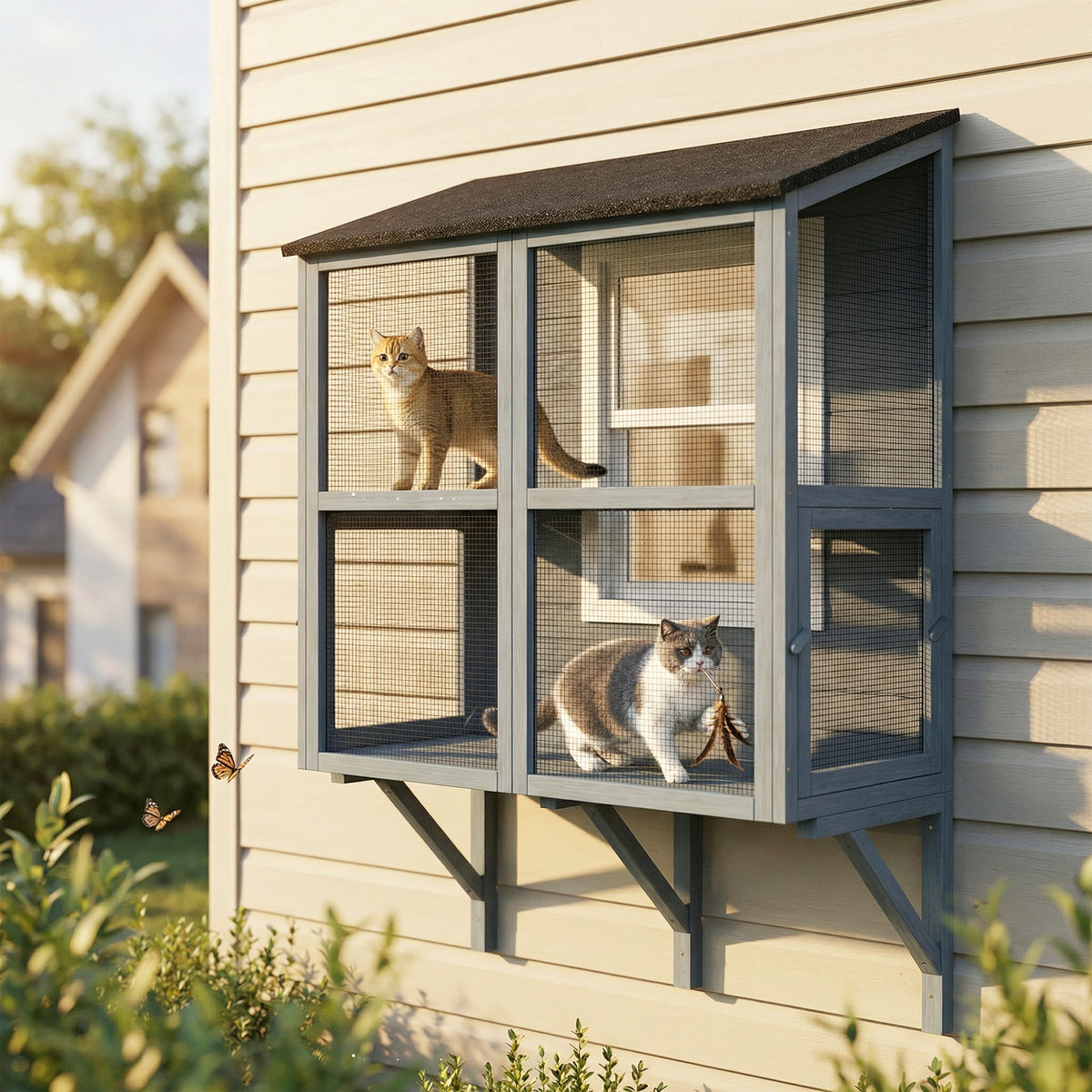
A small mesh box fixed outside a window, big enough to sit and watch, with a ramp or shelf inside. The cat steps out through the window and never touches the ground.
- Footprint
- About 2 to 3 feet deep; small
- Skill
- Some tools; frame and mounting
- Needs
- Landlord or HOA permission; strong mounting
- Best for
- Apartments and houses with no outdoor space
The Balcony Wrap
On the house
Mesh, a roof section and a door enclose the balcony so the whole floor becomes a catio. It is the biggest space gain for an apartment.
- Footprint
- Your balcony
- Skill
- Some tools; careful measuring
- Needs
- Permission; check building rules and the balcony's load rating
- Best for
- Apartments with a balcony or terrace
The Patio Corner
On the house
Frame and mesh two or three sides against the house wall, with the cat door or a human door as the entrance. It is the simplest version of a "real" catio.
- Footprint
- A 4 by 6 foot corner is common
- Skill
- Some tools; framing
- Needs
- Owner or permission to fix to the wall; check local rules
- Best for
- Patios and decks beside a door
Standing Alone: Ideas 4 to 6
The Freestanding Patio Box
Standing alone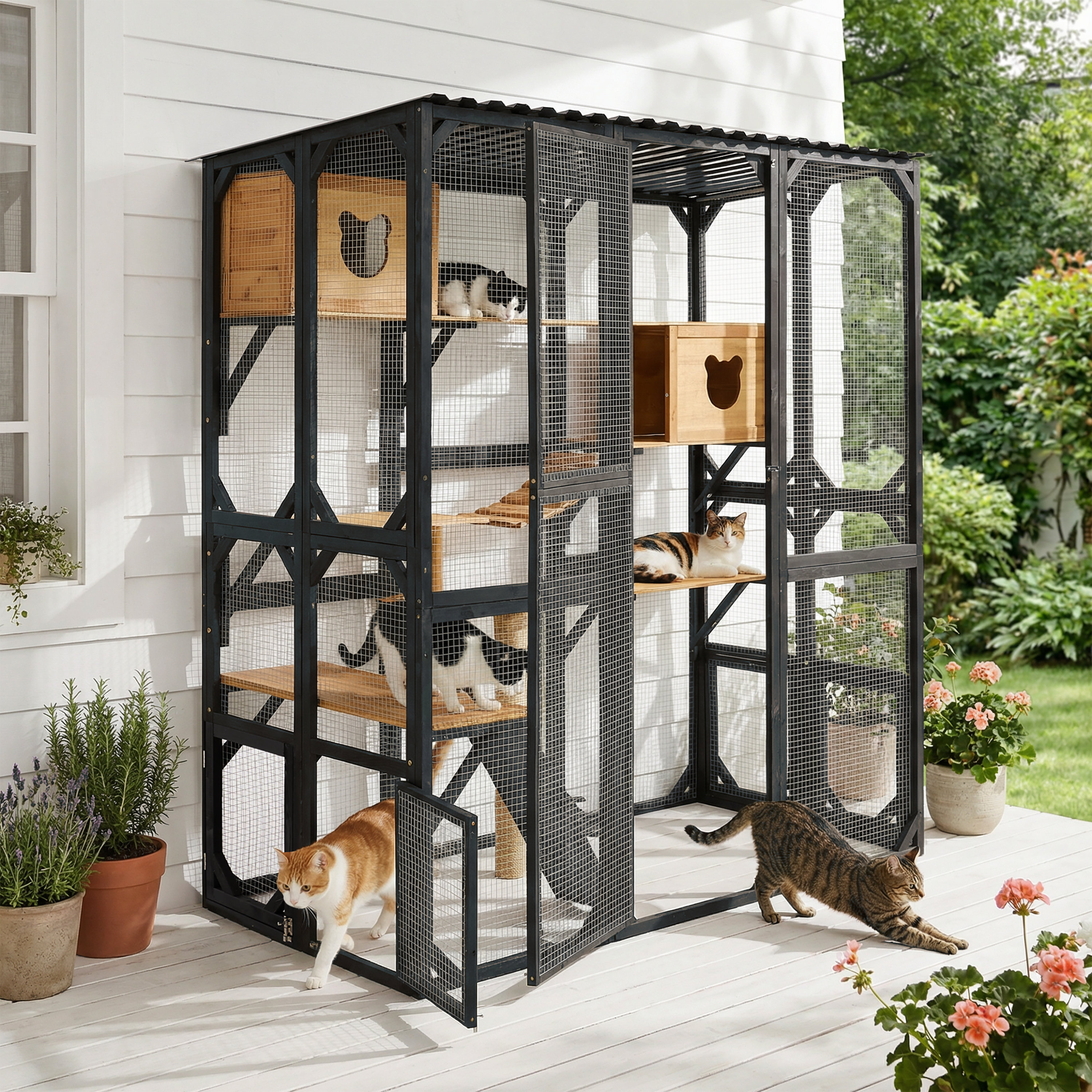
A self-supporting frame on a deck or patio, with mesh on all sides and the roof, and nothing fixed to the building. This is the renter's catio.
- Footprint
- Roughly 3 by 5 feet and up
- Skill
- Some tools
- Needs
- Weight or anchors, so wind cannot lift it
- Best for
- Renters, and patios you cannot drill
The Tall Skinny Tower
Standing alone
When floor is scarce, build up. A narrow enclosure about 2 to 3 feet square and 6 feet or more tall, with shelves at several heights, a covered top and a ramp or two.
- Footprint
- As little as 2 by 3 feet
- Skill
- Some tools; stable base design
- Needs
- A wide base or anchors, since tall frames tip
- Best for
- Tiny patios, narrow yards and climbers
The Fence-Line Run
Standing alone
A narrow walkway, 2 to 3 feet wide, running along a fence or the side of the house, with mesh on the open side and a roof. Length is what a small yard can spare.
- Footprint
- 2 to 3 feet wide, as long as you can spare
- Skill
- Some tools; level ground and a straight line
- Needs
- Permission if it touches the fence; check boundary rules
- Best for
- Side yards and long, thin gardens
Linking and Extending: Ideas 7 to 9
The Tunnel Link
Link and extend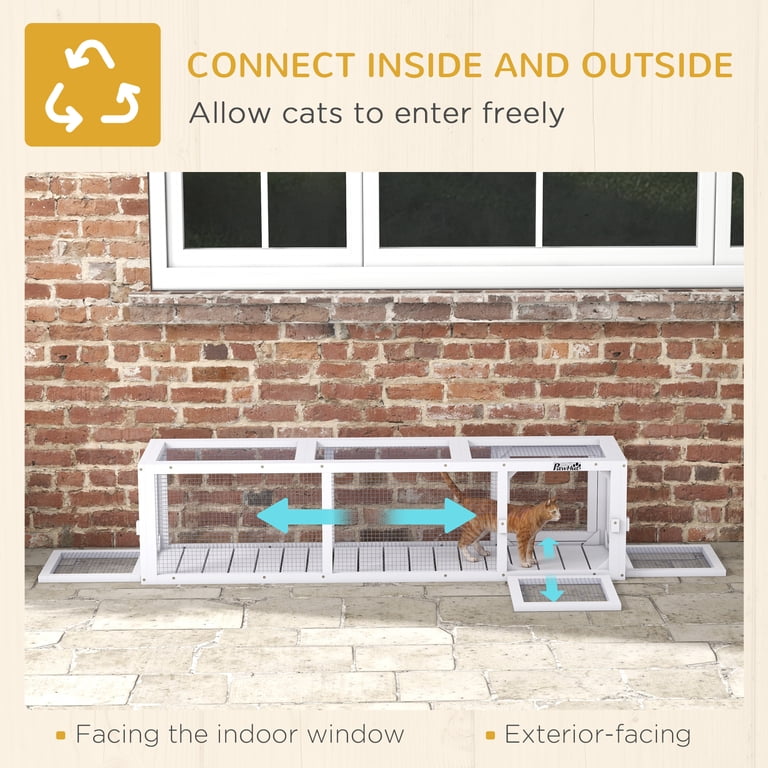
A short mesh or rigid tunnel connects a window or cat door to a catio, so the cat can come and go on its own.
- Footprint
- A narrow run, often about 8 to 12 inches wide
- Skill
- Some tools; a hole in a wall or window panel
- Needs
- Permission; a cut in a wall needs care
- Best for
- Cats that need free access to the catio
The Raised Deck Platform
Link and extend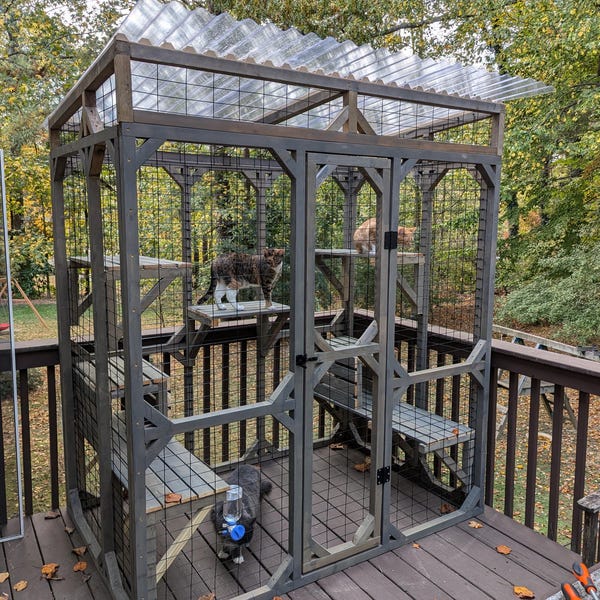
A catio raised on a platform or on a deck attached to a back door, with steps, so the whole thing lives off the ground and away from diggers.
- Footprint
- As large as the deck
- Skill
- Build; a solid, level base
- Needs
- Check local rules for structures and railings
- Best for
- Houses with a back door and a small yard
The Supervised Pop-Up
Link and extend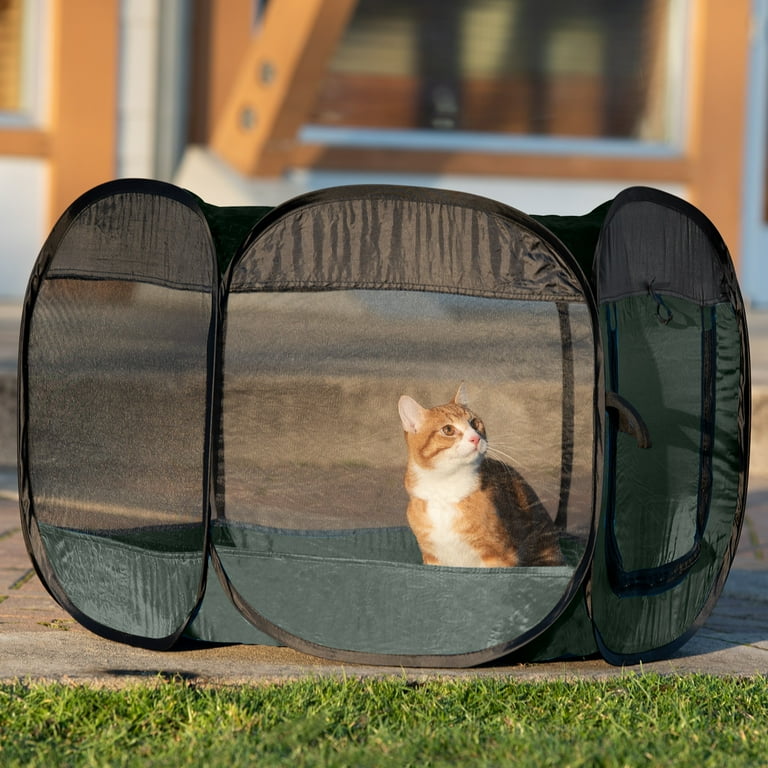
A lightweight play pen or tent with a mesh roof, for sessions you watch. It is the cheapest way to test whether your cat enjoys the outdoors before you build.
- Footprint
- Fits on any patio or lawn
- Skill
- None
- Needs
- Your presence the whole time
- Best for
- Trials, kittens and short sessions
Pick in 30 Seconds
| Your situation | Best builds | Check first |
|---|---|---|
| Apartment, window only | 1, 9 | Mounting, permission, fall risk |
| Apartment with a balcony | 2, 4 | Load, gaps, building rules |
| Rental patio, no drilling | 4, 5, 9 | Wind anchoring, written permission |
| Own a house with a patio | 3, 8, 7 | Local rules, sealing at the wall |
| Narrow side yard | 6, 5 | Fence climbing, floor or apron |
| Almost no floor | 5, 1 | Stable base, anchors |
| Climber or escape artist | 2, 3, 4 with a full roof and airlock | Every gap and the door |
| Kitten | 9 under supervision, then 4 | 1 inch mesh openings |
| Want free access in and out | 7 with 3 or 8 | Ventilation, heat, gaps |
| Hot climate | Any, with shade over most of the roof | Shade, water, hot surfaces |
| Not sure your cat will like it | 9, then build | Supervised trial first |
What Makes a Catio Worth Using

- Height beats floor. Cats like to look down. Two or three shelves at different heights, about 10 to 12 inches deep, are worth more than extra floor.
- A hiding spot. A covered box or a shaded corner gives a nervous cat a place to retreat.
- Something to watch. Face the long side toward birds, trees or a quiet street, and keep the cat away from loud or stressful views.
- Cat-safe greenery. Cat grass and catnip are commonly listed as safe. Check any plant against a trusted source such as the ASPCA, because many plants, especially lilies, are dangerous to cats.
- Scratching and climbing. Add a scratching post or a natural log, and a ramp so the cat can reach every level without jumping.
- Surfaces that feel good. Use a rug-covered or wooden shelf, not bare metal, which gets hot or cold.
- Weather. Part of the roof should be solid, so the cat can stay dry.
Mistakes That Lead to Escapes
- No roof. Cats climb mesh walls. An open top is an exit.
- Chicken wire. It is weak and can be torn, so use welded wire.
- Wide gaps. Check every joint, corner and gap under the door.
- A single door. One barrier is one mistake from an escape. Use an airlock.
- No floor on soil. Diggers get in and cats dig out. Use a floor or a buried apron.
- Weak fixings. Staples alone can pull out. Sandwich the mesh under battens or washers.
- Sharp ends. Cut ends scratch cats. Fold or cap them.
- No shade. A sunny catio can overheat quickly.
- Skipping the trial. A cat that panics in a catio is not a failure of the cat. Introduce it gently.
- Not checking after storms. Wind and rain loosen fixings. Inspect regularly.
The Cat's-Eye Audit: Before You Open the Door

Do these before the first unsupervised minute. They cost nothing.
- The gap gauge. Cut a 2-inch square from cardboard (1 inch for a kitten). If it passes through any opening, fix that opening.
- The shake and push test. Push and pull on every corner, panel and door. Anything that moves is a place a cat or a predator can work at.
- The roof walk. Look at every joint in the roof. A cat that climbs to the roof will test it first.
- The shade and hot-surface test. Put your palm on the shelves and the floor at the hottest time of day. If you cannot keep your hand there, your cat will not want to either.
- The three-day supervised trial. For three days, let your cat in while you watch, for short sessions. Watch for panic, climbing the mesh and escape attempts. Fix what the cat finds.
Safety Limits
- Do not leave a cat in a catio in very hot or very cold weather, or without shade, water and a place to retreat. Check often, because cats cannot tell you they are uncomfortable.
- Make the catio fully enclosed and secure, with a roof, small mesh openings, an airlock and a latch a cat cannot open. Use a floor or a buried apron on soil, because predators dig.
- Predators include dogs, raccoons, coyotes and birds of prey. Even a secure catio can be a stressful place with a predator nearby, so supervise at first.
- Check wood and finishes. Avoid old or unknown treated wood and toxic stains or paints, and let finishes cure and air out before the cat uses the space.
- Use mesh with no sharp ends. Fold, cap or trim every cut edge.
- Check every plant against a trusted pet-safe list such as the ASPCA, and keep cleaners, fertilizer and pest products out of the catio.
- Keep your cat's ID, microchip, vaccinations and flea and tick prevention up to date, and ask your vet about outdoor exposure.
- Anchor frames against wind, and inspect them after storms.
- Balconies and window boxes: cats fall. Close every gap, fix mounts into solid framing, stay within the load rating and keep an emergency exit clear.
- Do not let small children play in or on a catio without supervision, and keep tools and offcuts away from pets.
- Check local rules, your lease, the HOA and any building codes before you build. Renters: get written permission and photograph the area first.
Catio FAQ
What is a catio?
An enclosed outdoor space for cats, usually a frame covered in mesh, attached to a house, patio, balcony or window or built as a freestanding run. It lets a cat enjoy fresh air and sun while staying contained and protected.
How big should a catio be?
There is no single standard. As a rule of thumb, about 6 square feet of floor per cat suits short sessions, and about 12 or more per cat is more comfortable. Cats use height, so shelves and perches matter as much as the floor. The planner works from your measurements.
What mesh should I use for a DIY catio?
Welded wire, not thin chicken wire, with openings of about 2 inches or smaller for adult cats and about 1 inch for kittens or small cats. Choose galvanized or coated mesh, cap cut ends, and check the maker's information.
Does a catio need a roof?
Yes. Cats climb and jump, so an open top is an exit, and a roof keeps out birds of prey and climbing predators. Use mesh on top with a solid or shaded section for rain and sun.
Can renters build a catio?
Often yes, with a freestanding design or a window box the landlord has agreed to in writing. Anything fixed to a wall, fence or railing needs permission. Check your lease and photograph the area first.
How do you keep a catio from overheating?
Shade most of the roof, provide airflow, water and a cool resting place, and avoid dark metal or plastic in direct sun. Do not leave a cat in a catio in very hot or cold weather, and check it often.
Do I need a permit or permission to build a catio?
It depends on where you live and how large or permanent the structure is. Landlords, HOAs and local rules may apply. Check them before you build, and ask in writing when in doubt.
Is a catio safe without supervision?
Only if it is fully enclosed and secure, with a roof, small mesh openings, a locking airlock, a floor or apron on soil, shade and water. Start with supervised sessions and inspect it regularly. Pop-up pens are for supervised use only.
A Simple Takeaway
Build around your space, not a photo. Put a roof on it, use stiff mesh with small gaps, fit an airlock and give the cat shade, water and height. Try a supervised session first, run the cat's-eye audit and inspect it after bad weather. A small catio is worth it when your cat is safe in it and wants to be there.