
7 Dining Table Centerpiece Ideas That Look Expensive Without Making Your Table Feel Cluttered
Don't start with the prettiest piece. Start with your table size and the planner will tell you how big and how tall to go.

A centerpiece looks expensive when it looks chosen, not when it has more in it. Most cluttered tables have the same problem: too many small items, the wrong height, or a piece that is simply too wide for the table. That is why the best dining table centerpiece ideas start with measurements and restraint, not shopping.
This guide gives you seven ideas, a planner that turns your table size into a maximum width and length, a diagram of the height zones that block conversation, a simple 3-item edit rule, and four quick tests you can run at home before you buy anything.
Dining Table Centerpiece Ideas That Look Expensive: Quick Answer
Find your centerpiece zone: table width minus 28 inches (14 inches of depth for each place setting). Then match it to the ladder below.
- Zone of 12 inches or more (about a 40-inch-wide table or wider): all seven ideas.
- Zone of 6 to 11 inches (about 34 to 39 inches wide): ideas 1, 3, 5 and 6, kept slim.
- Zone under 6 inches (narrower tables): a single bud vase or a pair of taper candles.
- Shared dishes in the middle: subtract another 12 inches, or use idea 7.
All seven ideas: 1 bud vase trio, 2 low sculptural bowl, 3 mixed-height tapers, 4 tray with three items, 5 tall slim branches, 6 greenery runner with votives, 7 pedestal that clears for dinner.
The height rule: keep solid pieces under about 12 inches, or keep the bulk above about 24 inches. Avoid the zone in between unless the item is very thin.
Free Centerpiece Planner: How Big and How Long?
Measure your table in inches. For a round table, enter the diameter in the first box and ignore the second. The planner reserves 14 inches of depth on each side for place settings, then tells you the widest and longest piece that still leaves room to eat.
Dining table centerpiece planner
The Numbers Behind the Planner and the 3-Item Edit
- Place setting: each person needs roughly 24 inches of width and about 14 inches of depth. This is a common guideline.
- Length: a single piece should be no longer than about one-third of the table length. A low linear arrangement can run to about two-thirds.
- Round tables: aim for a centerpiece about one-third of the table diameter, and never wider than the center zone.
- Height: keep solid pieces under about 12 inches, or keep the bulk above about 24 inches on a standard 30-inch-high table.
The 3-item edit
Most "expensive-looking" tables follow one quiet rule: three things, one theme. Pick one container, one light source or accent, and one natural element, and repeat a single material or color across them, such as matte white ceramic, clear glass or warm brass. If you want to add a fourth item, remove something first. Odd numbers and varied heights add interest without noise.
Idea 1: Bud Vase Trio
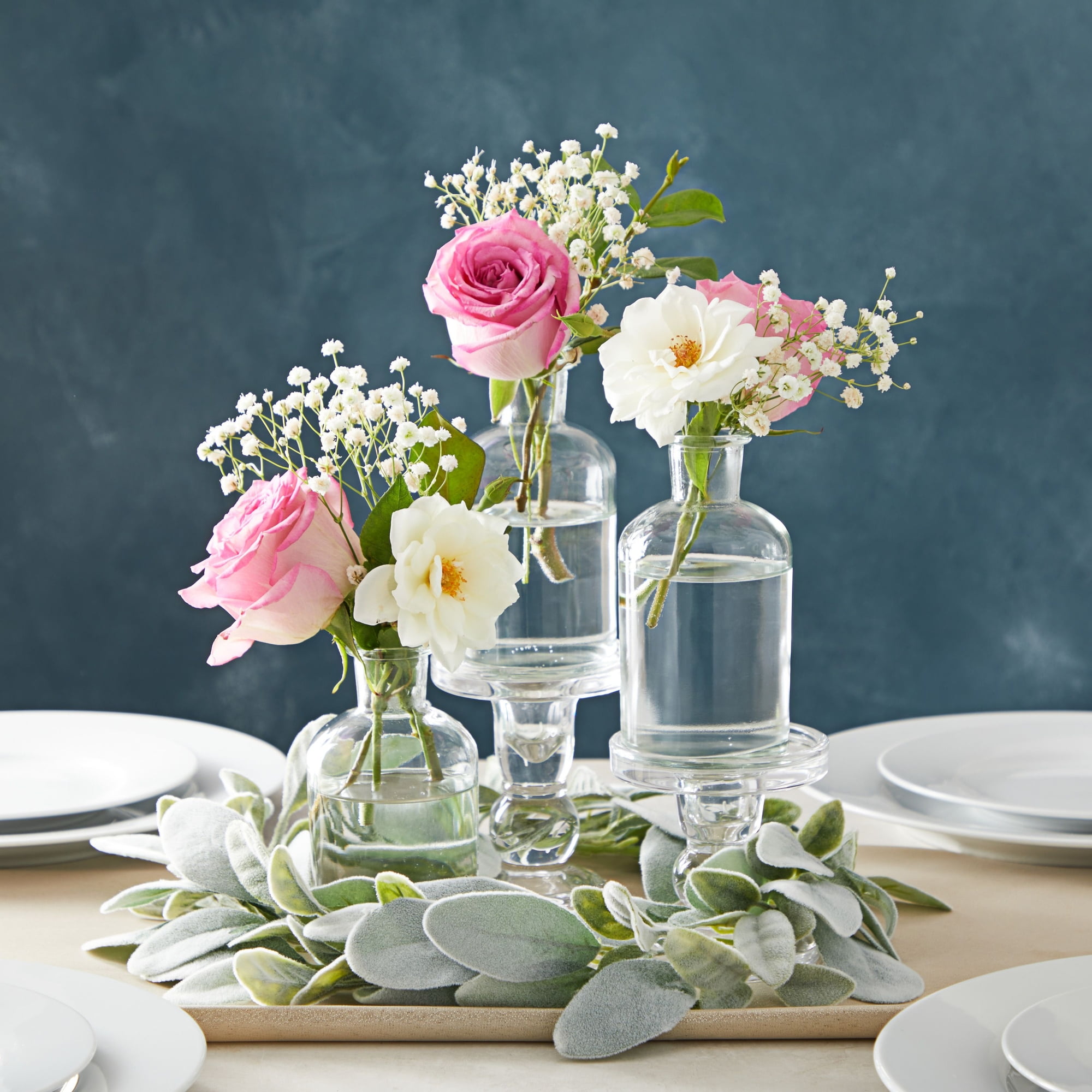
What it looks like: Three small vases in one color or material, each with a single stem or a few sprigs, placed in a loose cluster or a gentle line.
Why it works: Small vessels with single stems keep the table open. The cluster reads as designed, and thin stems let people see each other.
Idea 2: Low Sculptural Bowl

What it looks like: One wide, shallow bowl in ceramic, wood, stone or glass, either empty as an object or holding a few pieces of fruit or a single clean arrangement.
Why it works: A single strong shape needs nothing around it. The bowl's form does the work, and a low height keeps sightlines open.
Idea 3: Mixed-Height Taper Candles

What it looks like: Three or five taper candles in holders of varying heights, grouped together or spaced along the center line.
Why it works: Candles add light and warmth with almost no footprint. They are thin enough to rise into the 12 to 24 inch zone without hiding faces, and varied holders add a layered look.
Idea 4: Tray With Three Items
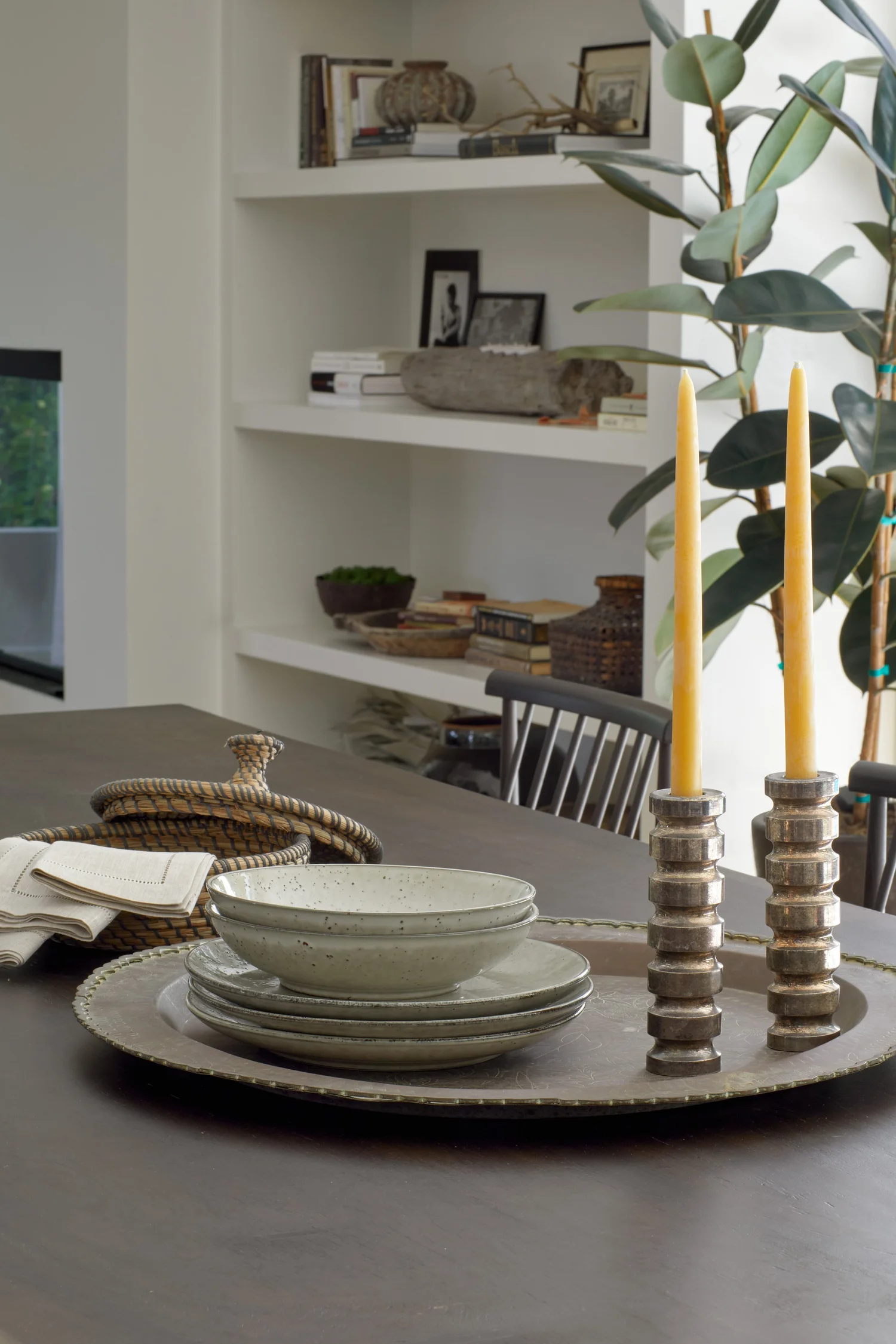
What it looks like: A slim rectangular or oval tray that holds exactly three objects, such as a vase, a candle and a small bowl.
Why it works: The tray draws a boundary around the group, so it reads as one composed object instead of loose clutter. It also lifts everything away in one move when you need the table.
Idea 5: Tall Slim Branches

What it looks like: A tall, slim vase holding a few branches or long stems, with most of the volume above about 24 inches.
Why it works: Height without bulk. Guests see under and around the arrangement, and the vertical line makes a low ceiling or a plain table look more finished.
Idea 6: Greenery Runner With Votives

What it looks like: A low, slim line of greenery or simple foliage running down the center of a long table, with small votives set into it.
Why it works: It fills the length of a long table with something proportionate, so the table does not look empty, and low foliage keeps every sightline open.
Idea 7: Pedestal That Clears for Dinner

What it looks like: A low pedestal or cake stand with one simple item on top, or a lazy Susan with a small centerpiece that rotates or lifts away.
Why it works: It is the answer to family-style meals. The centerpiece lives in the middle, and when the food arrives it either serves as the stand or moves to the sideboard in one motion.
Pick in 30 Seconds: Which Idea Fits Your Table?
Find your situation in the left column and read across.
| Your situation | Best ideas | Key check |
|---|---|---|
| Narrow table, under about 34 inches wide | 1 or 3, one small piece | Zone under 6 inches |
| Standard rectangular table, about 36 to 40 inches wide | 1, 3, 4, 5, 6 | Planner width and one-third length |
| Long table, 8 feet or more | 6, 3, 1 | Up to two-thirds length, leave both ends clear |
| Round table | 2, 4, 5, 7 | About one-third of the diameter |
| Family-style dinners | 7, 1 | Reserve about 12 inches for dishes |
| Everyday table you also work at | 4, 7, 1 | One-motion clear |
| Kids or pets | 2 (unbreakable bowl), 7, LED candles | Stable base, no open flame |
| Low ceiling or hanging fixture | 1, 2, 4 | Stay under about 12 inches |
| Tightest budget | 1, 5, 2 | Thrifted vessels, cut branches |
| Hosting, want the most impact | 6, 3, 5 | Keep sightlines open |
Mistakes That Make a Centerpiece Look Cluttered
- Too many small items. A scatter of tiny objects reads as noise. Group them or cut to three.
- Too wide for the table. A piece that reaches the place settings leaves no room to eat. Use the planner.
- Solid and tall at mid-height. A wide piece between about 12 and 24 inches blocks faces across the table.
- Too many colors or materials. Stick to one material or color family, plus one natural element.
- Ignoring the lights. A glossy vase can bounce glare from a pendant light. Matte finishes are calmer.
- Strongly scented flowers. Heavy scent competes with the food. Choose unscented or lightly scented stems.
- No protection on wood. Wet vases, hot candle holders and wax can mark a wood table. Use felt pads, mats or trays.
- Poor-quality faux stems. Shiny plastic leaves in identical shapes are the quickest way to look cheap. If you use faux, choose matte finishes and varied stems.
- Off-center placement. A piece that drifts to one side looks accidental unless the grouping is deliberately balanced.
Test Before You Commit: Four Quick Checks
These take about ten minutes and prevent most styling regrets.
- The sightline test. Sit in a dining chair. Have someone sit across from you while you hold up the piece, or stack books to its height and width. If you cannot see their face, lower it, thin it or lift it above the middle zone.
- The place-setting dry run. Lay out plates, glasses and flatware for every seat. Slide the centerpiece in. You should be able to reach your glass without brushing it, and it should not touch the edge of a plate.
- The squint test. Take a photo of the table from the doorway and squint at it, or view it small. If your eye does not land on one clear focal point, remove one item and look again.
- The dinner-flow test. Pass a serving dish across the table with the centerpiece in place. If it catches, shrink the piece or switch to idea 7.
Safety Limits
- Never leave a flame unattended. Use stable holders, keep flames away from greenery, dried stems, napkins and hanging decor, and snuff candles out before leaving the room.
- In homes with young children or pets, use LED candles and shatterproof vessels.
- Lilies are especially dangerous to cats, and many other plants are toxic to pets. Check a pet-safe plant list before using flowers or greenery.
- Wash fruit before using it as decor if you plan to eat it, and keep decor away from food prep.
- Protect wood tables from water rings, hot holders and wax with felt pads, mats or a tray.
- Weight tall vases, and keep them away from table edges and from anywhere a chair could bump them.
Dining Table Centerpiece FAQ
How big should a dining table centerpiece be?
A single piece should be no longer than about one-third of the table length, and a low linear arrangement up to about two-thirds. Keep it narrow enough to leave about 14 inches of depth for each place setting. On a round table, aim for about one-third of the diameter. The planner above does the math.
How tall should a dining table centerpiece be?
Keep solid pieces under about 12 inches, or keep the bulk above about 24 inches on a standard 30-inch table. The middle zone blocks faces unless the item is very thin, such as a taper candle or a single stem. Confirm with the sightline test.
What can I use instead of flowers for a dining table centerpiece?
A sculptural bowl, taper candles in mixed-height holders, cut branches, a tray with three objects, a greenery runner or a low pedestal stand. They last longer, cost less over time and avoid scent and allergy issues at the table.
How do I make a centerpiece look expensive on a budget?
Use fewer items, repeat one material or color, group in odd numbers, vary the heights and choose solid materials such as ceramic, glass, wood or brass. Thrifted vessels and cut branches often look better than a crowded mix of small decor.
Should a dining table centerpiece be centered?
Usually yes, on both the length and the width of the table. An asymmetrical grouping can still look intentional if its visual weight is balanced around the center line.
How do you decorate a long, narrow dining table?
Use a low, slim linear arrangement, such as a greenery runner with votives or a row of bud vases, up to about two-thirds of the table length. On tables under about 34 inches wide, keep to a single bud vase or a pair of tapers.
What do you do with a centerpiece when serving family-style?
Reserve about 12 inches of table width for shared dishes, choose a low pedestal or lazy Susan that clears easily, or move the centerpiece to a sideboard when the food arrives.
Are candles safe as a dining table centerpiece?
With care. Never leave a flame unattended, use stable holders, keep flames away from greenery and napkins, and snuff them out before leaving the room. In homes with young children or pets, LED candles are safer.
A Simple Takeaway
Measure the table, subtract 28 inches from its width, and that number is the widest piece you can use. Keep it under about 12 inches or put the bulk above about 24, stick to three items in one theme, and run the sightline test before you buy. A table looks expensive when it looks calm, and calm comes from taking things away.