
7 Cat-Proof Fence Ideas That Keep Cats in Your Yard
A cat escapes in four ways. Find yours, fix that first, and score your own fence before you let the cat out unsupervised.

A tall fence does not keep a cat in. Cats climb, jump, squeeze and dig, and a six-foot privacy fence can be a ladder to a cat that wants out. The fix is not a taller fence. It is a fence that closes each of the four escape moves.
This guide lists seven ideas under the escape move each one stops, with a planner for materials and a scored audit of your own fence. A fence also cannot stop predators or dogs reaching a cat from outside, so if your cat spends long unattended periods outdoors, read our catio guide too. For indoor comfort, see our window seat guide.
No fence is guaranteed to hold every cat. Athletic cats, kittens and cats with something to chase may find a way. Treat any fence as a way to lower the risk, start with supervised sessions, keep ID and a microchip current, and never rely on the fence alone for a cat that bolts.
The Four Escape Moves
Free Fence Planner: Materials for Your Yard
Measure your fence run in feet. The planner counts the extension mesh, brackets, lining and base barrier. It is a rule of thumb, so check your roll sizes and local rules.
Cat-proof fence planner

Stop the Climb: Ideas 1 to 3
Inward-Angled Mesh Extension

Brackets lean inward at about 45 degrees from the top of the fence, carrying stiff welded mesh. A cat that reaches the top meets a surface leaning back toward the yard.
Rotating Roller Bars
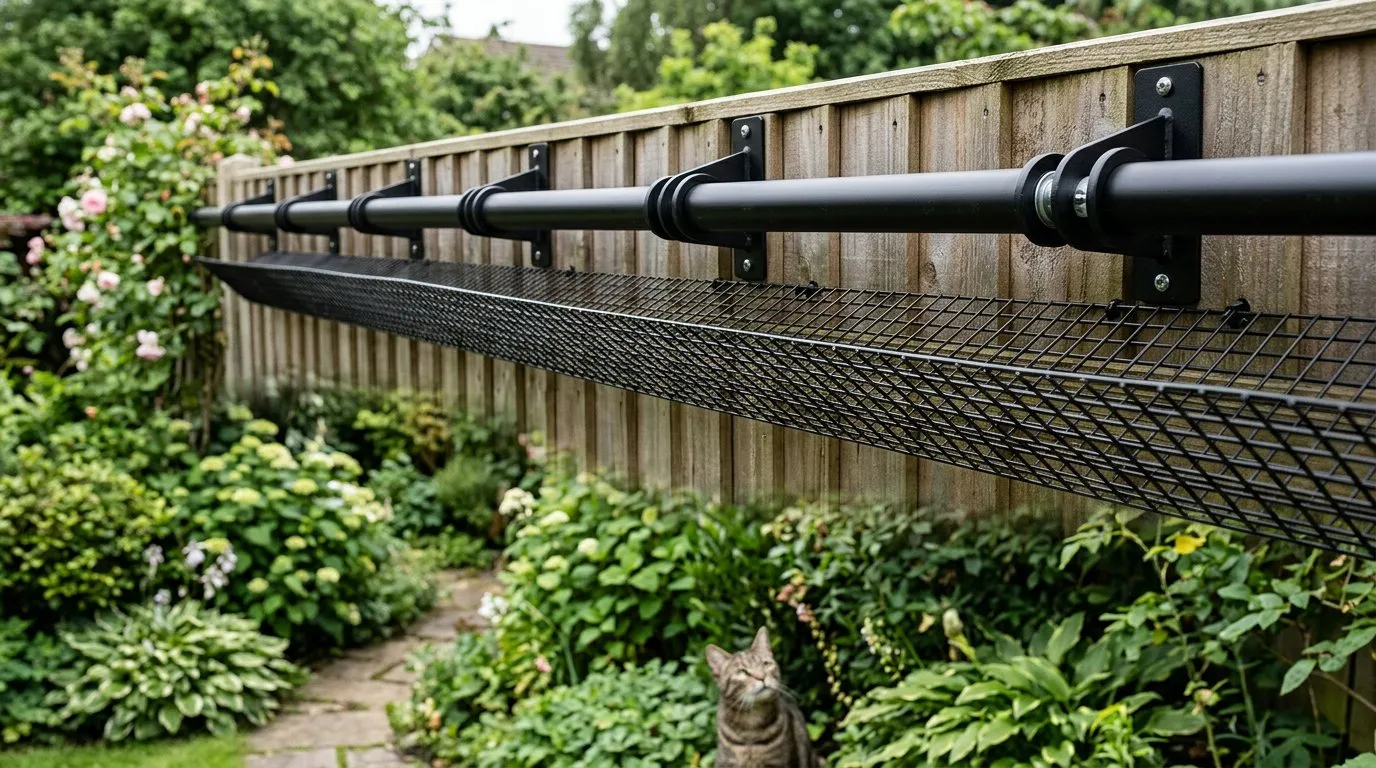
Rollers along the top turn when a cat puts its paws on them, so it cannot get a grip or a push. Kits and DIY versions exist.
Smooth Inside Face

Remove everything a claw can hook: horizontal rails, trellis, wire, and rough knots in the top two feet. Add a smooth slick panel to the inside face where needed.
Stop the Jump and Landing: Ideas 4 and 5
Clear the Launch Pads
Cats rarely jump a six-foot fence from the ground. They jump from the shed, the bin, the table, the woodpile or a tree branch. Remove or relocate those.
Netted Canopy for Small Yards

In a small yard or on a side run, stiff mesh is stretched over the top as well as the sides, turning the area into a roofed enclosure. This overlaps with a catio.
Stop the Squeeze and Dig: Idea 6
Gap-Proof the Base

Close every gap under and between panels to about 2 inches or less (1 inch for a kitten). On soil, add a buried mesh apron or a solid base so a cat cannot dig out.

Stop the Gate Exit: Idea 7
A Gate That Cannot Be Beaten

Most "escapes" are gates. Fit a latch a cat cannot lift or push, close gaps at the bottom and sides, and, where you can, make a double gate or a small vestibule so one barrier is always closed.

Pick in 30 Seconds
| Your situation | Start with | Check first |
|---|---|---|
| Solid 6 ft fence, cat climbs it | 1, 3, 4 | Footholds and launch pads |
| Chain link or wire fence | 1 with mesh lining, 6 | Openings of 2 inches or smaller |
| Slatted or picket fence | 6, 1, 3 | Gaps between slats |
| Athletic climber or jumper | 1, 2, 4 together | Every launch pad and every gap |
| Kitten or small cat | 6, 7 with 1 inch mesh | Tiny gaps, supervised first |
| Cat digs under | 6 | Apron or solid base |
| Cat slips out the gate | 7 | Latch, sill gap, double gate |
| Renter or shared fence | 4, 7 and written permission | Lease, neighbor consent |
| Small yard, high risk | 5 or a catio | Local rules, supervision |
| Dogs, coyotes or wildlife nearby | A roofed catio, not just a fence | A fence will not stop outside threats |
Score Your Fence: The Escape Audit
Walk your fence at cat height and tick every statement that is true today. This score is our own planning heuristic, not a standard, so use the unticked boxes as your to-do list.
Mistakes That Lead to Escapes
- Building higher instead of changing the top. Height alone does not stop a cat that can climb.
- Forgetting launch pads. A shed roof or a bin makes the fence irrelevant.
- Chicken wire and floppy netting. They are weak and can trap wildlife. Use stiff welded mesh.
- A gap at a post or corner. A cat needs only one.
- An unlatched or propped gate. Most escapes happen here.
- Ignoring the neighbor's side. Their tree or shed can give a cat a ramp.
- Skipping supervision. A new setup should be tested while you watch.
- Using spikes or barbed wire. They injure cats, wildlife and people, and may be illegal.
- Not checking after storms. Wind and rain loosen brackets, panels and gaps.
Safety Limits
- Never use spikes, razor wire, barbed wire or glue products. They can seriously injure cats, wildlife, children and neighbors.
- Avoid loose netting. Birds, hedgehogs and other wildlife, and cats, can become tangled. Use stiff, taut mesh and check it often.
- Fold, cap or trim every cut end and check for sharp edges at a cat's height.
- A fence does not stop dogs, coyotes or birds of prey from reaching a cat from outside. Supervise, and use a roofed catio for unattended time.
- Do not leave a cat in the yard in very hot or very cold weather, or without shade, water and shelter. Check often.
- Keep ID, a microchip, vaccinations and flea and tick prevention current, and ask your vet about outdoor time.
- Check plants against a trusted pet-safe list such as the ASPCA, and keep fertilizers, pest products and cleaners out of reach.
- Check buried utilities before you dig, and check local rules, height limits, HOA terms and boundary agreements. Talk to your neighbor before changing a shared fence.
- Tools and offcuts are hazards for pets and children. Store them away.
- Renters: get written permission before changing a fence, and photograph it first.
Cat-Proof Fence FAQ
Can a regular fence keep a cat in?
Usually not on its own. Cats can jump high and climb most fences, so height alone is rarely enough. What works is changing the top, closing gaps, blocking digging and securing the gates. Even then, no fence is guaranteed, so supervise at first.
How high does a fence need to be to keep a cat in?
No height reliably stops a determined cat. Many can clear about 5 to 6 feet or climb if there is anything to grip. A common approach is a fence of about 6 feet with an inward-angled extension or a roller bar, not simply building higher. These are rules of thumb.
Do roller bars on a fence work for cats?
They are designed so a cat cannot get a grip on top, and many owners use them. Results vary by cat and installation, and gaps defeat the idea. Check the maker's instructions and think about wildlife, neighbors and local rules.
What can I put on top of a fence to keep a cat from climbing over?
An inward-angled extension with stiff mesh, rotating roller bars, or a smooth slick panel on the inside top of the fence. Avoid spikes and barbed wire, which can seriously injure cats, wildlife and people.
Will a cat dig under a fence?
Some do, especially where soil is soft or a gap already exists. Close gaps to about 2 inches or less, and on soil add a buried mesh apron or solid base. Check the base after rain and after other animals have dug.
Do I need permission to add to a fence?
Possibly. Height limits, shared boundary fences, HOA rules and leases can apply. Check local rules, talk to your neighbor before changing a shared fence, and get written permission if you rent.
Is a cat-proof fence the same as a catio?
No. A fence contains the whole yard but leaves a cat exposed to dogs and predators from outside. A catio is a fully roofed enclosure. A fenced yard suits supervised time, and a catio suits unattended time.
How do I stop a cat getting out through the gate?
Fit a latch a cat cannot lift or push, close gaps at the bottom and sides, and use a double gate or vestibule where you can. Make sure everyone closes the gate behind them.
A Simple Takeaway
Do not just build higher. Find which escape move your cat uses, change the top of the fence, clear the launch pads, close every gap and secure the gate. Score your fence, test it with supervised sessions, and remember that no fence is perfect, so keep ID current and use a roofed catio for time you cannot watch.