The Planner That Reminded Me Why I Became a Teacher
For every teacher holding too much in their head, alone
It was 11:47pm on a Sunday, and I was sitting at my kitchen table surrounded by ungraded essays, a half-written lesson plan, and a permission slip I'd forgotten to send home three weeks ago. My coffee had gone cold twice. I remember looking down at my hands, ink-stained from grading, and thinking a thought I never expected to think as a teacher: I don't know if I can keep doing this.
Not because I didn't love my students. I did, fiercely. But I was drowning in a version of teaching nobody warns you about in college, the invisible second job of tracking a hundred and forty students' progress, IEP deadlines, parent emails, grading, lesson planning, and staff meetings, all of it living in scattered sticky notes and half-remembered mental lists.
I want to tell you about the small, unglamorous thing that pulled me back from that Sunday night. It wasn't a miracle. It was a planner, and the decision to stop carrying my entire teaching life inside my own exhausted head.
The Tuesday a parent asked me a question I couldn't answer
Three weeks after that breakdown at my kitchen table, a parent emailed asking how her son was progressing on a specific assignment I'd given weeks earlier. I opened four different notebooks and two apps trying to find my notes on it. I never fully found them. I had to guess, and I hate that I had to guess, because that child deserved a teacher who actually knew.
That was the moment it stopped being about my own exhaustion and started being about my students. I wasn't failing because I didn't care enough. I was failing because I had no single system holding the hundred moving pieces of my job.
What other teachers told me they never say out loud
I didn't want to write this article from just my own burnout, so I asked several teachers, some veterans, some in their first year, what actually got them through the parts of teaching nobody prepares you for.
A teacher named Winnie, seventeen years into the profession, told me she almost left teaching entirely in her tenth year, not because of the students, but because she felt like she was failing at the administrative weight of the job every single week. She said the year she finally built one written system, a single academic planner tracking lesson plans, grading deadlines, and IEP dates together, was the year she remembered she was actually good at this job. She'd just been drowning in the parts nobody sees.
A first-year teacher named Julius told me his hardest month was October, when the initial excitement of having his own classroom wore off and the sheer administrative load hit him all at once. He said a mentor teacher handed him a printed planner on a hard Friday and said, "Stop trying to remember everything. Start writing it down so your brain can actually rest." He told me that single sentence changed how he approached the entire rest of the year.
Both of them told me nearly the same thing, in different words: the exhaustion teachers carry is rarely about the teaching itself. It's about holding an impossible number of moving parts with no system built to catch what falls through.
Why a real planner gave me back my classroom, not just my calendar
I want to be honest with you: a planner doesn't grade papers for you. It doesn't fix a difficult parent conversation, and it definitely doesn't add hours to your day. But it gave me something I wasn't expecting, it gave me back the mental space to actually teach, instead of constantly scanning my memory for what I might have forgotten.
Here's what mattered most in the one I finally committed to using:
- A true academic-year layout, not a generic calendar. Built around semesters and terms, not January to December, so it actually matched how a school year moves.
- A single place for lesson planning and grading deadlines together. No more separate systems that never talked to each other.
- Space for IEP and accommodation tracking. A quiet, organized place for the details that matter most for the students who need the most consistency.
- Room for parent communication logs. So I never again had to guess what I'd already told a family, or hadn't.
- A section just for reflection. Small space to write what actually worked in a lesson, and what didn't, so I stopped relearning the same lessons year after year.
What changed by the spring semester
I won't tell you the school year became easy. It didn't. There were still hard Sundays, still report cards that took longer than they should have. But something real shifted:
- I stopped losing track of which students needed which accommodations, because it was written in one place I actually trusted
- I answered that same parent's next email in under two minutes, because the information was finally where I could find it
- I started leaving school at a reasonable hour more often, because less of my mental energy was spent trying to remember everything
- I remembered, for the first time in months, what it felt like to actually enjoy a lesson I was teaching, instead of just surviving it
If you're at your kitchen table tonight, wondering the same thing I did
If you're grading papers past midnight right now, wondering if you have anything left to give this profession, I want to say something to you gently: the exhaustion you're carrying is not proof that you're bad at this job. It's proof that you've been trying to hold too much, with no system built to help you carry it.
A planner won't do the teaching for you. But it can give your mind back the room to actually be present with your students, instead of constantly trying to remember what you might be forgetting. Sometimes that's the difference between surviving a school year and actually loving it again.
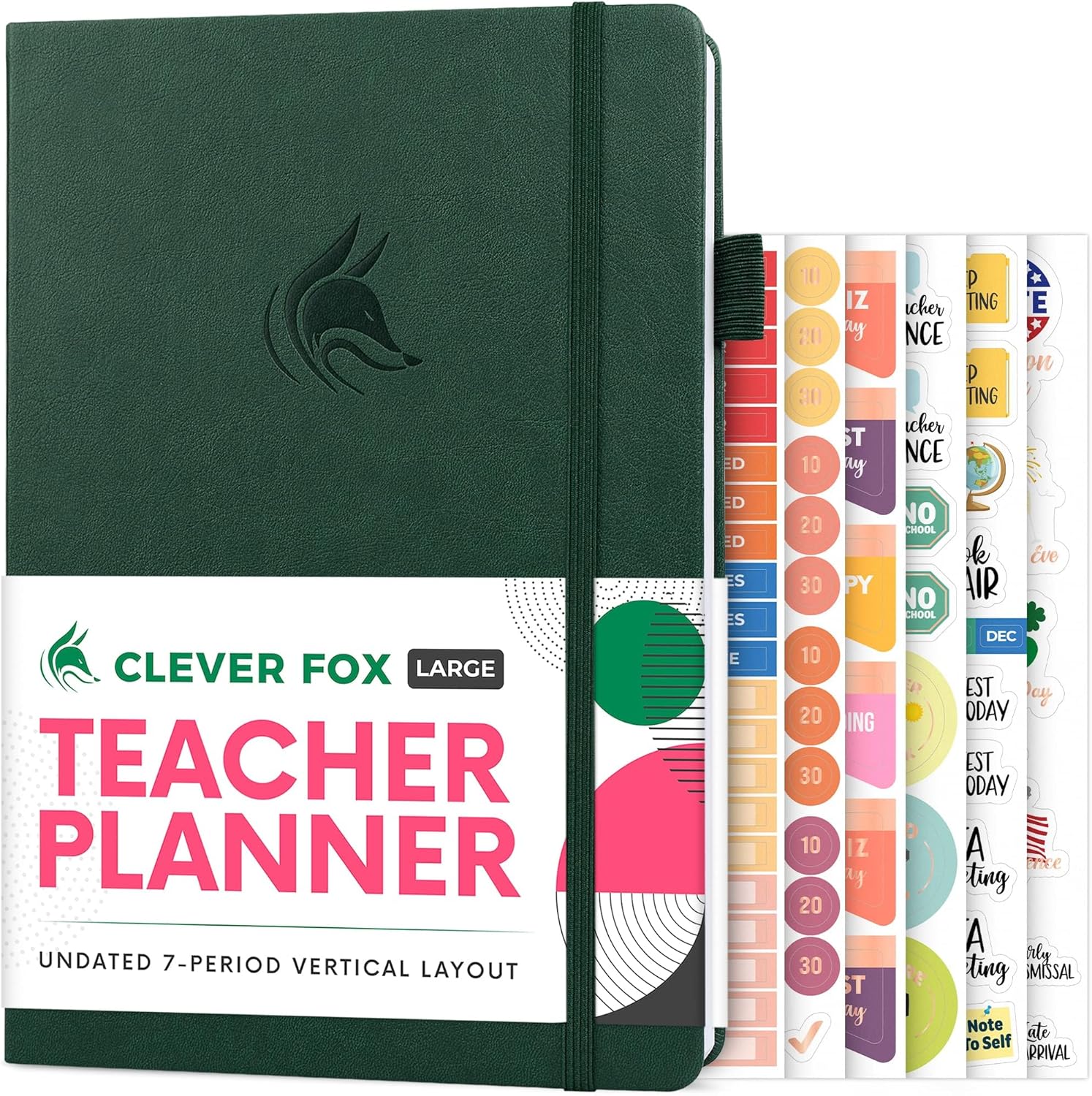
This is the exact teacher planner that finally held my lesson plans, grading deadlines, and IEP dates in one place, in case it helps you the way it helped me.
- Undated, 7-period vertical layout built for how a real school day runs
- Durable hardcover design made to survive a full school year in a bag
- Space for lesson planning, grading tracking, and parent communication logs
- Comes with a full sheet of planning stickers for quick, visual organization
- Large size gives enough room to actually write, not just check boxes
As an Amazon Associate, I may earn a small commission from qualifying purchases, at no extra cost to you.